 Breaking Analysis
Listen to this Recap
13:59
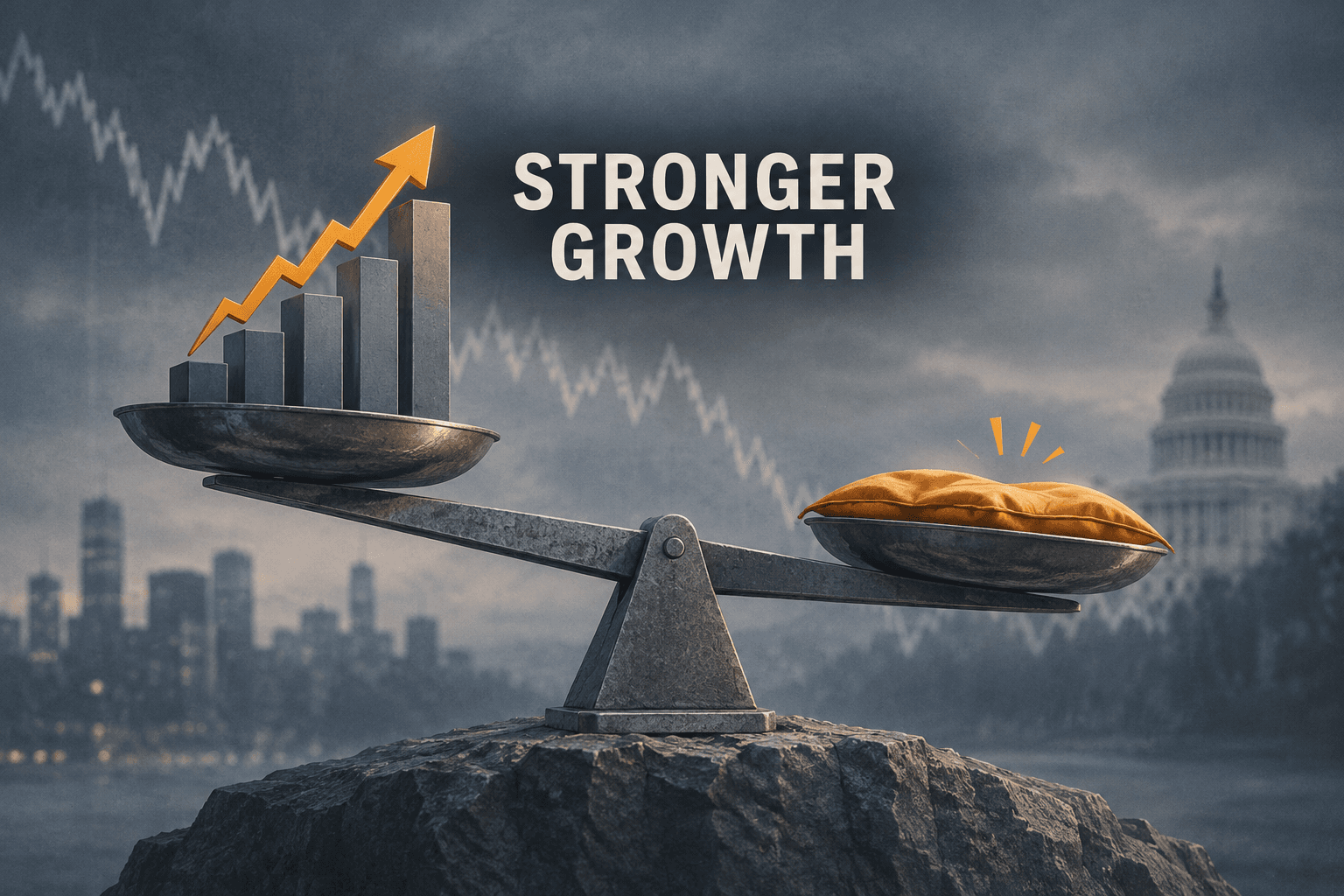
Stronger Growth, Thinner Valuation Cushion: A Cautious Market Picture Emerges
Podcast • Loading audio...
Share this article
Spread the word on social media
Key Takeaways
- •The analyses largely report third-quarter 2025 GDP growth revised to 4.3%, but give conflicting initial estimates ranging from 1.4% to 3.8%; the revision’s size cannot be reconciled from the supplied reports.
- •GLD fell 14.3% between the S&P 500’s October 6 record and November 25, while its longer historical record shows gains in six of nine cited major stock declines—evidence of conditional, not guaranteed, diversification.
- •Disney’s highest reported close since April 2022 is supported by profit growth, but analysts describe its valuation as near the top of its range, sharpening the importance of future results.
- •Post-earnings gains for TRU and UHS, and attention toward MRVL, ORCL and AI-linked small caps, are not accompanied by enough operating or valuation detail to establish their durability.
- •Thanksgiving closures mean there was no U.S. equity trading on November 26; several quoted moves are dated earlier, incomplete or unverified.
The day’s central tension: growth versus risk
The most consequential theme in the November 26 analyses is not a confirmed market move, but a debate about what stronger economic growth might mean for markets. Several reports say the Bureau of Economic Analysis (BEA) revised third-quarter 2025 real GDP growth to an annualized 4.3%, prompting President Donald Trump to call the change a “record setting error” and demand an investigation. A higher growth estimate can suggest firmer demand and support expectations for company revenues. It can also complicate the outlook for inflation and interest rates if economic activity proves more persistent than expected.
The reporting, however, is inconsistent about the starting point: different analyses describe the initial estimate as 1.4%, 2.8%, 3.0%, 3.4% or 3.8%. They largely converge on 4.3% as the revised figure, but those conflicting baselines make it impossible to state a single verified revision size from this source set. Some accounts attribute the change to consumer spending, exports and government spending; others emphasize delayed or updated source data following disruption to the data calendar. None establishes misconduct. The president’s demand for an investigation is a political response, not evidence that the statistical revision was manipulated.
There was no U.S. equity session on Thursday because markets were closed for Thanksgiving. Consequently, the analyses do not show how investors priced the GDP news on the day. The next trading session, Friday, November 27, will offer a market response, but subsequent economic releases and revised estimates will matter more than one day’s reaction in determining whether the stronger growth reading changes expectations.
A cautious turn in positioning, without proof of a broad retreat
A separate report says Goldman Sachs expects hedge funds to emphasize preserving gains after sector performance weakened in the second half, following a stronger first half. That is consistent with a wider focus on risk management, but the available account gives no performance figures, sectors, or position-level evidence. It therefore supports a description of more cautious commentary—not a conclusion that hedge funds are uniformly reducing exposure or that a broad market decline is underway.
Bank of America is also reported to have warned of a possible 2027 hard landing and a threat the market may be underestimating. The summary supplies no forecast probability, economic trigger, or supporting analysis. The warning is relevant as a reminder that current growth and future recession risks are different questions, but it cannot be assessed as a quantified forecast on the evidence available here.
The tension is familiar: strong near-term activity can benefit corporate earnings, while also keeping borrowing costs elevated; a possible future slowdown could eventually ease rate pressure, but at the cost of weaker demand. Neither the GDP revision nor the reported institutional warnings resolve that trade-off. For investors with shorter horizons, uncertainty over rates and data can affect volatility and the value of diversification. Longer-horizon investors may instead focus on whether economic strength translates into durable earnings and cash flow.
Defensive assets: protection is possible, not guaranteed
The clearest numerical evidence on portfolio protection concerns gold. GLD, an exchange-traded fund designed to track gold, reportedly fell 14.3% between the S&P 500’s October 6 record and November 25. That period illustrates that gold did not cushion investors over this particular stretch. The historical comparison is mixed: GLD rose in six of nine cited S&P 500 declines of at least 10% since the fund began in November 2004. In other words, the fund rose in most—not all—of the cited major declines, and the recent performance is a notable exception.
That record does not establish that gold is a reliable hedge in every sell-off. Gold’s relationship with equities can vary with interest rates, currency movements, investor demand and the source of a shock. A rise in real yields, for example, can weigh on an asset that does not generate income. The analysis provides no decomposition of GLD’s recent fall, so attributing it to a particular driver would go beyond the evidence.
A separate headline says BND, a broad bond-market ETF, cushioned six of nine major stock declines. But the analysis does not define “cushioned,” identify the periods or declines, or explain three associated percentages—7.03%, 3.46% and 0.00%. The result is therefore suggestive rather than comparable with the GLD record. Bonds and gold have different sources of return and risk; neither headline alone demonstrates that an allocation would have protected a particular portfolio.
Company stories: earnings matter more than attention
Disney provides one of the more substantive company-level signals. Its stock reportedly closed at its highest level since April 2022, with profit growth supporting the rally. Yet analysts are described as seeing the valuation near the top of its range, leaving limited room for further rerating. This sets up a familiar test: whether future profit growth can justify the expectations embedded in the price. No share price, valuation multiple or forward earnings estimate is supplied, so the report identifies the debate without settling it. The next reported company figures may be important to whether the market’s assessment is sustained.
Recent post-earnings performance is positive for two healthcare-related companies, but the supporting detail is thin. TransUnion (TRU) is reported to have risen about 6% since its latest earnings report, while Universal Health Services (UHS) is up 10.7% over a similar post-report period. Both are said to have outperformed the S&P 500 over the relevant stretch, but the analyses do not provide the earnings results, estimate revisions or valuation data needed to explain the gains. Price performance can reflect improved expectations, but it does not by itself prove that those expectations are justified or durable.
AstraZeneca (AZN) is presented in a different light: shares reportedly retreated, even as the company ranked tenth on a list of ten healthcare stocks for 2027 and was described as potentially undervalued. The analysis supplies a one-year trailing total return of 14.22%, but no size or timing for the retreat and no valuation measures behind the favorable characterization. The apparent contrast between a retreat and a positive long-term ranking is not necessarily contradictory; it may reflect different time horizons. Still, the available figures do not establish whether the shares are cheap or why they fell.
Several technology-related reports underline the distinction between investor attention and operating evidence. Marvell (MRVL) and Oracle (ORCL) are attracting attention from Zacks.com users, but no new corporate catalyst or company results are identified. AXT (AXTI) ranks eighth on a list of ten small-cap AI stocks, while the accompanying report does not establish whether the wafer shipments highlighted in its headline can continue. Applied Optoelectronics (AAOI) is framed around orders and parts availability, but the supplied figures do not say how many orders exist or whether the company can fulfill them. Its quote data is dated: $38.70 at the November 23 close, up $5.77 or 17.52%, alongside a separate, undated premarket quote of $36.35, down 6.07%. These are not a confirmed November 26 move, and the dates should not be conflated.
Nu Holdings (NU) is described as receiving a mixed reaction despite strong results, but the available summary gives no company-specific results or explanation for the market response. It also mentions Hayden Capital’s third-quarter 2026 portfolio performance: down 0.4% for the quarter and 23.6% year to date. Those figures describe the firm’s portfolio, not Nu’s share performance. Fjord Defence’s quarterly presentation reportedly cites 20% growth and a NOK 1.4 billion 2027 target, but neither the growth measure nor the target metric is defined. In both cases, headline figures are not enough to assess business momentum.
At the most speculative end, SNXX is reported to have fallen 12.12% to $1.45 on volume of 272.67 million shares. The source does not verify the date, identify the security reliably, or provide a catalyst. The decline should therefore be treated as an unconfirmed report, not as evidence of a broader market signal.
Geopolitics and the limits of the day’s evidence
Reports of intensified attacks on Ukraine’s electricity and heating infrastructure, alongside warnings from Trump and NATO Secretary-General Mark Rutte to Russia, add another source of uncertainty. The analyses point to winter energy risks and heightened geopolitical sensitivity, but do not establish a change in NATO policy or a new military commitment. No directly affected public company or ticker is identified. The potential market relevance is indirect: developments could influence energy prices, risk sentiment and regional economic expectations, depending on how the conflict evolves.
Across the day’s coverage, one limitation stands out: many headlines imply a stronger conclusion than their supporting details permit. The GDP revision is reported with conflicting starting estimates; the hedge-fund warning lacks positioning data; and several stock stories omit prices, operating results or the meaning of reported percentages. This does not make the subjects irrelevant. It does mean that factual verification and context are central to interpreting them.
Strategic considerations
For investors focused on macro conditions, the key issue is whether the 4.3% GDP estimate is sustained by later data—and how markets balance stronger demand against possible inflation and rate pressure. For investors evaluating diversification, the GLD and BND headlines reinforce that historical protection is conditional and depends on the period and definition used. For company-focused investors, reported share gains, rankings and online attention are less informative than earnings, cash generation, guidance and valuation measures. Short-term traders may also want to distinguish verified closes from stale or undated quotes, especially after the holiday closure.
The day’s overall picture is therefore mixed rather than decisively bullish or bearish. Growth data point upward, but its reported revision details need reconciliation; some stocks have advanced since earnings, while valuation and sustainability questions remain; and traditional defensive assets have not behaved consistently. The most useful next evidence will be updated economic releases, a clearer account of the GDP revision, company-specific results and guidance, and verified post-holiday market prices. This synthesis is informational only and does not constitute investment advice.
Sources
+ 13 more sources
Use these insights — enter this week's contest.
Free practice contests — earn Alpha CoinsExplore More Content
Disclaimer: StockAlpha.ai content is for informational and educational purposes only. It is not personalized investment advice. Sentiment ratings and market analysis reflect data-driven observations, not buy, sell, or hold recommendations. Always consult a qualified financial advisor before making investment decisions. Past performance does not guarantee future results.
Spotted something wrong? Report an error.