 Breaking Analysis
Listen to this Recap
12:07
Midterm Sweep Reprices Risk: Tech Rotation, Bond Relief, and an Options Pinch
Podcast • Loading audio...
Share this article
Spread the word on social media
Key Takeaways
- •Democratic midterm sweep triggered a rapid market reprice: equities rallied (Dow +~1,500 pts) while Treasury yields fell (10-year 4.92%, 30-year 5.30%).
- •Options positioning is a key near-term market driver: dealers short 83,000 MSOS calls into Friday opex and concentrated retail books create gamma-driven volatility.
- •Rotation favored large-cap, diversified tech (Amazon +6.12%, Apple strong) even as earnings and unit-economics divergences (Figma, Uber) create cross-sector dispersion.
- •Supply-chain nuance in AI: analysts see component makers (optical and parts) as potentially mispriced relative to headline AI infrastructure builders.
Today's top-line moves
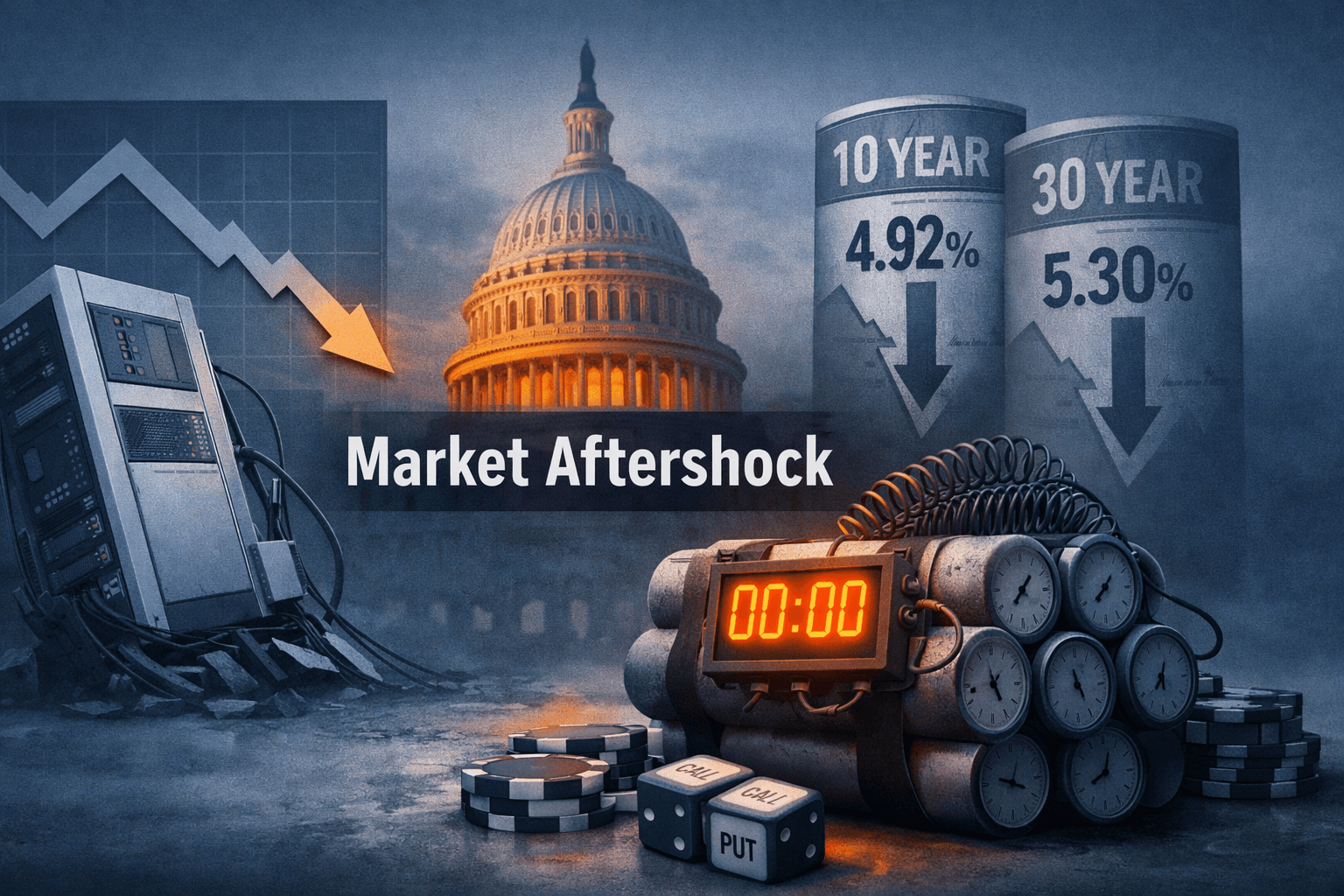
The most consequential market development on Nov. 4 was the post-midterms repricing across equities and fixed income. Early-session panic in AI infrastructure names—CoreWeave (CRWV) printed as much as an 8% pre-market gap—gave way to a broad risk-on swing that lifted the Dow by roughly 1,500 points (about 3%) intraday. At the same time, the 10-year Treasury yield slipped to 4.92% and the 30-year to 5.30%, a meaningful multi-day decline that compressed yields by roughly 20–70 basis points across maturities according to market reports. Big-cap, diversified tech names outperformed: Amazon (AMZN) rallied 6.12% to $266.03 and Apple (AAPL) logged its best session in more than a year.
Those headlines, however, mask a set of cross-cutting, sometimes contradictory themes: a rotation away from concentrated, high-beta AI infrastructure risk; a reflation of select growth narratives (e.g., AWS-led upside for AMZN); and concentrated options positioning—most notably the MSOS gamma map—that leaves dealers and some retail-heavy books exposed into Friday opex.
The synthesis: four dominant themes
Political shock + fast repricing. Democratic wins in both chambers triggered a quick re-evaluation of policy and fiscal expectations. Markets initially sold AI infrastructure names on the headline, then recalibrated: not all AI exposures are equal. Analysts and trade desks flagged component makers (optical parts and other inputs) as relatively underpriced versus the headline infrastructure builders, a nuance that helped the tape reverse.
Rotation into large-cap defensives within tech. Money moved toward mega-cap, diversified tech (Apple, Amazon) as traders sought ballast from names perceived as durable amid policy and macro uncertainty. AMZN’s 6.12% gain reflects renewed focus on AWS-driven growth and the AI-related spend thesis filtered through a more macro-stable lens.
Options market mechanics matter this week. The MSOS story is a case study in concentrated retail flow and dealer gamma. Dealers are short some 83,000 calls into Friday opex while a WallStreetBets whale put on a levered call structure (100k shares at $3.9949, 2k Nov 6 $4 calls at $0.18, and 13k Nov 6 $4.50 calls at $0.0786). That book carried about $138k of premium against roughly $400k of stock exposure in the screenshot—an extreme asymmetric position. When MSOS printed $4.49 on Tuesday and then $4.72 pre-market on Wednesday, the dealer hedging dynamic amplified intraday moves and increased the likelihood of pinning between $4.50 and $5 into opex.
Mixed earnings reactions and sector dispersion. Corporate results produced divergent market responses: McDonald’s (MCD) beat and advanced on signs of improved U.S. restaurant trends; Uber (UBER) beat revenue ($14.77B, +9.4% YoY) but flagged mobility and delivery unit weakness; Figma posted an earnings beat yet fell after choosing to expand AI access at existing pricing—a deliberate growth-first tradeoff that markets sold off on. Novo Nordisk (NVO) rallied on Wegovy pill sales outpacing expectations and an upgraded full-year outlook.
Where analysts agree — and where they don't
Agreement
- Markets broadly agree that the midterm results repriced near-term policy odds and that this drove the initial moves in rates and equities. Multiple teams highlighted the same 10-year (4.92%) and 30-year (5.30%) print.
- There’s consensus that not all AI exposure is the same: AI infrastructure builders and large-cap platform players will be evaluated under different macro/policy regimes.
Divergence
- Valuation vs. fundamentals debate: Goldman Sachs projects S&P 500 earnings growth decelerating to roughly 18% in 2027—an analyst-level signal that earnings momentum will be tougher to sustain. Yet the market’s risk-on rotation into mega-cap tech suggests investors are still willing to pay for durable revenue engines and scale. That raises a classic debate: will the market rely on earnings to underpin multiples, or will sentiment and rotation extend multiple expansion?
- Short-termers vs. long-termers on AI monetization: Figma’s decision to expand AI access without immediate price increases split the market. Some analysts framed it as a reasonable long-term adoption strategy; others view it as near-term pressure to revenue per user with real margin uncertainty.
- Private vs. public valuation pathways: Morgan Stanley’s faster path for SpaceX to positive free cash flow by 2031 and the Starship Flight 15 catalyst contrast with public-equity risk dynamics—private valuations may re-rate faster than public proxies, but uncertainty on technical execution remains a subject of debate.
Deeper context on major moves
Treasury moves: The sub-5% 10-year print is meaningful in an era of higher-for-longer discourse. A roughly 20–70 bps drop across maturities signals a near-term relief trade after the midterms and improves mark-to-market comparisons for long-duration assets. For fixed-income-sensitive strategies (long-duration equities, REITs), the yield compression changes discount-rate inputs and can favor higher multiple names, all else equal.
Options and dealer gamma: Dealer short-call exposure forces delta-hedging dynamics that can amplify price moves. When dealers are short calls and the underlying rallies, they buy to hedge, exacerbating upward moves. Conversely, if dealers are long calls, gamma can work the other way. MSOS’s concentrated positioning into Friday opex is a textbook setup for pinning, volatile intraday moves, and outsized short-covering squeezes.
AI supply-chain differentiation: Analysts flagged that the AI buildout still “needs parts”—optical components, semiconductor substrates, and niche suppliers may see a steadier revenue ramp than the large AI-cloud service builders who face more political and margin scrutiny. This is a classic supply-chain vs. platform bifurcation: a large-cap cloud provider benefits from demand for compute, but component makers can capture secular hardware upgrades even if platform-level spend is lumpy.
Implications by investor type
Short-term traders and options strategists: Watch opex gamma maps closely (MSOS this Friday) and be prepared for pinning and elevated realized volatility. Delta-hedging flows can create outsized moves in relatively small-cap instruments.
Event-driven and activist-focused investors: CVS’s announced split of the drugstore business (a reversal of the Aetna-era vertical model) and Berkshire’s incremental purchases of SiriusXM (SIRI to 52-week highs) reinforce the importance of corporate actions and block trades as catalysts.
Income and fixed-income allocators: Falling yields (10-year to 4.92%) change the comparison set between dividend-yielding equities and Treasuries. MarketWatch’s list of Dividend Aristocrats that could outpace the 10-year over a decade remains contextually relevant; lower near-term yields brighten the income trade-off.
Growth investors and long-term allocators: Goldman’s 18% S&P earnings growth forecast for 2027 suggests earnings-driven returns may moderate. That raises the bar on stock selection: favor firms with durable free-cash-flow conversion or clear secular growth drivers. Companies like Novo (Wegovy traction) illustrate idiosyncratic secular winners.
Private/space investors: Morgan Stanley’s faster path to positive free cash flow at SpaceX and Starship Flight 15 as a catalyst elevate the private-space narrative—timing and technical execution remain the principal risks.
Tactical watchlist (near-term signals to monitor)
- Opex and gamma: MSOS into Nov 6 expiry and other concentrated retail books. Watch intraday bid/offer dynamics and volume concentration around strike clusters.
- Policy and oil: Analysts flagged oil near $95.70 as a macro input; energy price moves will interact with inflation expectations and fiscal calculus.
- Earnings momentum and guidance: Figma’s pricing decision and Uber’s mobility unit pressures underscore the need to parse revenue beats vs. unit economics.
- Treasury yields and the Fed narrative: Continuing moves below 5% on the 10-year would materially alter discount-rate assumptions for growth names.
Strategic considerations (what analysts say to monitor next)
- Decompose AI exposure: separate platform/cloud-level exposure (sensitive to big-ticket policy, capex cycles, and margin scrutiny) from component/supply-chain exposure (potentially steadier hardware upgrade cadence).
- Treat options flows as market drivers, not just reflections of sentiment: concentrated retail or dealer positions can create transient but tradable dislocations—especially into opex.
- Watch for a valuation/earnings tug-of-war: Goldman’s slower growth projection suggests multiple expansion alone may be fragile; any softening in earnings guidance during the next reporting windows would force re-leveraging of risk premia.
- Keep event catalysts front and center: CVS breakup, SpaceX Starship milestones, Berkshire’s portfolio moves, and company-level pricing experiments (e.g., Figma) will produce asymmetric returns for event-driven strategies.
Closing note and disclaimer
Analysts across our coverage agree the midterms reshaped near-term policy expectations and that gamma/option dynamics will dominate some pockets of the market this week. However, views diverge on whether the market’s rotation into mega-cap tech will be sustained in the face of slower projected earnings growth and uneven corporate fundamentals.
Investment disclaimer: This analysis is informational only. It does not constitute a recommendation to buy, sell, or hold any security, nor does it provide personalized investment advice. Analysts note market data and positions to highlight risks and potential catalysts; readers should consult their own advisors and consider their risk tolerance and investment horizon before making decisions.
(Compiled from multiple Alpha Breaking analyses, Nov. 4.)
Sources
+ 15 more sources
Use these insights — enter this week's contest.
Free practice contests — earn Alpha CoinsExplore More Content
Disclaimer: StockAlpha.ai content is for informational and educational purposes only. It is not personalized investment advice. Sentiment ratings and market analysis reflect data-driven observations, not buy, sell, or hold recommendations. Always consult a qualified financial advisor before making investment decisions. Past performance does not guarantee future results.
Spotted something wrong? Report an error.