 Breaking Analysis
Listen to this Recap
9:22
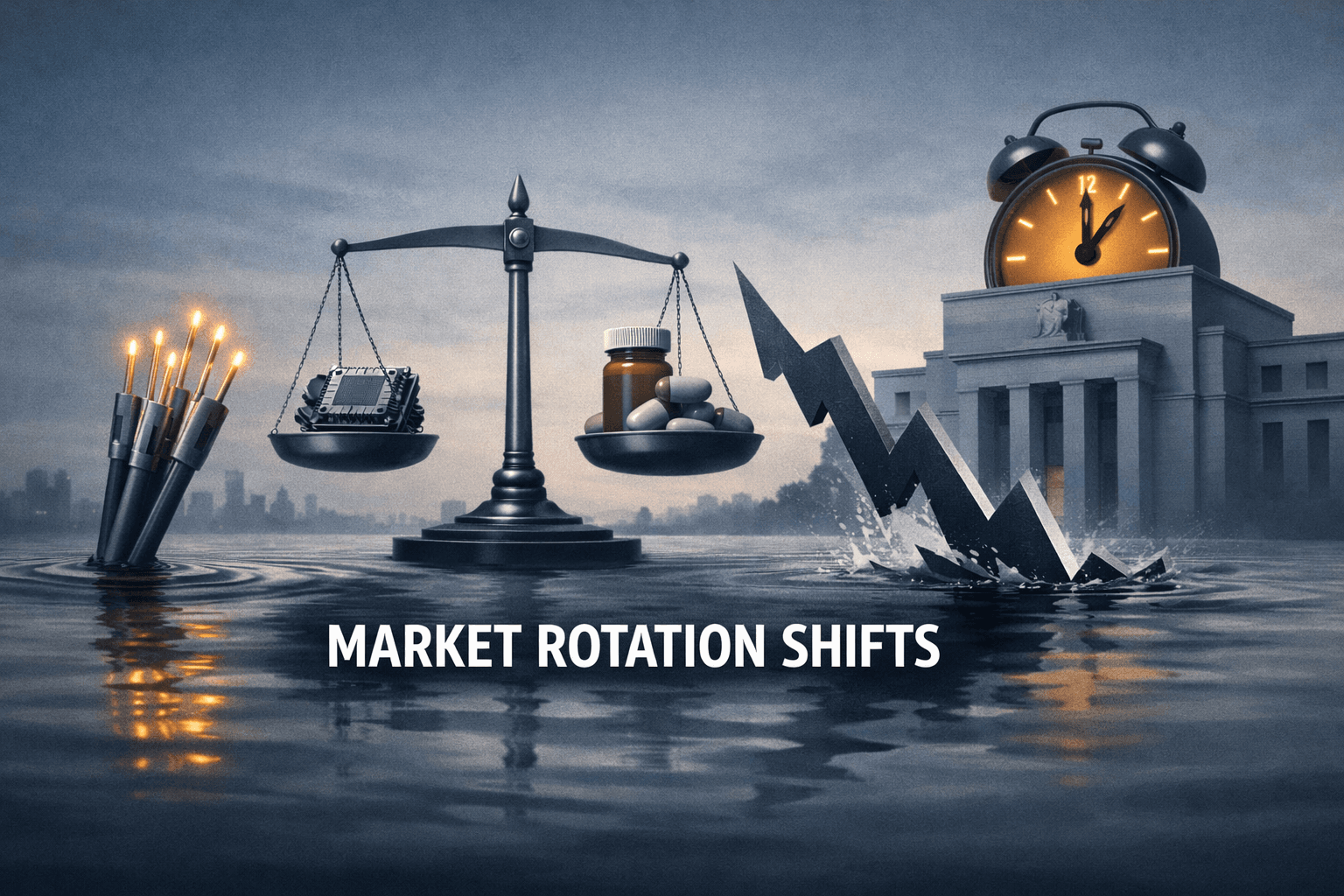
M&A Ripples, Earnings Divergence and a Higher-for-Longer Fed: Markets Parse Rotation from AI Hype to Cyclicals and Health Care
Podcast • Loading audio...
Share this article
Spread the word on social media
Key Takeaways
- •Marvell–Lumentum rumor (~$83B) re‑rated photonics names; LITE jumped double digits after hours while MRVL fell ~9%, creating heightened volatility into Nov 2–16 earnings.
- •Earnings were bifurcated: Samsung, Lilly and Merck posted strong results and guide lifts, while ServiceNow’s ~24–25% collapse highlighted fragility in AI‑linked software expectations.
- •Macro remains a major swing factor — Fed kept rates at 3.75%–4.0% with hawkish commentary from Kevin Warsh, increasing sensitivity of long‑duration growth names to incoming data.
- •Cyclicals and energy (Shell) showed cash generation and buyback actions, underscoring a partial rotation away from pure growth in the near term.
- •Investors should monitor regulatory timelines for large cross‑border M&A, upcoming inflation and Amazon prints, and the Nov 2–16 optics/photonic earnings window.
Today's most significant market developments
Markets opened and closed on a mix of confirmed earnings beats, sector shocks and a late‑day takeout rumor that reshuffled a theme already under active repricing. The biggest single headline: Bloomberg reported Marvell (MRVL) is in advanced talks to buy Lumentum (LITE) for roughly $83 billion. Nothing is signed, but the tape behaved like a done deal — Lumentum jumped double digits after hours while Marvell slid roughly 9% intraday. The rumor immediately re‑priced every photonics and optics name, with analysts flagging November’s earnings window (Nov 2–16) as a key run for the group.
That M&A noise came on a busy corporate‑news day: Samsung posted an outsized quarter that refocused attention on the memory cycle; Intel beat on non‑GAAP EPS ($0.52 vs. consensus +$0.12) and revenue ($16.51B, +$20M vs. estimates); Rivian beat with revenue of $575.9M and adjusted EPS $0.61 while software revenue rose 46% to $36M and R2 deliveries improved; Lilly raised full‑year sales guidance as Zepbound sales surge (Q3 revenue +39% to $24.4B); Merck topped estimates and hiked profit outlook (adj. EPS $3.40 vs. $2.66 expected); and ServiceNow reported a disappointing quarter that sent shares down roughly 24–25%, its largest single‑day selloff.
Overlaying corporate news, Kevin Warsh’s public remarks signaled a hawkish tilt even as the Fed held the policy range at 3.75%–4.0%, reinforcing a “higher‑for‑longer” interest‑rate expectation that is reshaping valuations across long‑duration growth names.
Key themes synthesized across analyses
- M&A and the optics/photonics re‑rating
- The Marvell–Lumentum rumor (deal value ~ $83B) is both a valuation event and a signal: it suggests strategic buyers are willing to pay premiums for photonics assets tied to data‑center optics, AI compute interconnects and transceiver technology. Analysts link this to a broader repricing after Nvidia’s outsized quarter, which earlier widened the addressable market for photonics and transceivers. Expect heightened volatility into Nov 2–16 earnings for optics names (AAOI, COHR, POET and others) as investors parse takeout math versus organic fundamentals.
- Earnings divergence — cyclicals and healthcare outperform; software shows fragility
- Large, cyclical and commodity‑exposed names posted strong results: Shell nearly doubled quarterly profit on record refining margins (shares +~3% on the print; buybacks expanded). Industrials such as Caterpillar surprised on earnings amid investments tied to AI deployments. Healthcare led by Lilly (+39% Q3 revenue to $24.4B) and Merck (adj. EPS $3.40 vs. $2.66 expected) drove a defensive rotation into pharma and GLP‑1/oncology winners. Conversely, ServiceNow’s underwhelming quarter wiped out a large chunk of market value and revived concerns around competition and AI monetization timing for enterprise software.
- Semiconductor nuance — memory cycle signals versus deal premium anxiety
- Samsung’s rare outsized quarter and management commentary have refocused investors on memory‑cycle dynamics. That’s constructive for chip cyclicals and suggests inventory or price stabilization in DRAM/NAND. But the Marvell–Lumentum rumor introduces complexity: strategic M&A in adjacent photonics could accelerate consolidation and change competitive dynamics, while also raising regulatory (China approval) and premium‑funding concerns that worry bidders like Marvell.
- Macro backdrop: policy uncertainty is a risk to long‑duration growth
- Kevin Warsh’s hawkish remarks and the Fed’s decision to keep rates at 3.75%–4% reinforce a higher‑for‑longer narrative. That raises the discount rate on long‑duration cash flows and helps explain why growth and AI‑adjacent names are now more susceptible to headline risk. Upcoming inflation data and Amazon earnings are flagged as proximate catalysts that could swing sentiment quickly.
Conflicting views and market debates
Is photonics a takeover play or a fundamentals story? Some analysts read Marvell’s purported approach to Lumentum as validation that photonics is the new battleground for AI infrastructure — a strategic reallocation of capital into optics and interconnects. Others caution that the rumor‑driven move overprices smaller photonics peers and underestimates regulatory risk (notably China approval timelines), which could reverse the rally in acquirers like Marvell if drawn‑out.
Memory recovery — cyclical trough or temporary relief? Samsung’s quarter prompted optimism that the memory downcycle is stabilizing, which would benefit chip equipment and memory suppliers. Skeptics point to the volatility of memory pricing and inventory swings and contend the strength could be more supplier‑led than demand‑led, warranting cautious readthroughs for the rest of the semiconductors supply chain.
AI as durable earnings driver vs. headline‑driven hype: ServiceNow’s collapse is the clearest sign that AI attribution can be binary — one miss or weak outlook can undo multiple quarters of thematic premium. Yet other companies (Caterpillar citing AI buildout, Rivian growing higher‑margin software revenue) offer a counterpoint that AI monetization can be real but heterogeneous across business models. Analysts therefore disagree on how to value AI upside: as a revenue re‑rating or as an event‑driven trade subject to quick reversal.
Deeper context on major moves
Why the Marvell–Lumentum rumor matters beyond optics: Photonics (lasers, transceivers, optical engines) is increasingly integral to scaling AI datacenters. Nvidia’s revenue scale and chip architectures created a demand shock for higher‑bandwidth interconnects — that, in part, underpinned the earlier repricing of photonics. A large strategic buyer paying an $83B premium would accelerate consolidation, lift multiples across peers, and redraw supply‑chain economics. But large cross‑border M&A is slower to clear in China, and the prospect of prolonged approvals introduces meaningful deal execution risk.
ServiceNow’s drop in context: A ~24–25% single‑day decline is not merely a valuation reset; it’s a sentiment shock that tests the narrative that AI will uniformly lift enterprise software multiples. The move amplifies the Fed effect: in a higher‑rate environment, future AI earnings must arrive sooner and be more visible to justify current multiples.
Lilly and Merck: Structural demand and pricing optionality: Lilly’s guidance lift tied to Zepbound and Mounjaro and Merck’s Keytruda strength show how durable product adoption and incremental new formulations can drive outsized cash generation and re‑rate large caps even as growth multiple compression hits other sectors.
Shell and refining margins: A record surge in refining margins amid product tightness and geopolitical pressure has bolstered cash flow and triggered buybacks. For cyclically exposed portfolios, this is a reminder of commodity‑driven upside that can occur independent of the tech‑led market narrative.
Implications by investor type
Short‑term traders and event‑driven managers: Elevated volatility around rumored M&A, earnings surprises (both positive and negative), and macro prints creates opportunity — and risk. Tight stop discipline, active hedging around earnings (Nov 2–16 optics window, inflation data, Amazon), and liquidity awareness are essential.
Growth investors: The higher‑for‑longer rate backdrop increases sensitivity to guidance and execution. ServiceNow is a cautionary example; companies with long duration earnings must show more visible monetization. Reassessing position sizing and requiring nearer‑term catalysts before adding exposure are reasonable analytical adjustments (not recommendations).
Value and income investors: Cyclicals and energy names (Shell, select industrials) delivered cash flow and buyback support. Those defensive/earnings‑stable sectors may offer lower sensitivity to rate moves and headline risk.
Thematic/sector allocators (AI, semiconductors, biotech): Photonics and semiconductors require parsing M&A math versus organic demand. Biotech/synthetic biology names (Twist Bioscience flagged by Conestoga) show pockets of strong end‑market demand but come with small‑cap volatility.
Long‑term holders: Macro uncertainty and episodic headline risk argue for portfolio diversification and monitoring of catalysts (regulatory approval timelines, guidance revisions, policy shifts). Investors relying on multi‑year secular themes should update models to reflect potential near‑term volatility.
Strategic considerations and what to watch next
Watch the optics earnings window (Nov 2–16) closely: If Marvell–Lumentum catalyzes other bids or materially changes guidance expectations, volatility across AAOI, COHR, POET and peers will remain elevated.
Monitor inflation prints and Amazon’s results: Kevin Warsh’s hawkish tone means macro data will quickly translate into repositioning across long‑duration growth and cyclicals.
Track China regulatory signals on cross‑border deals and large semiconductor/photonic transactions: Approval timing could be the difference between a sustained re‑rating and a short‑lived rumor spike.
Earnings cadence: Big pharma (Lilly, Merck) and payments (Mastercard beat by $0.15) show how certain sectors can decouple from tech weakness. Compare operating leverage and cash flow trends to assess durability.
Volatility and hedging: Given the mix of M&A rumor risk, large single‑day software shocks (ServiceNow), and a hawkish Fed narrative, investors may want to reassess risk sizing and hedging tactics appropriate to their mandate and time horizon.
Conclusion
Today’s tape underscores an environment of selective winners and rapid repricing. Strategic M&A narratives (Marvell–Lumentum) can lift entire subsectors while a hawkish monetary policy stance increases the cost of waiting on distant AI monetization. At the same time, clear, demand‑driven beats from Samsung, Lilly and Merck show that sector and stock selection still matters: earnings quality and cash generation are being rewarded even as sentiment toward long‑duration growth becomes more binary. Market participants should prepare for continued headline‑driven volatility, monitor the outlined catalysts, and update valuation frameworks to reflect a market where execution and near‑term visibility matter more than ever.
Disclaimer: This synthesis is for informational purposes only. Analysts note the signals described above; it is not personalized investment advice and does not constitute a recommendation to buy, sell, or hold any security.
Sources
+ 12 more sources
Use these insights — enter this week's contest.
Free practice contests — earn Alpha CoinsExplore More Content
Disclaimer: StockAlpha.ai content is for informational and educational purposes only. It is not personalized investment advice. Sentiment ratings and market analysis reflect data-driven observations, not buy, sell, or hold recommendations. Always consult a qualified financial advisor before making investment decisions. Past performance does not guarantee future results.
Spotted something wrong? Report an error.