 Breaking Analysis
Listen to this Recap
9:56
Weekend Wrap: Yields, Geopolitics and Tech Dispersion Drive Mixed Market Signals
Podcast • Loading audio...
Share this article
Spread the word on social media
Key Takeaways
- •Market action is highly idiosyncratic — firms with clear demand signals (SMCI, LLY) are outperforming while others (INTC) face sharp intraday moves.
- •Yield dynamics are mixed: short‑term rates near or above 5% coexist with a 10‑year yield around mid‑to‑high 3%, creating a challenging term‑structure backdrop.
- •Geopolitical risk in the Middle East has reintroduced an energy risk premium even as Exxon’s strong refining margins add ~$4.5B to Q3 earnings.
- •High valuation dispersion (e.g., PLTR at 78.2x sales) raises execution risk for growth names; steady dividend yields (NEE ~3.0%) don’t always close multi‑year price gaps.
- •Investors should re‑test models across rate scenarios, monitor backlog and margin converts to cash, and brace for elevated Monday volatility.
The day’s standout developments
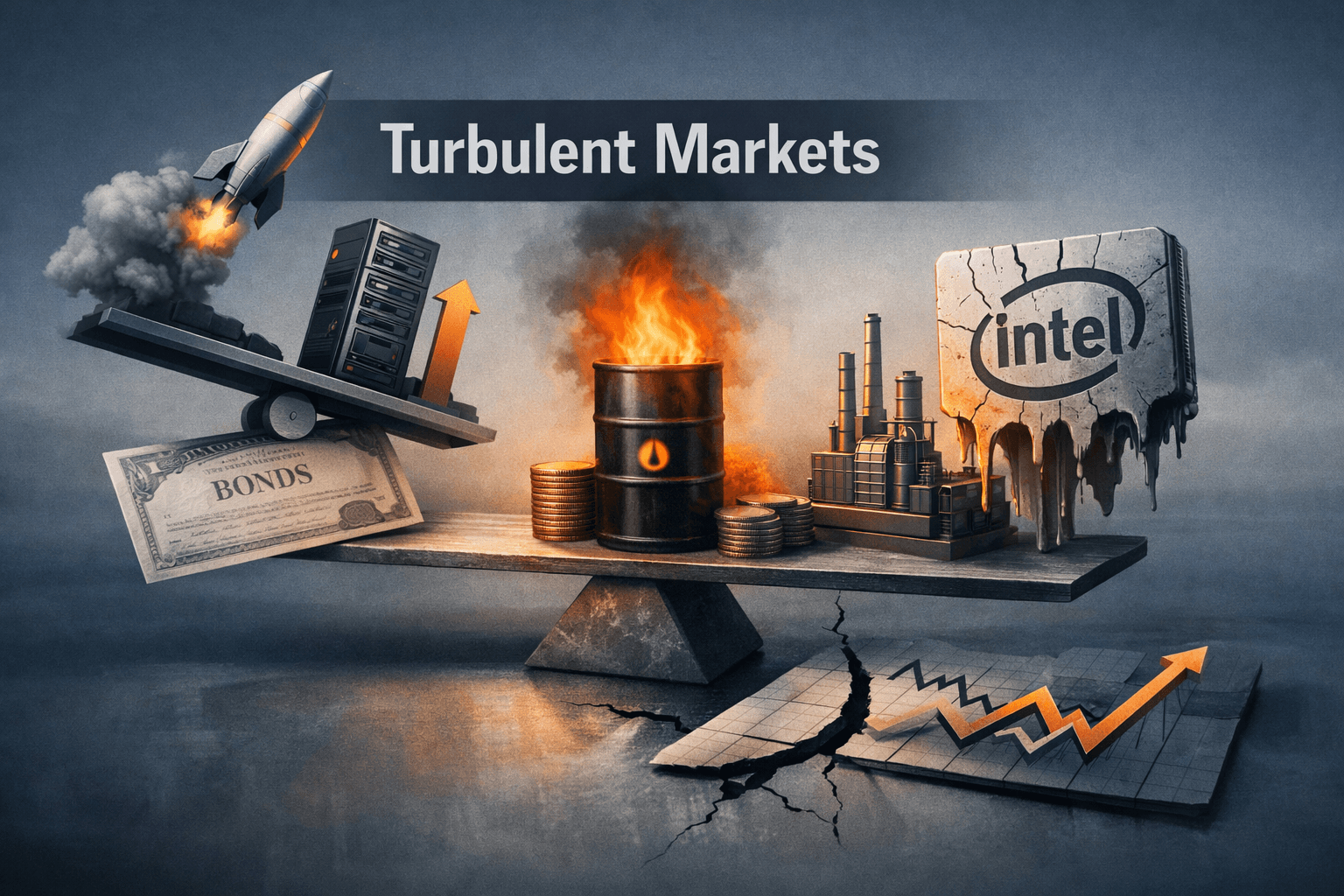
Markets closed for the long weekend, but a set of cross-cutting developments reported through Oct. 17 set distinct themes that investors should carry into Monday’s session. The most consequential items are: a concentrated, dramatic rally in Super Micro Computer (SMCI) that reflects accelerating order flow and an elevated fiscal 2027 revenue target; fresh geopolitical risk after missiles reportedly struck a Saudi oil hub; materially higher refining profit expectations at Exxon that boost near‑term earnings; and a disjointed picture in rates — headlines referenced both “yields above 5%” and a 10‑year yield trading around the mid‑to‑high 3% area.
Each of these items points to a larger market dynamic: dispersion. Certain companies and sectors are experiencing concentrated moves driven by idiosyncratic data (product launches, backlogs, margin changes), while macro forces — rates and geopolitics — are increasing cross‑asset volatility and re-shaping valuation frameworks.
What the pieces say, together
Super Micro (SMCI): The stock climbed 45.1% between July 17 and Oct. 15, outpacing the S&P 500’s roughly 4.1% rise in that window. Management disclosed a fiscal‑2027 revenue target of $65 billion to $72 billion and reported a record order backlog. Analysts note that when a company couples strong price action with explicit multi‑year revenue targets and backlog data, the move is more likely tied to accelerating end‑demand (servers and data center refresh) than pure momentum.
Energy and geopolitics: Reports of missiles striking a Saudi oil hub escalate a regional risk premium. Energy-focused analyses flagged that this can lift oil volatility, insurance costs for tankers and prompt tactical positioning in energy supply chains. Separately, Exxon expects higher refining margins to add roughly $4.5 billion to Q3 earnings, a concrete profit uplift investors can fold into near‑term models.
Rates and deficits: Two analyses emphasize fiscal and monetary tension. One frames the problem as a near $2 trillion deficit paired with Treasury yields above 5% — a combination that raises borrowing costs economy‑wide and compresses growth valuations. Another notes that despite hotter inflation prints, the bond market “shrugged” as 10‑year yields retraced to about the mid‑to‑high 3% range (around 3.5%), suggesting buyers found those yields attractive. These are not perfectly incompatible: much of the 5% headline applies to short‑term nominal yields (e.g., 2‑year), while the 10‑year has stayed materially lower, producing an inverted or compressed yield curve with important implications for banks, discounting and risk premia.
Tech dispersion: The sector shows acute divergence. Intel fell 5.79% to $89.85 on heavy volume in the last trading session, while Palantir (PLTR) trades at 78.2x price‑to‑sales versus the S&P’s 3.1x — an extreme multiple that requires very durable top‑line growth to validate the premium. Tesla presented a high‑profile product narrative (a Roadster with flight capabilities targeting 2028 production), yet shares were caught in a broader tech retreat and trade around $235 with an implied market value near $30 billion and scenario swings on the order of $50 per share. This split — heavy selling in some legacy chip and auto names while high multiple software/analytics names hold lofty valuations — speaks to rotation and re‑pricing within technology.
Dividend and total return assessment: Utility stalwart NextEra (NEE) yields about 3.0% as of Oct. 15 close. Analysts weigh whether steady income offset five years of price underperformance relative to benchmarks. Meanwhile, product‑driven winners like Eli Lilly (LLY) have shown how pharma revenue upside translates into equity outperformance: a hypothetical $10,000 invested in LLY on Oct. 14, 2025 would have grown to about $15,500 by Oct. 15, 2026 versus roughly $11,790 in the S&P over the same period.
Where analysts agree and where they differ
Agreement
- Dispersion is high: Most pieces converge on the view that market action is increasingly idiosyncratic — company‑specific catalysts matter more than uniform market trends.
- Rates are central: Nearly every analysis treated yields as a key input for valuation, either by noting higher borrowing costs or by pointing to changed discount rates for long‑duration equities.
- Energy is vulnerable to geopolitics: There is consensus that strikes in the Gulf raise the immediate volatility and risk premium for oil and related assets.
Differences and debates
- How high are yields? One analysis flagged yields “above 5%” as a macro stress — a broad framing that reflects short‑end rates (2‑year and other money‑market instruments) rather than the 10‑year. The bond‑market piece emphasized a retracement of 10‑year yields to roughly 3.5% after inflation shocks. The tension between short‑term yields (5%) and the 10‑year (3.5%) creates an important debate about the term structure: are markets signaling persistent tight policy (sustained higher short rates) or are longer maturities discounting moderating growth and inflation?
- Valuation tolerance: Palantir’s 78.2x sales multiple triggered differing tones. Some analyses treat the multiple as a reason for cautious sizing (given the execution burden), while others argue that shifting customer mixes and product optionality could justify a higher premium — the classic high‑growth vs. execution risk debate.
- Energy signal interpretation: Exxon’s $4.5 billion refining uplift is tangible and positive for its near‑term earnings, but analysts note a tradeoff: geopolitical‑driven oil price rises help E&P margins but can raise refined product pricing volatility and supply chain risk.
Deeper context on major moves
Super Micro’s rally: When a firm publicly sets a multi‑year revenue target ($65B–$72B for fiscal 2027) and reports a record backlog, that shifts the narrative from “momentum” to “demand acceleration.” Backlog represents confirmed or highly probable sales that haven’t been shipped; for server vendors, it maps closely to capex cycles in hyperscalers and enterprise data centers. The market reacted accordingly: a 45.1% run in roughly three months signals investors are re‑rating the firm for significant top‑line expansion.
Yield curve dynamics: Short‑end yields above 5% with a 10‑year near 3.5% implies inversion and aggressive policy pricing. Inversion historically tightens bank net interest margins in the short run, compresses borrowing for consumers and corporates, and increases pressure on growth multiples by raising discount rates — particularly for long‑duration growth stocks.
Exxon’s refining margin windfall: A $4.5B add to Q3 earnings materially affects free cash flow models and near‑term payout capacity. Unlike speculative, forward‑looking product narratives, high refinery margins translate quickly into cash. Investors focused on cash generation and free‑cash‑flow yields will re‑run their models with this uplift.
Geopolitical premium in oil: Strikes on Saudi infrastructure create a near‑term premium priced into futures, shipping insurance and regional equities. Even if physical supply is not structurally impaired, risk premia — which can be volatile — will influence energy sector cash flows and sentiment.
Implications for different investor types
Growth investors: Higher short‑term yields and a higher discount rate increase the hurdle for long‑duration growth stocks. Analysts note the importance of stronger-than-expected execution to justify lofty multiples (e.g., PLTR’s 78.2x P/S). Growth investors should monitor customer durability, revenue cadence and margin expansion as tolerance for valuation risk narrows.
Income and dividend investors: Names like NextEra with a steady 3.0% yield remain attractive for income stability, but total‑return comparisons show dividends don’t always close multi‑year price gaps. Rising yields improve income alternatives and change opportunity cost calculations for dividend strategies.
Value and cash‑flow investors: Exxon’s $4.5B refining boost highlights how cyclical tailwinds can rapidly improve free‑cash‑flow profiles. Investors focusing on cash generation may find re‑rated opportunities where near‑term cash improves balance sheet or buyback capacity.
Macro and fixed‑income focused investors: The divergence between short and long yields raises questions about policy expectations, recession risk and curve positioning. The bond market’s ability to absorb inflation shocks — as signaled in the 10‑year retracement — is a key datapoint for duration allocation and carry strategies.
Risk‑tolerant, event‑driven traders: Geopolitical volatility and single‑name dispersion (SMCI’s backlog, Intel’s sharp one‑day drop) create short‑term trading opportunities but also raise execution risk. Elevated volume and headline risk around Monday’s open require clear stop and liquidity plans.
Strategic considerations heading into next week
Re‑examine discount rates: With short rates elevated and longer yields mixed, investors should stress‑test models across a range of discount scenarios, particularly for long‑duration names.
Track real order/backlog confirmation: For companies like Super Micro, follow shipments and customer confirmations that convert backlog into revenue. Backlogs can be cancelled or delayed; conversion rates matter.
Monitor energy risk premium and refining margins separately: Geopolitical headlines can lift crude futures, but refinery economics and downstream margins determine profitability for integrated producers like Exxon.
Account for valuation dispersion: High multiples require durable growth; look for consistent evidence of customer stickiness and margin expansion before assuming premium multiples are sustainable.
Prepare for Monday liquidity swings: Markets closed Friday; geopolitical and macro headlines may provoke outsized moves when trading resumes. Position sizing and risk controls that assume wider intraday ranges are prudent.
Closing synthesis
Friday’s information flow produced a market characterized by concentrated winners and losers against a backdrop of macro ambiguity. Company‑level signals — order backlogs at SMCI, product success at Lilly, and a tangible earnings uplift at Exxon — are lifting or re‑rating specific names, while macro dynamics (divergent yields across the curve and renewed Middle East risk) are elevating cross‑asset uncertainty. Analysts note that in such an environment, active differentiation, disciplined valuation work and scenario planning matter more than ever.
Investment disclaimer: This summary presents market analysis and data for informational purposes only. It does not constitute a recommendation to buy, sell or hold any security, nor does it provide personalized investment advice. Analysts’ sentiment and metrics described above reflect the content and context of the cited analyses.
Sources
Use these insights — enter this week's contest.
Free practice contests — earn Alpha CoinsExplore More Content
Disclaimer: StockAlpha.ai content is for informational and educational purposes only. It is not personalized investment advice. Sentiment ratings and market analysis reflect data-driven observations, not buy, sell, or hold recommendations. Always consult a qualified financial advisor before making investment decisions. Past performance does not guarantee future results.
Spotted something wrong? Report an error.