 Breaking Analysis
Listen to this Recap
7:46
Rotation and Repricing: AI Fatigue, Event Risk, and Narrow Breadth Drive Today's Market Moves
Podcast • Loading audio...
Share this article
Spread the word on social media
Key Takeaways
- •Tech remains concentrated: Snowflake’s +59.3% YTD rally highlights a narrow leadership that increases index sensitivity to sentiment shifts.
- •Event and policy risk are front and center: POET’s announced Q3 date, upcoming earnings for Capital One and Meta, and the UK budget (Oct. 28) create compressed uncertainty.
- •AI narrative shows tension: long-term conviction remains, but growing near-term fatigue could accelerate rotation into valuation-sensitive and income names.
- •Banking dynamics diverge: legal clarity (WFC) reduces some overhangs, while potential UK bank profit surcharges increase sector risk and dividend uncertainty.
Today's top developments
Three developments framed market action and commentary across Alpha Breaking notes: 1) a continued, concentrated tech re-rating led by AI beneficiaries (exemplified by Snowflake's 59.3% YTD rally from Jan. 18 to Oct. 15), 2) rising investor fatigue on the AI narrative prompting talk of a rotation away from hype-driven winners, and 3) an uptick in event- and policy-driven risk that is reshaping bank and small-cap flows (UK banking tax-surcharge fears and several company-specific event dates).
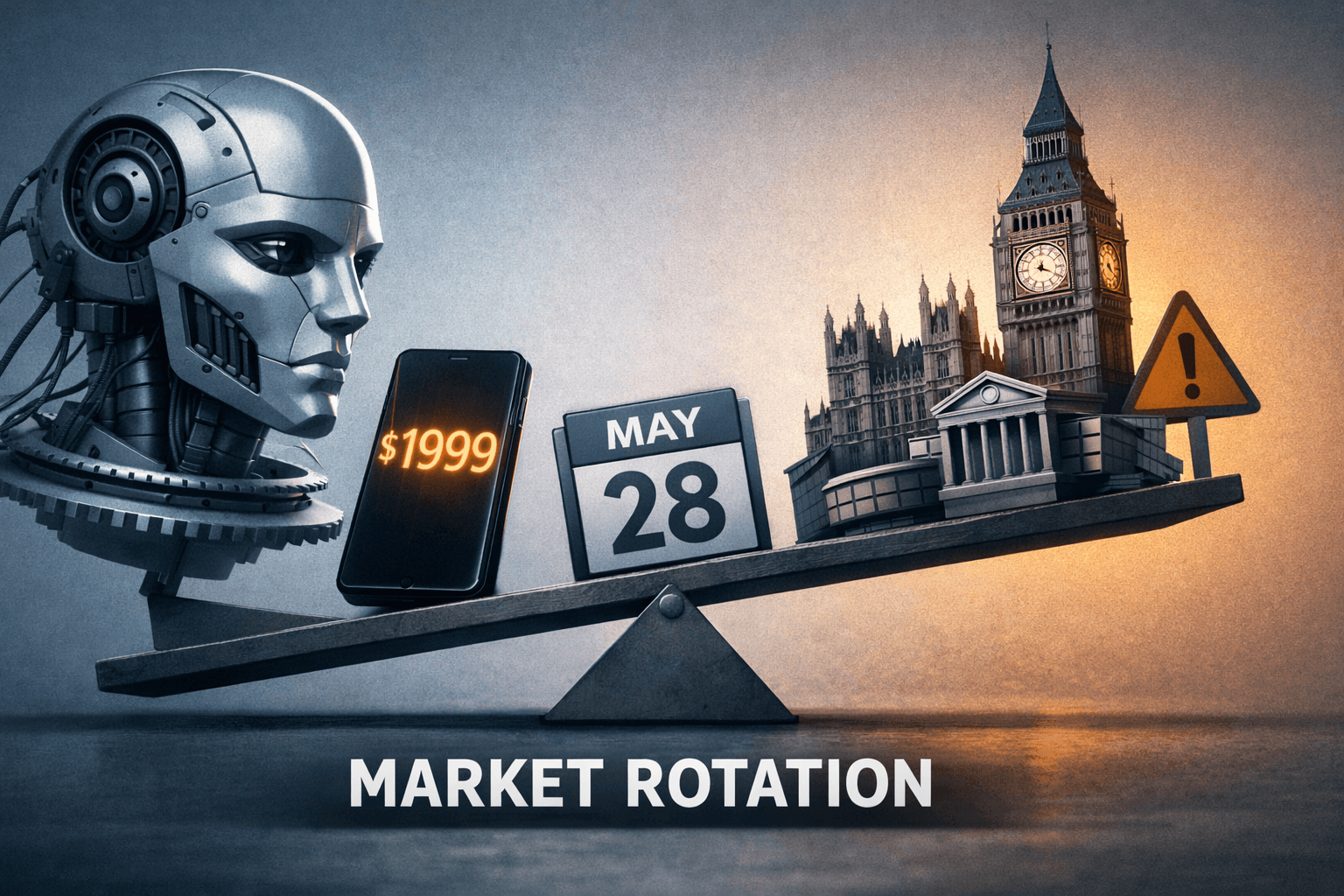
Those threads were visible in individual stories: Snowflake's large rally and attendant valuation questions; Apple launching a $1,999 foldable iPhone Duo and how that shapes premium hardware revenue; POET Technologies setting a Q3 release date and clearing a large options position; and London lenders sliding on reports the Oct. 28 Budget could include a higher profit surcharge.
Below I synthesize themes across the day's coverage, show where analysts converge and diverge, and map implications for different kinds of investors.
Synthesis: four cross-cutting themes
- Tech re-rating vs. AI burnout
- What analysts note: Snowflake's run (about +59.3% between Jan. 18 and Oct. 15) reinforces a broader market move that prices AI-driven demand into both revenue growth and margin expansion. At the same time, MarketWatch and related commentaries capture an "AI burnout" narrative: analysts still expect long-term payoff from AI, but investor patience for near-term execution and measurable returns is thinning.
- Why it matters: when momentum is sustained, multiples expand quickly; when sentiment turns, the reversals can be sharp because positioning is concentrated.
- Event-driven positioning and options flows
- What analysts note: POET Technologies putting a Q3 release on the calendar for Nov. 16 (results before the open) — and the company saying it will resume quarterly conference calls starting March 1, 2027 — matters because options-market players trade calendars and known dates. Recent activity included a cleanup of ~49,000 calls and a short-term hinge around Nov. 20 with $7 a focal strike; technical levels noted include $5.74 and a close at $6.07 (up 3.9%).
- Why it matters: named dates compress uncertainty into a single event, changing implied volatility dynamics and creating tradeable setups for event-driven funds and options traders.
- Narrow market breadth and concentration risk
- What analysts note: Middle Coast Investing and several sector writeups point to narrow leadership — a small set of high-multiple names driving broad cap-weighted indices while many quality names lag. Examples: Tripadvisor and Mobility Global were flagged as sidelined despite underlying business strength. Q3 commentary also highlighted uneven outcomes (F&G pre-announcing weaker Q3 results; Carnival showing higher earnings but booking setbacks earlier in the year).
- Why it matters: concentrated rallies make portfolios sensitive to any abrupt sentiment changes; they also create diverging fortunes for value vs. momentum managers.
- Policy and event risk in financials
- What analysts note: London banks fell up to ~8% on reports of a potential higher profits surcharge in the Oct. 28 Budget, taking roughly 3% off the wider UK index. Within US banking, company-specific developments matter: Wells Fargo saw a legal overhang eased when a court dismissed a pay-related suit against its former CEO; First Citizens and Provident show mixed regional-bank positioning (First Citizens at $2,097/share with a modest 5.8% six‑month gain vs. the S&P's 9.7%; Provident trading near $22.20 and range‑bound since April).
- Why it matters: political/regulatory moves can swiftly reprice dividend expectations and capital-return plans, hitting income-oriented portfolios and bank valuations.
Where analysts agree and where they clash
Agreement
- Narrow breadth is real: multiple analyses — Middle Coast, Tripadvisor, MBGL, and several company writeups — point to concentration at the top of the market.
- Event risk is actionable: POET’s date, Capital One and Meta earnings next week, and the UK budget are universally flagged as potential short-term catalysts.
- Valuation requires context: Carnival’s ~11.5x trailing earnings vs. S&P ~22.7x prompts a value narrative, but analysts consistently caution that event-driven booking trends and execution risk can justify the discount.
Disagreement / debate
- AI’s timing and valuation premium: some analysts treat Snowflake’s rerating as a forward-looking repricing that accurately reflects future AI workload demand; others emphasize the AI burnout trade — that investors are tiring of speculative multiple expansion and will rotate into names showing immediate revenue and margin proof points.
- How to treat long-dated optionality: Tesla’s multidecade roadmap from batteries to thrusters is framed as strategic optionality by some sources, while others urge treating such initiatives as long-term optionality with limited near-term cashflow impact.
Deeper context on the biggest moves
Snowflake and the AI re-rating
- Data: SNOW +59.3% YTD vs. S&P +12.5% in the same span (Jan. 18–Oct. 15).
- Context: the market is pricing in both demand and margin leverage from AI workloads. That lifts expectations for future quarters and makes the stock sensitive to any guidance shortfalls.
POET and options-driven micromanagement
- Data: Company set Q3 results for Nov. 16 before the open; 49,000 calls were part of a "cleanup"; Nov. 20 and $7 identified as a hinge; $5.74 as a chart level; stock at $6.07 close (+3.9%).
- Context: options traders value calendars — moving from an undefined reporting schedule to a firm date reduces ambiguity and can increase short-term gamma as implied vols reprice.
UK banking reaction to policy risk
- Data: Some lenders down as much as ~8%; the broader index off ~3%. Budget date Oct. 28.
- Context: tax-proposal headlines can reprice dividend sustainability and the effective return of capital for banks, forcing rapid multiple compressions in a sector that had priced in steady distributions.
Apple’s foldable and premium hardware dynamics
- Data: iPhone Duo starts at $1,999.
- Context: the price point signals Apple targeting a high-end segment; the key signal for markets will be unit demand vs. margin lift — whether the product adds incremental premium revenue or displaces more mid-priced purchases.
Implications by investor type
Momentum traders / quant funds
- Landscape: momentum remains concentrated; a reversal in AI sentiment or any earnings disappointment from concentrated leaders would likely trigger outsized drawdowns for momentum strategies.
- Watch: SNOW guidance, META ad trends, and the durability of Coca‑Cola's seven-session advance as a short-term momentum indicator.
Event-driven & options traders
- Landscape: newly scheduled corporate dates (POET Nov. 16) and earnings (Capital One, Meta) compress uncertainty and create volatility surfaces for trade ideas.
- Watch: implied volatility, open interest around key strikes (POET $7) and calendar spreads into announced dates.
Value and income investors
- Landscape: names like Carnival (about 11.5x trailing earnings) present a valuation gap vs. the market, but early 2026 booking softness is a live risk. UK banks face political policy risk that could threaten dividends and capital returns.
- Watch: booking trends for travel names, regulatory announcements in the UK, and legal developments (e.g., WFC dismissal reducing one overhang).
Long-term growth investors
- Landscape: stories around Tesla’s long-term optionality and Apple’s entry into foldables remain strategic rather than immediate cashflow drivers.
- Watch: how managements tie long-duration projects to near-term unit economics and R&D capitalization.
Strategic considerations (non-prescriptive)
- Reassess concentration risk: narrow breadth argues for checking cap-weight exposures and understanding how a handful of names influence your portfolio’s performance.
- Align time horizons with catalysts: event-driven dates (POET, earnings calendar) compress uncertainty — choose sizing that matches your conviction and horizon.
- Separate narrative from measurables: AI remains a compelling long-term theme, but shorter-term positioning should be validated by customer wins, revenue recognition, and margin inflection.
- Monitor policy headlines for income strategies: dividend-reliant allocations should track regulatory or tax-policy shifts (UK banking surcharge risk; US bank legal developments).
Conclusion
Today's tape reflects a market at an inflection point: concentrated tech leadership and AI-driven reratings coexist with investor fatigue and elevated event and policy risk. That mix produces asymmetric outcomes — outsized gains for a few names and notable underperformance for many others. Analysts across the Alpha Breaking notes agree on the importance of upcoming dates and on the narrowness of current leadership, but they diverge on how much of the AI premium is justified today versus how much is speculative — a debate that will play out in quarterly reports, product launches and policy headlines over the coming weeks.
Investment disclaimer: This report is for informational purposes only. It does not constitute personalized investment advice or a recommendation to buy, sell, or hold any security. Analysts note trends, data and market sentiment; investors should consult a licensed professional for individual guidance.
Sources
+ 8 more sources
Use these insights — enter this week's contest.
Free practice contests — earn Alpha CoinsExplore More Content
Disclaimer: StockAlpha.ai content is for informational and educational purposes only. It is not personalized investment advice. Sentiment ratings and market analysis reflect data-driven observations, not buy, sell, or hold recommendations. Always consult a qualified financial advisor before making investment decisions. Past performance does not guarantee future results.
Spotted something wrong? Report an error.