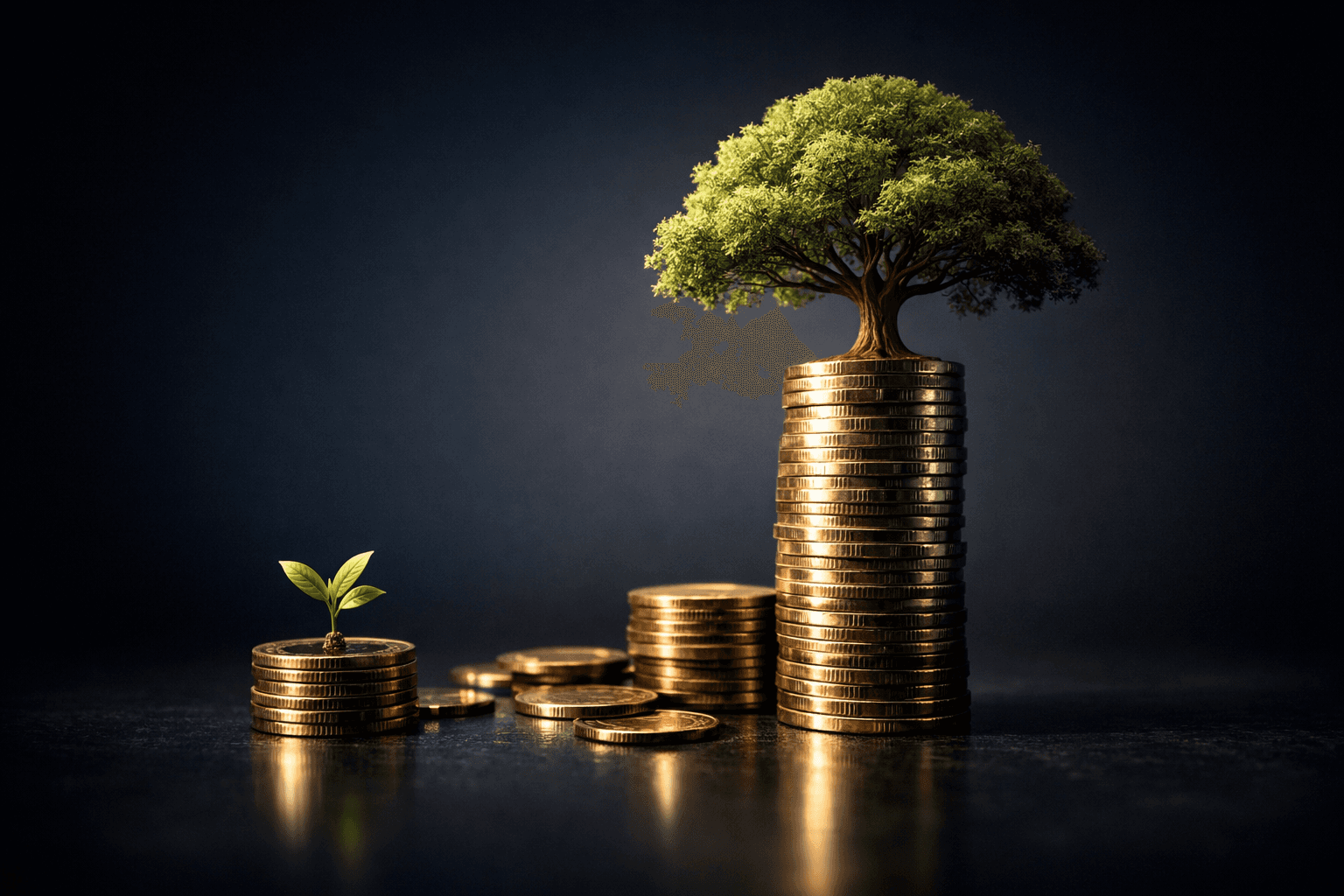
- Compound interest means you earn returns on both your original money and on past returns, that’s exponential growth.
- Starting early matters: the same monthly amount grows far larger when you begin decades sooner.
- Small regular contributions and reinvesting earnings (like dividends) are the practical way to compound wealth.
- The Rule of 72 helps estimate how long it takes money to double at a given rate.
- Fees, taxes, and withdrawing money interrupt compounding, keep costs low and stay invested.
Introduction
Compound interest is the process where investment returns earn additional returns over time. Put simply, you make money on your original investment and then make money on the money that money made.
This idea is central to long-term investing. For new investors, understanding compounding explains why time, not timing, is often the most powerful factor in building wealth.
In this article you will learn how compound interest works, see clear math examples, learn practical ways to benefit from it, and avoid common mistakes that reduce long-term growth.
How Compound Interest Works
At its core, compound interest follows a simple formula for lump-sum growth: A = P(1 + r)^n, where P is the starting amount, r is the annual return (as a decimal), and n is years invested.
Example: If you invest $10,000 at a 7% annual return for 30 years, the calculation is A = 10,000 * (1.07)^30. That results in about $76,120, meaning your money roughly septupled over 30 years.
Regular contributions and compounding
Most people invest by adding money regularly. The future value of a regular series of contributions grows even faster because each new amount also compounds.
Practical example: contributing $200 per month at a 7% annual return for 40 years results in roughly $526,000. Starting earlier made a big difference, that same $200/month for 30 years would be about $244,000.
Frequency of compounding
Interest can compound yearly, monthly, daily, or continuously. More frequent compounding slightly increases returns, but the annual rate matters most for long-term growth.
For beginners, focus on consistent contributions and reinvesting earnings rather than getting hung up on whether compounding is daily or monthly.
Why Starting Early Makes a Big Difference
Time is the multiplier in compounding. Even small contributions can become large sums when given decades to grow.
Rule of 72: divide 72 by the annual return percentage to estimate how many years it takes for an investment to double. At 7% annual return, money roughly doubles every 10 years (72 / 7 ≈ 10.3).
Two scenarios: start early vs. start late
- Start at age 25 and save $200/month at 7% for 40 years: about $526,000 at age 65.
- Start at age 35 and save the same $200/month at 7% for 30 years: about $244,000 at age 65.
Those two scenarios use the same monthly amount but differ by about $282,000 because of the extra 10 years of compounding. That illustrates why even modest contributions today can matter more than larger cuts made later.
Real-World Examples: Companies, ETFs, and Dividends
Reinvesting dividends is a practical way to compound returns. Many stocks and ETFs pay dividends; reinvesting those payments buys more shares that then generate future dividends.
Example with an ETF
Consider a broad ETF like $VTI (Total U.S. Stock Market). Its long-term returns include price appreciation plus dividends. If dividends are reinvested, total returns compound and historically have been meaningfully higher than price-only returns.
Example scenario: $5,000 one-time investment in a broad ETF that averages 8% total return annually (price + dividends) grows to about $46,600 in 20 years and $46,600 * (1.08)^20 if held longer, compounding adds up fast.
Stock example highlighting reinvestment
A company like $AAPL has paid dividends more recently and previously increased its share price substantially. Reinvesting dividends during periods of growth means owning more shares at later dates, which accelerates gains compared with taking dividends as cash.
Important note: individual stocks can be volatile. ETFs and diversified strategies reduce company-specific risk while still benefiting from compounding.
Practical Steps to Use Compound Interest
Follow these simple, actionable steps to harness compounding in your investments.
- Start as early as possible. Even small amounts matter when given time.
- Make contributions automatic. Use automatic transfers or payroll deductions to stay consistent.
- Reinvest earnings. Choose dividend reinvestment plans (DRIPs) or set your brokerage to reinvest dividends and capital gains.
- Use tax-advantaged accounts. Accounts like IRAs or 401(k)s (depending on where you live) allow tax-deferred or tax-free growth, which enhances compounding.
- Keep fees low. Management fees and trading costs reduce returns; lower costs mean faster compounding.
How Fees, Taxes, and Inflation Affect Compounding
Fees and taxes are like a leak in a bucket of compound growth: even small percentages reduce long-term outcomes noticeably.
Example: a 1% annual fee versus a 0.2% fee on a portfolio averaging 7% return cuts decades of compounded growth by thousands of dollars. Keep expenses low with low-cost ETFs and index funds when appropriate.
Inflation and real returns
Nominal returns are before inflation. If the market returns 8% but inflation is 2.5%, the real return is about 5.5%. Focus on real returns (after inflation) to understand purchasing power growth.
Common Mistakes to Avoid
- Expecting quick riches: Compounding is powerful but works over years and decades, not overnight. Patience is essential.
- Ignoring fees: High management fees and trading costs can erode compounded returns. Compare expense ratios and keep costs low.
- Withdrawing money early: Taking money out interrupts compounding and can cost you far more than the amount withdrawn.
- Not reinvesting dividends: Taking dividends as cash instead of reinvesting reduces the compounding effect.
- Concentrating too much in one stock: While individual stocks can compound, diversification reduces the chance of outsized losses that erase years of gains.
FAQ
Q: What's the difference between simple and compound interest?
A: Simple interest pays returns only on the original principal. Compound interest pays returns on the principal plus prior returns, so the balance grows faster over time.
Q: How much should I contribute to benefit from compounding?
A: Start with what you can afford and increase over time. Even small regular amounts matter due to compounding. Aim to automate savings and raise contributions gradually, such as with raises or yearly increases.
Q: Do dividends really affect long-term returns that much?
A: Yes. Reinvested dividends buy more shares, which then produce future dividends and price growth. Over decades, dividends often account for a significant portion of total stock-market returns.
Q: How do taxes change compounding outcomes?
A: Taxes on dividends, interest, and capital gains reduce net returns. Tax-advantaged accounts (where available) can shelter growth and improve compounding by allowing earnings to grow without annual tax drag.
Bottom Line
Compound interest is one of the most important concepts for building long-term wealth. Small, consistent contributions made early, reinvestment of earnings, low fees, and patience unlock exponential growth.
Actionable next steps: set up automatic contributions, select a diversified investment vehicle that reinvests dividends, keep costs low, and give your investments time to compound. The earlier you begin, the more powerful compounding becomes.
Keep learning, stay consistent, and let time work in your favor, compounding rewards persistence more than perfection.