
Introduction
Diversification is the practice of spreading your investments across different assets so that the performance of any single holding has less influence on your overall portfolio. For new investors, diversification is one of the simplest and most effective ways to manage risk without trying to time the market.
This article explains why diversification matters, how it reduces risk, and practical ways to build a diversified portfolio. You will learn clear, beginner-friendly steps and real examples using common tickers and asset types.
- Don’t put all your money in one stock; diversification reduces the chance a single loss wipes out your savings.
- Combine assets that behave differently in various market conditions, stocks, bonds, and commodities, to smooth returns.
- Sectors and geographic diversification lower the risk tied to one industry or country.
- Use broad ETFs like $VTI (total U.S. stock market) and $BND (total bond market) for instant diversification.
- Rebalance periodically to keep your target allocation and control risk over time.
Why Diversification Matters
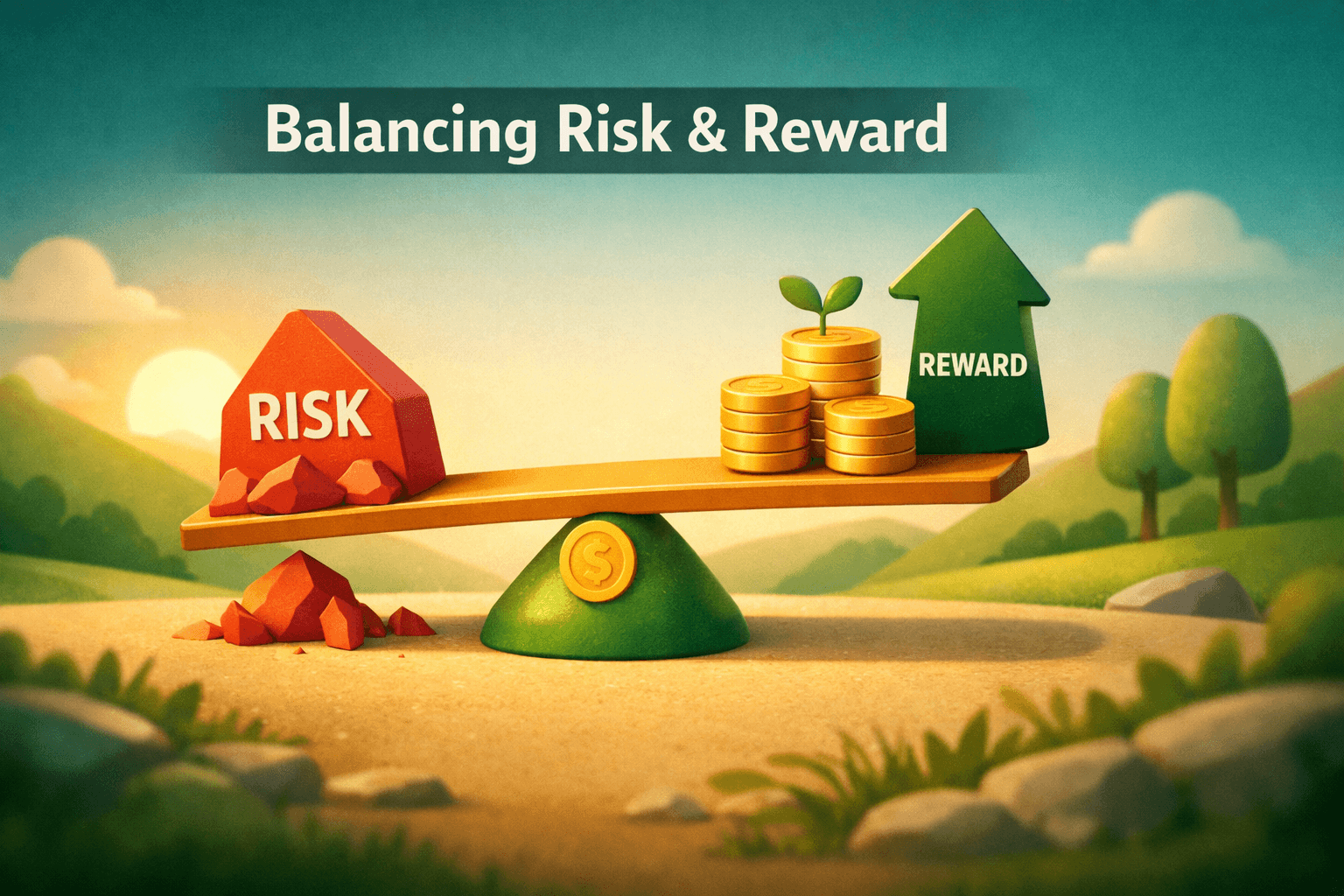
Risk in investing comes from uncertainty about future returns. Some risks are company-specific (idiosyncratic) and some affect entire markets (systematic). Diversification mainly reduces company-specific risk by holding many different investments.
If one company performs poorly because of bad management or a product failure, other holdings can offset that loss. Over time, a diversified portfolio tends to have lower volatility (ups and downs) than a portfolio concentrated in a few stocks.
Analogy: Don’t put all your eggs in one basket
Imagine carrying eggs in several baskets versus one. If a basket drops, only some eggs break. The same idea applies to investments: spreading your money reduces the damage from one loss.
How Diversification Lowers Risk: The Basics
Diversification works because assets do not move in perfect unison. The key measure is correlation: how closely two assets move together. Low or negative correlation between assets reduces overall portfolio volatility.
Three basic levers you can use to diversify are: number of holdings, sectors/geographies, and asset classes. Each lever reduces certain types of risk.
1) Number of holdings
Holding more individual stocks reduces company-specific risk. Academic studies show most diversification benefit occurs within the first 20-30 stocks in a portfolio; beyond that, each additional stock provides smaller improvements.
For beginners who don’t want to pick many stocks, broad ETFs allow diversification with a single trade.
2) Sector and geographic diversification
Sectors (like technology, healthcare, energy) often perform differently based on economic cycles. Geographic diversification spreads exposure across countries whose economies are not perfectly correlated.
For example, $AAPL and $MSFT are both U.S. technology companies and may move together, while $BP (a U.K. energy company) could perform differently when oil prices change.
3) Asset class diversification
Asset classes, stocks, bonds, cash, real estate, and commodities, each have different risk-return profiles. Bonds typically provide income and lower volatility, while stocks offer growth with higher volatility.
Including bonds or cash can reduce the portfolio’s overall swings and provide funds to buy stocks during market downturns.
Practical Ways to Diversify Your Portfolio
This section shows beginner-friendly steps you can take right away. Each approach can be combined to build a portfolio that fits your risk tolerance and goals.
- Use broad ETFs for instant diversification
Exchange-traded funds (ETFs) like $VTI (total U.S. stock market) or $VEA (developed international stocks) hold hundreds or thousands of securities. Buying these ETFs gives you exposure to diverse companies in one trade.
For bonds, consider $BND (Vanguard Total Bond Market ETF) or similar funds to add fixed-income exposure without selecting individual bonds.
- Mix asset classes
A simple starting allocation for many investors is a mix of stocks and bonds, for example, 70% stocks and 30% bonds. Stocks drive long-term growth; bonds reduce short-term volatility.
Adjust the split to match your time horizon and risk tolerance. Younger investors often favor higher stock allocations, while those nearing retirement often increase bonds.
- Spread within stocks
Within the stock portion, diversify by sector and geography. You could split stock allocation like 60% U.S. ($VTI), 25% international developed ($VEA), and 15% emerging markets ($VWO). This reduces the risk tied to a single economy.
Sector ETFs, like $XLK for technology or $XLE for energy, let you add or trim sector exposure without buying many individual stocks.
- Consider alternative diversifiers
Commodities and real assets, such as gold ($GLD) or real estate ETFs ($VNQ for U.S. REITs), can act differently than stocks and bonds during certain market events and help lower portfolio correlation.
Alternatives are not required, but a small allocation (e.g., 5-10%) may improve diversification for some investors.
- Use dollar-cost averaging and periodic rebalancing
Dollar-cost averaging, investing a fixed amount regularly, reduces the risk of investing a lump sum at a market peak. Rebalancing means adjusting allocations back to your target (e.g., 70/30) at set intervals to maintain your risk profile.
Rebalancing can be done annually or semiannually. It enforces a discipline of selling high and buying low without market timing.
Real-World Examples
Two simple examples show how diversification changes outcomes. These are hypothetical scenarios to illustrate mechanics.
Example 1: Single stock vs. diversified ETF
Scenario: You invest $10,000 in either a single stock, $TSLA, or a diversified U.S. ETF, $VTI.
If $TSLA drops 40% in a year, your $10,000 becomes $6,000. If $VTI drops 10% the same year, the $10,000 becomes $9,000. By investing in $VTI you reduce the chance that a single company’s large loss wipes out a major portion of your capital.
Example 2: 70/30 mix with rebalancing
Scenario: Start with $10,000 split 70% stocks ($VTI) and 30% bonds ($BND). Stocks rise 20% and bonds rise 2% over the year.
Value after one year: stocks = $7,000 × 1.20 = $8,400; bonds = $3,000 × 1.02 = $3,060; total = $11,460. Your allocation is now ~73% stocks and 27% bonds. Rebalancing back to 70/30 involves selling some stocks and buying bonds, locking in gains and restoring risk targets.
How Much Diversification Do You Need?
The right level depends on your goals, timeline, and comfort with volatility. More diversification lowers volatility but can also reduce peak gains.
Beginners often start with simple, diversified portfolios: a target-date fund, a 3-fund portfolio (U.S. stocks, international stocks, bonds), or a managed ETF that matches risk preferences.
Simple portfolio templates
- Conservative: 40% stocks ($VTI/$VEA), 60% bonds ($BND)
- Balanced: 60% stocks, 40% bonds
- Growth: 80% stocks, 20% bonds
These templates are starting points. Adjust allocations to your situation and revisit them as life changes.
Common Mistakes to Avoid
- Overdiversifying: Owning too many similar investments (e.g., lots of U.S. tech stocks) gives a false sense of safety. Focus on true diversification across sectors and asset classes.
- Underweighting bonds or cash: Some investors ignore bonds entirely and face bigger swings than they can tolerate. Match allocations to your risk tolerance.
- Neglecting international exposure: Many investors overweight their home country. A U.S.-only portfolio misses growth opportunities and increases country-specific risk.
- Failing to rebalance: Letting allocations drift can change your risk profile unintentionally. Rebalance regularly to maintain control.
- Chasing diversification gimmicks: Exotic products marketed as diversifiers can be complex and costly. Prefer low-cost broad ETFs and simple allocations.
FAQ
Q: How many stocks do I need for adequate diversification?
A: For many retail investors, 20, 30 carefully chosen stocks can substantially reduce company-specific risk. However, owning a single broad ETF like $VTI provides diversification across thousands of stocks with far less effort.
Q: Does diversification eliminate all risk?
A: No. Diversification reduces company-specific risk but cannot remove market risk (systematic risk) that affects most assets, such as economic recessions or geopolitical events.
Q: Should I diversify by sector or by country first?
A: Both matter. Start with asset classes (stocks vs. bonds), then ensure coverage across major sectors and geographies. Prioritize broad market exposure and then refine sector/country weights based on your goals.
Q: How often should I rebalance my portfolio?
A: Common approaches are annual or semiannual rebalancing, or rebalancing when allocations shift by a set threshold (e.g., 5 percentage points). Choose a method that balances discipline with transaction costs and tax considerations.
Bottom Line
Diversification is a practical, low-cost way to reduce the risk that a single investment will derail your financial goals. By spreading money across stocks, bonds, sectors, and countries, or by using broad ETFs, you lower volatility and increase the probability of smoother long-term returns.
Actionable next steps: define your investment horizon and risk tolerance, choose a simple diversified allocation (for example, a 3‑fund portfolio or target-date fund), and set a rebalancing schedule. Start small, invest consistently, and revisit your plan as your situation changes.