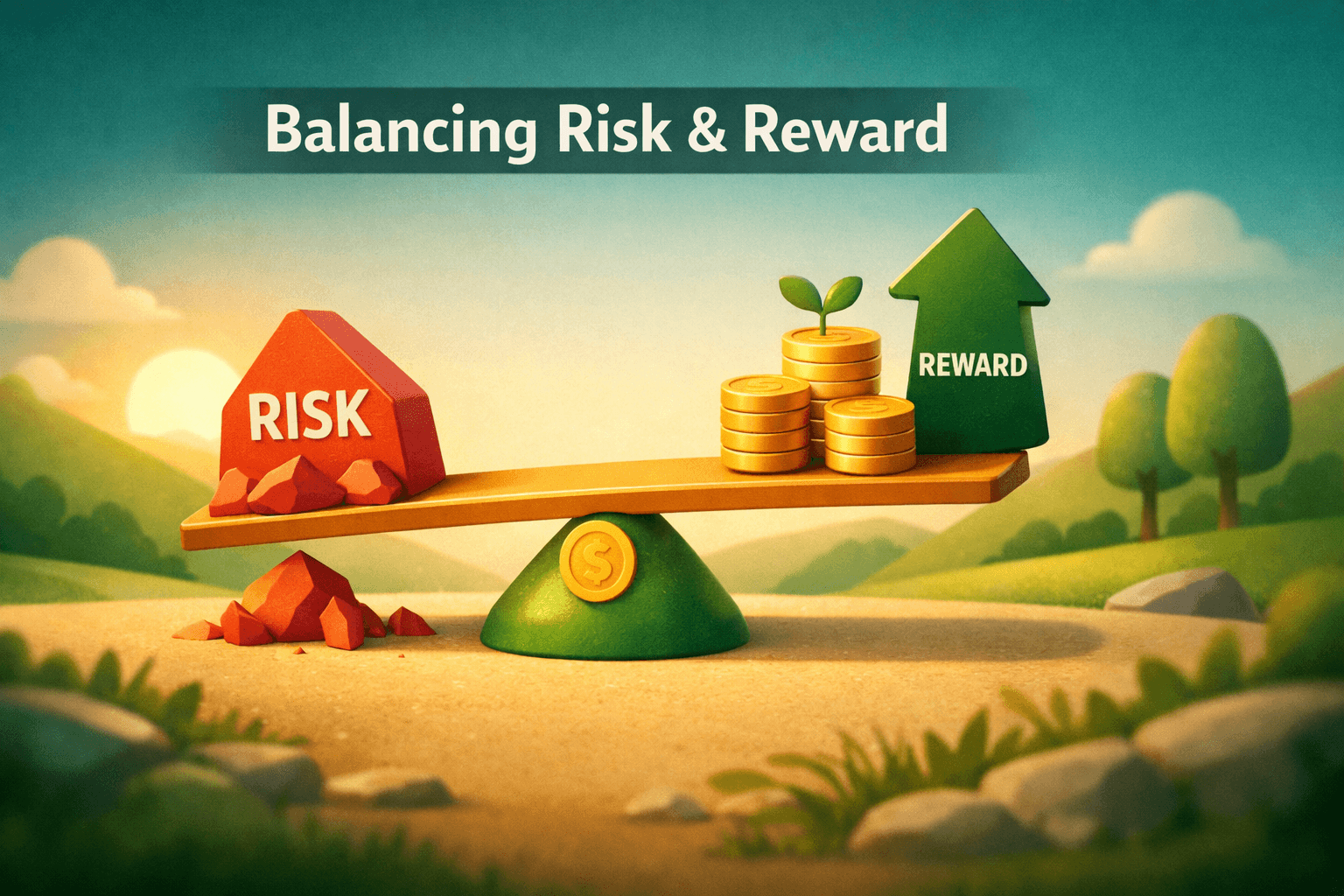
- Risk tolerance is your emotional and financial ability to handle market ups and downs; knowing it helps you pick suitable investments.
- Conservative, moderate, and aggressive profiles map to different asset mixes, e.g., more bonds for conservative, more stocks for aggressive.
- Assess risk tolerance with questionnaires, scenario testing, and by reviewing finances and time horizon.
- Practical portfolios use simple allocations (e.g., 60/40) and low-cost index funds like $VTI or $BND to reflect each risk level.
- Avoid common mistakes: chasing returns, ignoring time horizon, and changing allocation after short-term drops.
Introduction
Risk tolerance is the degree of variability in investment returns that an investor can stomach without selling or changing course. It combines emotions, how you react to losses, with practical factors like time horizon and financial needs.
Why this matters: matching your portfolio to your risk tolerance increases the chance you will stay invested through market swings and reach long-term goals. This article explains the conservative-to-aggressive spectrum, shows how to assess your own tolerance, and gives sample portfolios and real-world examples.
What you'll learn: clear definitions, simple assessment methods, example allocations for different risk levels, common mistakes to avoid, and actionable steps to align investments with your comfort level.
What Is Risk Tolerance?
Risk tolerance is both psychological and practical. Psychologically, it describes how you feel about fluctuations in account value. Practically, it reflects your capacity to absorb losses based on income, savings, and financial goals.
Two people with similar accounts may have different tolerances. One may panic at a 10% drop and sell; another may view it as a buying opportunity. Your tolerance influences whether you choose a conservative bond-heavy portfolio or a growth-oriented stock portfolio.
Risk Spectrum: Conservative to Aggressive
Think of risk tolerance as a spectrum with three broad categories: conservative, moderate, and aggressive. Each point on the spectrum suggests a rough asset allocation and typical behaviors during market moves.
Conservative
Conservative investors prioritize capital preservation and income over growth. Typical goals include emergency funds, near-term purchases, or retirees relying on portfolio income.
Common allocation: 60, 80% bonds or cash-like instruments, 20, 40% stocks. Example funds: $BND (aggregate bonds), short-term Treasury ETFs, and high-quality dividend-paying stocks.
Moderate
Moderate investors balance growth and preservation. They seek steady long-term growth but want to limit large drawdowns. This suits many long-term savers who will need money in 5, 15 years.
Common allocation: 40, 60% stocks, 40, 60% bonds. Example funds: $VTI (total stock market) plus $BND or intermediate-term bond funds.
Aggressive
Aggressive investors emphasize long-term growth and accept higher volatility today. Typical investors are younger or have long time horizons and can recover from downturns.
Common allocation: 70, 100% stocks, 0, 30% bonds. Example funds: $VTI or sector/large-cap funds like $QQQ or positions in individual growth stocks such as $NVDA and $AAPL (used sparingly).
How to Assess Your Risk Tolerance
Assessing risk tolerance takes both introspection and objective checks. Use simple tools plus scenarios to test how you might react during real market moves.
1. Questionnaires and Scorecards
Many financial platforms offer short questionnaires that assign a score or category. Questions cover time horizon, reaction to losses, and financial obligations. These give a consistent starting point but are not definitive.
2. Scenario Testing
Imagine specific drops: how would you react if your portfolio lost 20% in six months? If your answer is “sell everything,” you may be a conservative investor even if your age suggests otherwise. If you’d buy more, you might be more aggressive.
3. Financial Reality Check
Consider these objective factors: time horizon (years until you need the money), emergency savings (months of living expenses), income stability, and other obligations like debt or upcoming college tuition. Longer horizons and stable income typically support higher risk tolerance.
4. Stress Tests with Numbers
Run a simple calculation: if you invest $10,000 and experience a 30% drop, your balance falls to $7,000. Can you ignore that paper loss without liquidating? If not, lower risk may fit you better.
Building Portfolios for Different Risk Levels
Below are practical, example allocations and their characteristics. These are illustrative, not recommendations. Use low-cost index funds or ETFs to implement allocations for diversification.
Example 1, Conservative: 20% Stocks / 80% Bonds
Allocation: 20% $VTI (total U.S. stocks), 80% $BND (total U.S. bonds). Expected behavior: lower volatility, smaller long-term returns, better capital preservation in downturns.
Historical context: over the last 30 years, U.S. stocks averaged ~8, 10% annual returns, while bonds averaged ~3, 5% depending on the period. A heavy bond allocation reduces portfolio swings but also lowers expected growth.
Example 2, Moderate: 60% Stocks / 40% Bonds
Allocation: 60% $VTI, 40% $BND. Expected behavior: balanced growth with moderate volatility. This is a common target for many retirement accounts and aligns with a mix of growth and stability.
Hypothetical numbers: starting with $10,000 and assuming an average annual return of 6% over 10 years, the portfolio could grow to about $17,908. Variability is possible, down years and up years will change the path.
Example 3, Aggressive: 90% Stocks / 10% Bonds
Allocation: 90% $VTI, 10% $BND. Expected behavior: higher long-term growth potential, higher short-term volatility. Best for long horizons (10+ years) and the ability to tolerate steep temporary drops.
Hypothetical numbers: with an assumed average stock return near 8% and bond return 3%, a 90/10 mix might average ~7.5% annually. On $10,000 over 10 years, that could reach roughly $20,200, but year-to-year swings could be large.
Real-World Examples: Putting Numbers to Concepts
Example A: Sarah is 30, has a stable job, and a 30-year horizon to retirement. She has six months of expenses saved. She chooses a 80/20 or 90/10 allocation for higher growth. She plans to rebalance annually, resisting the urge to sell during downturns.
Example B: Mark is 62 and plans to retire in three years. He needs income and wants stability. He chooses a conservative mix like 30/70 or 20/80 and uses laddered bond funds and short-term Treasuries to reduce interest rate sensitivity.
Example C: Priya is 40 with moderate savings and plans to buy a house in five years. She selects a moderate allocation (50/50) for balance, moving more to bonds as the house purchase date approaches.
Adjusting Risk Over Time
Risk tolerance should evolve with life events. As goals approach, many investors shift allocations toward lower volatility to protect capital. This process is called de-risking or glide path management.
Target-date funds automate this process: they start aggressive when you’re young and gradually become conservative as the target date approaches. Examples include target-date retirement funds available in many 401(k) plans.
Common Mistakes to Avoid
- Chasing recent winners: Buying aggressive assets after big gains often leads to buying at high prices and poor risk-adjusted returns. Avoid timing the market; focus on long-term allocation.
- Ignoring time horizon: Keeping a high-risk allocation when you need the money soon can force selling at losses. Match allocation to when you will use funds.
- Reacting to short-term drops: Selling during market downturns crystallizes losses. Create a plan before volatility and stick to it unless fundamentals change.
- Overconcentration in single stocks: Holding too much of one company (e.g., heavy $AAPL or $MSFT exposure) increases company-specific risk. Diversify across many stocks or funds.
- Confusing risk tolerance with risk capacity: Wanting aggressive returns (tolerance) doesn’t mean you can afford heavy losses (capacity). Consider both.
FAQ
Q: How is risk tolerance different from risk capacity?
A: Risk tolerance is how comfortable you are with ups and downs; risk capacity is how much loss you can afford without derailing goals. Both should guide allocation decisions.
Q: Can my risk tolerance change over time?
A: Yes. Major life events, job changes, inheritance, approaching retirement, can shift tolerance. Regularly reassess and adjust allocations as needed.
Q: Should young investors always be aggressive?
A: Not always. Age matters but so do financial obligations and temperament. Young investors with stable income and long horizons often can be more aggressive, but personal comfort with volatility is key.
Q: How often should I rebalance my portfolio?
A: Common approaches are calendar-based (annually or semiannually) or threshold-based (rebalance when allocation deviates by X%). Rebalancing maintains your intended risk level.
Bottom Line
Understanding risk tolerance helps you choose a portfolio that fits both your emotional comfort and financial situation. Whether conservative, moderate, or aggressive, the right allocation reduces the chance you will abandon a plan during market stress.
Next steps: take a short risk questionnaire, run scenario tests (e.g., imagine a 20, 30% drop), and map your time horizon and emergency savings. Use simple, low-cost funds like $VTI and $BND to implement allocations and rebalance periodically.
Learning to balance risk and reward is ongoing. Reassess after major life changes and focus on a plan you can stick with through market cycles.