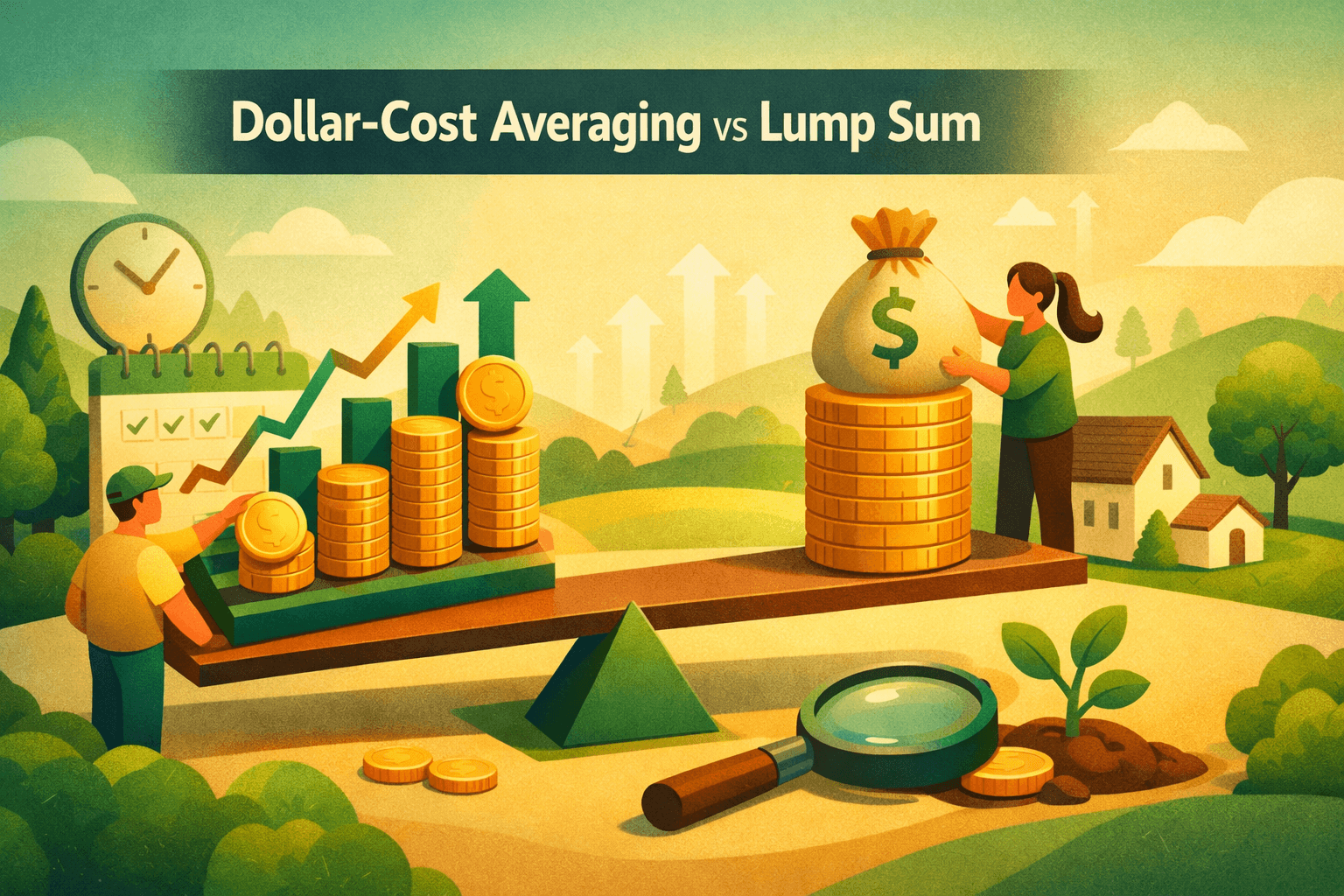
- Dollar-cost averaging (DCA) spreads purchases over time to reduce timing risk; lump sum invests immediately to maximize market exposure.
- Historically, lump-sum investing outperformed DCA in most long-term market studies because markets tend to rise over time.
- DCA can be preferable when investor risk tolerance, behavioral bias, or market uncertainty makes immediate full investment impractical.
- Use DCA for large cash inflows when you want emotional discipline; use lump sum when you have a long horizon and can tolerate short-term volatility.
- Combine approaches: consider partial lump sum plus DCA to balance potential upside with psychological comfort.
Introduction
Dollar-cost averaging (DCA) and lump-sum investing are two common ways to put cash to work in the markets: DCA staggers purchases over time while lump sum invests the full amount immediately.
This choice matters because it affects long-term returns, downside risk exposure, and investor behavior. Many investors focus on which method “beats” the other, but the optimal approach depends on market context, time horizon, risk tolerance, and behavioral factors.
In this article you will learn how each strategy works, what historical data shows, practical scenarios with numbers and tickers, implementation tips, common mistakes to avoid, and clear guidance for choosing between them.
How Dollar-Cost Averaging and Lump Sum Work
At its core, DCA is a plan to buy a fixed dollar amount of an asset at regular intervals (for example, $1,000 monthly) regardless of price. Over time, you buy more units when prices are low and fewer when prices are high, which averages your cost basis.
Lump-sum investing means deploying all available cash into the chosen investments immediately. That maximizes the time your capital is invested and benefits most from a rising market but also exposes you to full downside risk from the start.
Mechanics and examples
Example of DCA: You have $12,000. With DCA, you invest $1,000 each month for 12 months into $SPY. If prices fall early, you buy more shares at lower prices and reduce the average cost per share over the year.
Example of lump sum: You deploy $12,000 into $SPY on day one. If the market rises over the next 12 months, your entire $12,000 benefits from the gain; if the market drops right after, the whole amount declines.
Historical Performance: What Data Shows
Multiple studies across global equity markets show lump-sum investing historically outperforms DCA most of the time because equity markets have positive expected returns. For example, analyses using U.S. stock returns often find lump sum wins roughly 60, 75% of the time over multi-year horizons.
That advantage comes from being invested earlier, compound returns favor money that stays in the market. Over long horizons (10+ years), the probability that lump sum outperforms DCA increases materially.
Key statistics
A study by Vanguard comparing lump-sum vs DCA across 12 developed markets found lump sum outperformed DCA about two-thirds of the time for horizons of one year, and the gap widened for longer horizons. Another industry study indicated the expected excess return of lump sum is approximately the expected market return multiplied by the average time funds would have been invested under DCA.
While these numbers favor lump sum on average, the distribution matters: DCA reduces volatility of outcomes and lowers the chance of suffering a large immediate loss from an unfortunate market entry.
When Dollar-Cost Averaging Makes Sense
DCA is often the right choice when the investor faces substantial uncertainty about the market, has low tolerance for short-term losses, or requires emotional discipline to invest. It converts a psychologically difficult one-time decision into a predictable routine.
Situations that favor DCA include receiving a large windfall that you’re afraid to invest immediately, starting a retirement account with limited investing experience, or when valuation concerns are unusually high.
Practical example, windfall scenario
Suppose you inherit $100,000 and feel nervous about investing it all. A DCA plan that invests $8,333 each month over 12 months reduces anxiety and spreads timing risk. If $AAPL drops 20% in month two, you buy more shares when prices are lower, improving your average entry.
While you might miss some upside if the market rises steadily, DCA helps avoid the regret and behavioral mistakes that can follow after a sharp immediate loss.
When Lump Sum Makes Sense
Lump-sum investing typically makes sense when you have a long investment horizon, high confidence in basic asset allocation, and the emotional capacity to tolerate short-term losses. If the goal is to maximize expected returns and you do not require the safety valve of gradual investing, lump sum is mathematically advantageous.
Use lump sum when you can tolerate volatility and want to benefit from compounding right away, especially in a diversified equity allocation or dollar-cost averaged contributions like employer retirement plans where immediate investment is common.
Practical example, long horizon
Imagine you have $50,000 to invest and a 20-year horizon. Historical U.S. equity returns (real, after inflation) have averaged around 6, 7% annually over long periods. Deploying the $50,000 immediately into a diversified vehicle like $VTI or $SPY gives the full amount exposure to that compound growth.
If you instead DCA that $50,000 over a year, the portion not yet invested misses some of the market’s gains, lowering expected terminal value on average.
Implementing Either Strategy
Implementation details determine how well either strategy works in practice. For DCA, decide your cadence (weekly, monthly), the duration, and whether to rebalance contributions by asset class rather than single tickers to maintain allocation targets.
For lump sum, implement through low-cost, diversified funds to avoid security selection risk. Consider dollar-cost averaging within an allocation: invest the equity portion immediately and drip the fixed-income portion, or split the cash, this hybrid reduces regret while capturing some upside.
Practical rules and order types
Common practical rules include: limit DCA duration to 6, 12 months for market entry; use automatic recurring purchases to remove emotion; and keep transaction costs minimal (use ETFs or low-fee mutual funds). For lump sum, ensure emergency savings remain intact before deploying large amounts.
Example hybrid: With $60,000, invest $40,000 lump sum into $VTI and DCA $20,000 into emerging-market equities like $EEM over 6 months. This balances immediate market exposure with phased risk-taking for higher-volatility components.
Real-World Example: 12-Month Simulation
Scenario: $12,000 to invest in $SPY on January 1. Lump-sum buys $SPY at $300 (40 shares). DCA invests $1,000 monthly across 12 months as prices vary between $280 and $320.
Outcome A (market rises steadily to $330): Lump-sum final value = 40 * $330 = $13,200 (10% gain). DCA final value might be ~ $12,900 (7.5% gain) because some funds entered later. Outcome B (market drops sharply to $250 mid-year then recovers to $300): DCA buys more when price is low and could outperform lump sum in this specific path.
The takeaway: path dependency matters. Lump sum benefits when markets rise; DCA helps when early declines occur after investment.
Common Mistakes to Avoid
- Failing to define a plan: Randomly timing buys isn’t DCA. Use consistent amounts and schedule to avoid emotional decisions.
- Ignoring fees and taxes: Frequent small purchases can increase transaction costs, use low-cost ETFs or automated no-fee plans.
- Overusing DCA to avoid decisions: Stretching DCA for years can leave large cash drag; set a clear maximum duration (e.g., 6, 12 months).
- Neglecting diversification: Putting a lump sum into a single stock like $TSLA or $AAPL without diversification increases idiosyncratic risk.
- Confusing volatility with risk tolerance: Short-term drops are normal; ensure your strategy aligns with your capacity to stay invested.
FAQ
Q: Is dollar-cost averaging better in a bear market?
A: DCA reduces the chance of being fully invested before a steep decline, so it can feel safer in a bear market. However, if you have a long horizon and can tolerate interim declines, lump sum may still offer higher expected returns once the market recovers.
Q: How long should I DCA a one-time large deposit?
A: Most practitioners use 3, 12 months for DCA of a lump deposit. Shorter windows reduce cash drag; longer windows increase the chance of missing market gains. Choose a duration that balances emotional comfort and expected opportunity cost.
Q: Does DCA reduce long-term risk?
A: DCA lowers timing risk, the risk of investing at a market peak, by spreading entry points. It does not reduce market risk (systematic risk) and may lower expected long-term returns compared with lump sum when markets trend upward.
Q: Can I combine both strategies?
A: Yes. A common hybrid is to invest a portion as lump sum to capture immediate market exposure and DCA the rest to manage behavioral risk. This can be tailored to your allocation, horizon, and comfort level.
Bottom Line
There is no universal winner: lump-sum investing generally delivers higher expected returns because money is exposed to the market sooner, while DCA offers behavioral and downside-timing protection by spreading purchases.
Choose lump sum when you have a long horizon, can tolerate volatility, and want to maximize compound growth. Choose DCA when you need emotional discipline, face significant short-term uncertainty, or want to reduce the chance of immediate large losses.
Finally, apply pragmatic rules: use diversified, low-cost vehicles, limit DCA duration, consider hybrid approaches, and align the choice with your risk tolerance and financial goals.