
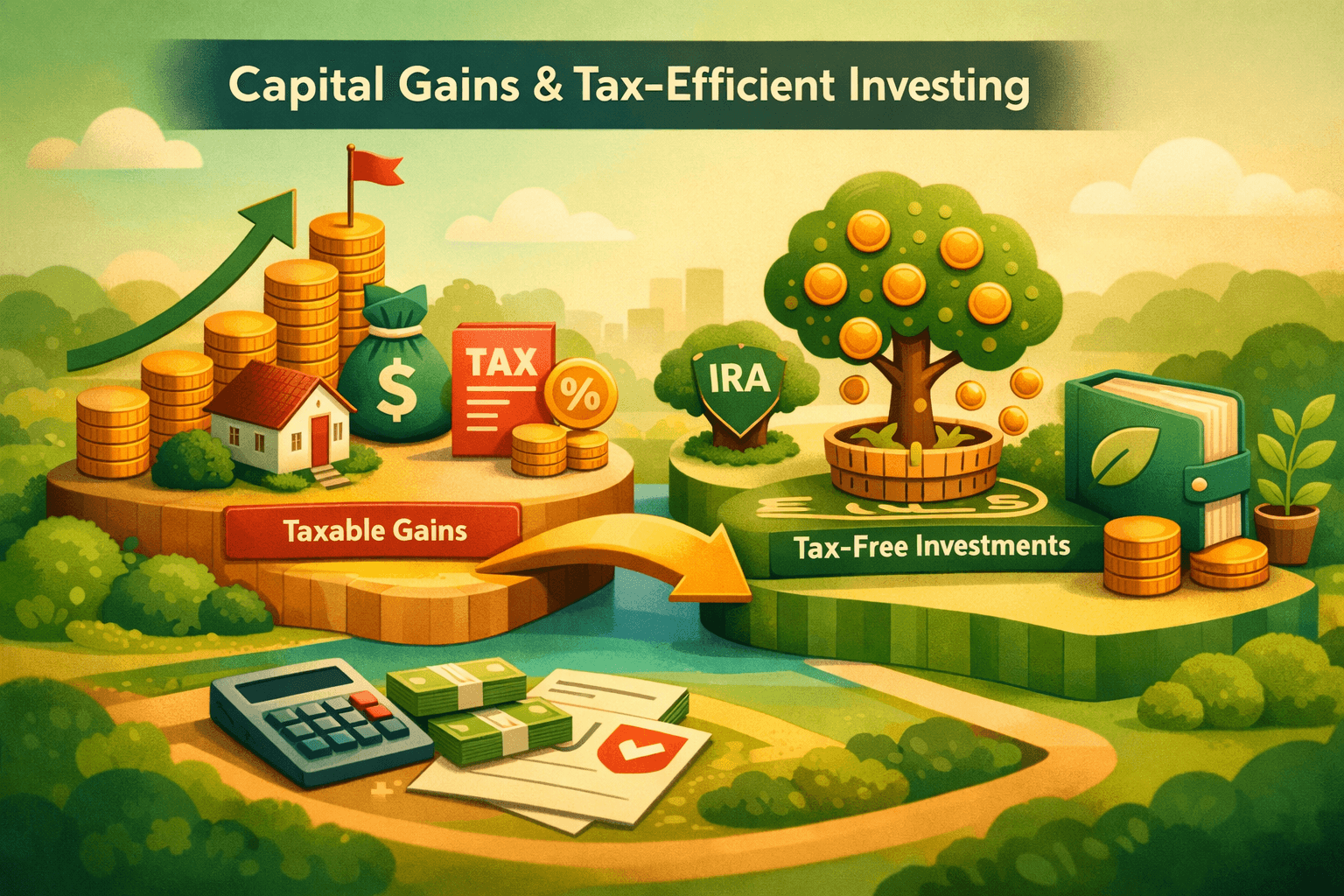
- Short-term capital gains are taxed as ordinary income; long-term gains get lower rates (0/15/20%).
- Qualified dividends are taxed like long-term gains if holding and company rules are met; nonqualified dividends are ordinary income.
- Tax-loss harvesting and specific-share identification can reduce current tax bills and create carryforwards.
- Use tax-advantaged accounts (Traditional/Roth IRAs, 401(k)s, HSAs) and asset location to minimize taxes over time.
- Watch wash-sale rules, holding periods, and net investment income tax (NIIT) for high earners.
Introduction
Taxes materially affect after-tax investment returns and compound performance over time. Understanding how capital gains, dividends, and other investment income are taxed helps you make smarter choices about what to buy, where to hold it, and when to sell.
This article explains the core tax rules investors face: short-term vs long-term capital gains, dividend taxation, and the net investment income tax. It then covers practical, tax-efficient strategies such as tax-loss harvesting, asset location, tax-advantaged accounts, and specific-share identification.
Expect clear definitions, numeric examples using real tickers, and step-by-step tactics you can apply to reduce your tax drag while staying within the rules.
How Investment Income Is Taxed: The Basics
Investment income generally falls into three buckets: capital gains (from selling assets), dividends (company distributions), and interest. Each is taxed differently depending on holding period, type of account, and your income level.
Short-term vs Long-term Capital Gains
Short-term capital gains occur when you sell assets held one year or less. They’re taxed at your ordinary income tax rates, which can be as high as 37% (federal) depending on your bracket.
Long-term capital gains apply to assets held more than one year. Federal long-term rates are typically 0%, 15%, or 20% depending on taxable income. High earners may also face a 3.8% Net Investment Income Tax (NIIT) on top of those rates.
Dividends: Qualified vs Nonqualified
Qualified dividends meet specific IRS rules and are taxed at the same favorable long-term capital gains rates. Nonqualified (ordinary) dividends are taxed at ordinary income rates.
To be qualified for common stock, you must generally hold the shares more than 60 days during a 121-day period that starts 60 days before the ex-dividend date. Some dividends, like those from REITs or certain foreign payers, are often nonqualified.
Other Rules and Concepts
Basis: Your cost basis (what you paid adjusted for splits and returns of capital) determines taxable gain or loss when you sell. Accurate records are essential for calculating taxes owed.
Step-up in basis: At death, many assets receive a step-up in basis to fair market value, reducing capital gains taxes for heirs. This is an estate-planning consideration, not an investing strategy to rely on.
Tax-Efficient Investing Strategies
Tax efficiency isn’t just about minimizing taxes this year; it’s about maximizing after-tax wealth over your investment horizon. Apply multiple tactics in combination for best results.
1) Asset Location: Place Assets in the Right Accounts
Asset location means putting tax-inefficient investments in tax-advantaged accounts and tax-efficient ones in taxable accounts.
- Put bonds, taxable REITs, and actively managed high-turnover funds into IRAs or 401(k)s where interest and ordinary dividends aren’t taxed annually.
- Hold tax-efficient index ETFs like $VTI or $VOO in taxable accounts; ETFs often generate fewer taxable distributions than mutual funds.
- Place municipal bonds in taxable accounts only if their tax-free interest provides advantage at your bracket.
2) Tax-Advantaged Accounts: Know the Tradeoffs
Traditional IRAs/401(k)s defer taxes: contributions are often pre-tax, investments grow tax-deferred, and withdrawals are ordinary income. Roth IRAs/401(k)s are funded with after-tax dollars and provide tax-free qualified withdrawals.
Health Savings Accounts (HSAs) are unusually tax-efficient: contributions are pre-tax (or tax-deductible), investments grow tax-free, and qualified medical withdrawals are tax-free, effectively triple tax-advantaged.
3) Tax-Loss Harvesting
Tax-loss harvesting means selling investments at a loss to offset realized gains and reduce taxable income. Losses first offset gains of the same type (short-term vs long-term) and then up to $3,000 of ordinary income per year, with the remainder carrying forward indefinitely.
Example: You sold $AAPL shares with a $5,000 short-term gain and sold $TSLA shares at a $7,000 loss. The $7,000 loss first nets the $5,000 gain, leaving a $2,000 net loss that can offset ordinary income up to $3,000 this year.
4) Specific Share Identification
When you sell part of a holding, the default tax lot methods (FIFO) may not be optimal. Specific-share identification lets you choose which shares to sell, typically the highest-cost basis lots, to minimize gains or maximize harvested losses.
Example: You own 100 shares of $AAPL bought in three lots (50 @ $120, 30 @ $150, 20 @ $200). If you need to raise cash and want to minimize gains, you might sell the 50 shares bought at $120 only if you’re harvesting losses elsewhere; otherwise you might choose higher-basis lots to reduce taxable gains.
5) Use Tax-Efficient Vehicles and Funds
ETFs, index funds, and tax-managed mutual funds tend to be more tax-efficient than actively traded funds. Many ETFs use in-kind redemptions to avoid triggering capital gains distributions.
Municipal bond funds often pay tax-exempt interest at the federal level (and sometimes state), but they can produce taxable capital gains when managers sell holdings, consider individual muni bonds for predictable tax-free income.
Real-World Examples: Numbers That Illustrate the Impact
Example 1, Holding Period Impact: Suppose you bought $AAPL at $120 and sold at $180 for a $60 gain on 100 shares = $6,000 gain.
- If sold within a year and your ordinary marginal tax rate is 32%, federal tax would be about $1,920 on that gain.
- If held >1 year and taxed at 15% long-term rate, federal tax would be $900, saving $1,020 versus short-term treatment.
Example 2, Tax-Loss Harvesting with Carryforward: You realize $10,000 long-term gain from selling $VTI. You also realize $15,000 long-term loss selling an underperforming stock. The $15,000 loss nets the $10,000 gain, leaving $5,000 loss to offset other income up to $3,000 this year and carry forward $2,000 to future years.
Example 3, Asset Location: A taxable account holding a high-yield corporate bond fund generating 4% interest vs a tax-deferred account. At a 24% marginal rate, the after-tax yield in the taxable account is 3.04% (4% * (1-0.24)), while inside a retirement account you'd keep the full 4% until withdrawal. Over many years that difference compounds.
Rules to Watch: Wash Sale, NIIT, and Holding Periods
Wash-sale rule: If you sell a security at a loss and buy a substantially identical security within 30 days before or after the sale, the loss is disallowed and added to the basis of the new shares. This prevents immediate repurchasing to harvest losses.
Net Investment Income Tax (NIIT): High-income taxpayers may face an additional 3.8% tax on the lesser of net investment income or the excess of modified adjusted gross income over a threshold ($200,000 for single, $250,000 married filing jointly). Include this when planning large realized gains.
Holding periods also matter for dividends to be qualified; ensure you meet the day-count rules for stocks that pay qualified dividends.
Common Mistakes to Avoid
- Ignoring wash-sale rules: Selling and quickly rebuying substantially identical securities can disallow losses. To avoid this, wait 31 days or buy a different but similar ETF/fund.
- Mixing tax efficiency and convenience: Holding tax-inefficient assets in taxable accounts because it’s convenient wastes after-tax returns. Rebalance with asset location in mind.
- Over-trading to time taxes: Frequent trading often raises short-term gains and taxable income. Favor long-term horizons unless you have a taxable strategy and rationale.
- Failing to track cost basis: Inaccurate basis records can lead to overpaying taxes. Use broker reports and consolidate statements for accuracy.
- Neglecting state taxes and NIIT: Federal rules are only part of the story. State capital gains taxes and the 3.8% NIIT can materially change outcomes for high earners.
FAQ
Q: What is the easiest way to lower my investment tax bill?
A: The simplest steps are: hold investments for more than one year to access long-term capital gains rates, use tax-advantaged accounts for tax-inefficient assets, and choose tax-efficient funds (index ETFs) in taxable accounts.
Q: Can tax-loss harvesting be automated?
A: Yes, many robo-advisors and brokerage platforms offer automated tax-loss harvesting. Be aware of wash-sale rules and the specific tax lots they select; automated services can be convenient but review their implementation and costs.
Q: How does selling part of a position affect my taxes?
A: Selling part of a position triggers a realized gain or loss based on the cost basis of the shares sold. Use specific-share identification to choose which lots to sell and potentially reduce taxable gains or increase harvestable losses.
Q: Do tax-advantaged accounts eliminate capital gains taxes entirely?
A: Tax-advantaged accounts defer or eliminate taxes depending on the account. Traditional IRAs/401(k)s defer taxes until withdrawal (taxed as ordinary income), while Roth accounts offer tax-free qualified withdrawals. They change the timing and nature of taxes, not necessarily eliminate them forever.
Bottom Line
Taxes can significantly erode investment returns if ignored, but thoughtful choices about holding periods, account type, and the tax characteristics of assets can preserve much of your gains. Combine basic rules, prefer long-term holdings, use tax-advantaged accounts for tax-inefficient assets, and harvest losses, to improve after-tax performance.
Start by organizing cost-basis records, reviewing your asset location, and identifying recurring taxable events. Small structural changes, moving bond funds into retirement accounts or switching to tax-efficient ETFs in taxable accounts, can compound into meaningful tax savings over years.
Continue learning about specific rules (wash-sale, NIIT, qualified dividends) and consult a tax professional for personalized planning, especially if you have concentrated positions or large impending realized gains.