Introduction
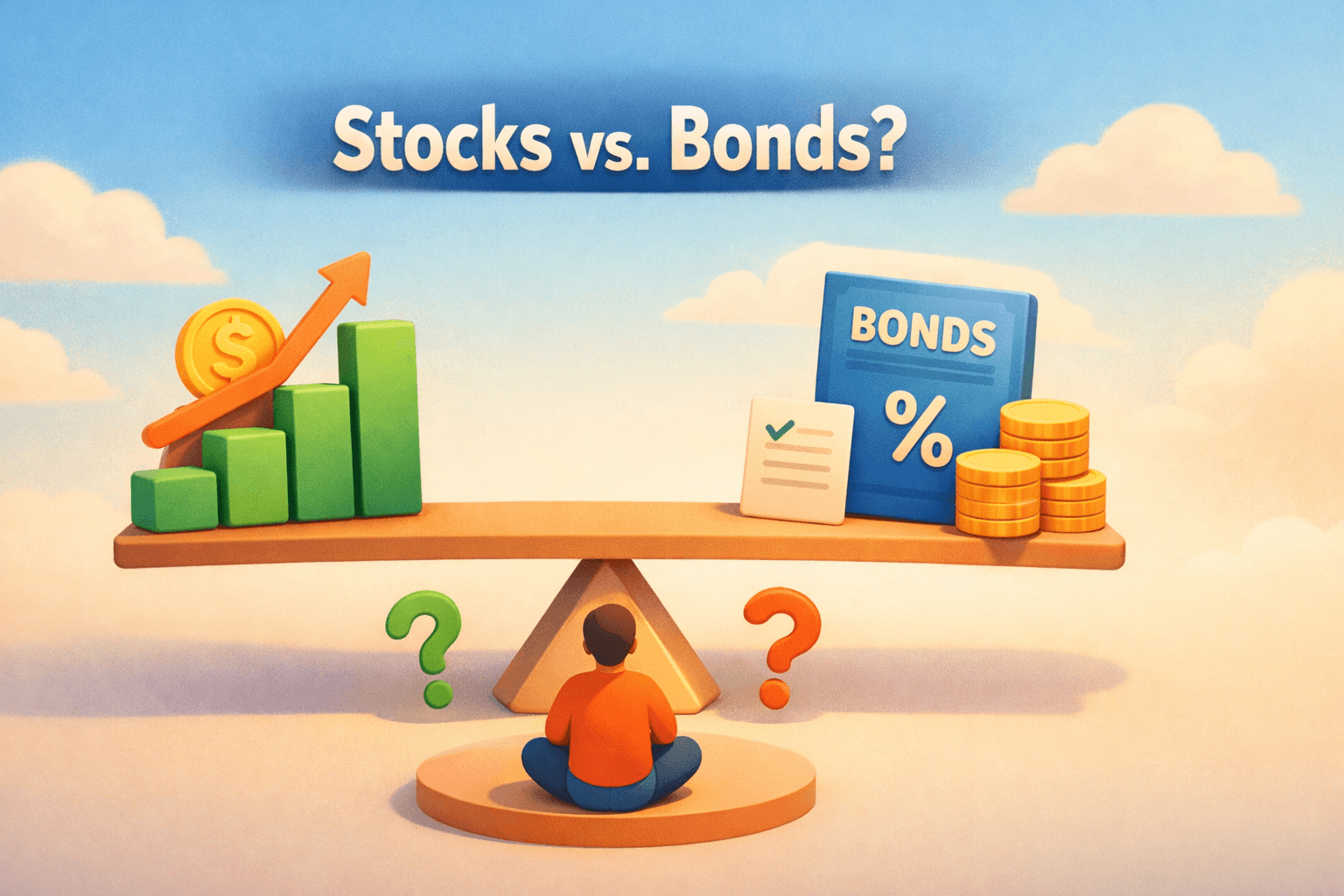
Stocks vs bonds refers to two fundamental types of investments: stocks (equities), which represent ownership in a company, and bonds (fixed income), which are loans you make to a company or government. Understanding these two asset classes is one of the first and most important steps for new investors.
This matters because the balance between stocks and bonds in your portfolio shapes your potential returns, how much risk you face, and how your investments behave during market ups and downs. Different people should hold different mixes depending on goals, time horizon, and risk tolerance.
In this article you will learn what stocks and bonds are, how they generate returns, how they differ in risk and reward, simple allocation approaches, concrete examples with numbers, common mistakes to avoid, and practical next steps you can take today.
Key Takeaways
- Stocks give ownership and higher long-term growth potential but come with higher short-term volatility.
- Bonds are loans that pay interest and generally offer lower returns with more stability and income.
- Your time horizon and risk tolerance should drive the mix of stocks and bonds in your portfolio.
- Diversification, holding many stocks and bonds or funds, reduces single-asset risk.
- Rebalancing and a plan are more important than trying to time markets.
How Stocks Work
When you buy a stock you buy a share of ownership in a company. If you own one share of $AAPL, you own a tiny piece of Apple. Owners (shareholders) benefit when the company grows its profits and the market values those future profits higher.
Stocks produce returns in two ways: price appreciation (the share price goes up) and dividends (periodic cash payments some companies distribute). For example, $AAPL and $GOOGL have delivered growth and sometimes dividends, while other companies may focus solely on growth.
Risk and reward for stocks
Stocks often offer higher expected returns than bonds because shareholders take more risk: company profits can fall, industries can change, and markets can crash. Historically, broad U.S. stocks (e.g., the S&P 500) have averaged around 9, 11% nominal annual returns over long periods, though year-to-year returns vary widely.
Because of this variability, stocks are best for investors with longer time horizons who can tolerate short-term drops in exchange for higher potential long-term gains.
How Bonds Work
Bonds are loans you make to an issuer (a government, city, or corporation). In exchange, the issuer promises to pay periodic interest (coupon) and return your principal at maturity. An example is a U.S. Treasury bond or a corporate bond issued by a company.
Bonds are often described by credit quality and maturity. Higher-quality bonds (like U.S. Treasuries) have lower default risk, while corporate bonds pay higher yields to compensate for greater credit risk. Bond funds such as $BND (a total bond market ETF) let investors hold many bonds at once.
Types of risk for bonds
Two key bond risks are credit risk (the borrower may default) and interest-rate risk (bond prices fall when market interest rates rise). Long-term bonds like $TLT (20+ year Treasury ETF) are more sensitive to interest-rate moves than short-term bonds.
Bonds typically provide steady income and lower volatility than stocks, making them useful for capital preservation and income generation, especially for investors closer to spending their savings.
Comparing Risk and Return
Risk and return form a tradeoff: generally, higher expected returns come with higher risk. Stocks usually sit on the higher-return/higher-risk end, while bonds sit on the lower-return/lower-risk end.
Key differences to consider: volatility, income consistency, inflation protection, and how each behaves during market stress. Stocks often outperform inflation over long periods, while bonds may protect principal in the short term but can lose purchasing power if yields are very low and inflation is high.
Historical perspective
Over many decades, broad U.S. stocks have delivered roughly 9, 11% nominal annual returns, while long-term government and investment-grade corporate bonds have averaged lower, often in the 4, 6% range depending on the period. Past performance is not a guarantee of future results, but history shows the general pattern of higher stock returns with greater volatility.
During sharp equity market drops, bonds, especially government bonds, can act as a stabilizer because they may hold value or even rise, depending on interest-rate moves.
Building a Portfolio: Stocks, Bonds, and Allocation
Your mix of stocks and bonds (your allocation) should reflect your goals, time horizon, and comfort with market swings. A common rule of thumb is to subtract your age from 100 to get the percentage in stocks (so a 30-year-old might have 70% stocks, 30% bonds), though many modern advisors use higher stock weights given longer life expectancies.
Practical steps to choose an allocation:
- Define your goal and time horizon (e.g., retirement in 30 years vs. buying a house in 3 years).
- Assess risk tolerance: Can you sleep during a 30% market drop?
- Pick broad, low-cost funds for stocks and bonds (e.g., total market ETFs or target-date funds).
- Rebalance annually to maintain your target mix.
Example allocation types
Conservative: 30% stocks / 70% bonds, less volatility, lower long-term growth.
Balanced: 60% stocks / 40% bonds, moderate growth and risk.
Aggressive: 80, 100% stocks, higher long-term growth potential, higher short-term volatility.
Real-World Examples
Below are simple scenarios showing how allocation and assumed returns can affect results. These are illustrative only and assume constant annual returns for clarity.
Example 1, Young investor (30-year horizon)
Assume $10,000 initial investment and no additional contributions. Use assumed annual returns: stocks = 8% and bonds = 3%.
Portfolio: 80% stocks / 20% bonds.
- Stocks portion: $8,000 growing at 8% for 30 years → FV = 8,000 × (1.08^30) ≈ $80,500.
- Bonds portion: $2,000 growing at 3% for 30 years → FV = 2,000 × (1.03^30) ≈ $4,850.
- Total FV ≈ $85,350.
Compare that to a conservative 30% stocks / 70% bonds allocation under the same returns: the final amount would be much lower because more money was placed into the lower-return bond portion.
Example 2, Near-retirement investor (5-year horizon)
Assume $100,000 and an allocation of 40% stocks / 60% bonds, with the same return assumptions (stocks 8%, bonds 3%).
- Stocks portion: $40,000 × (1.08^5) ≈ $40,000 × 1.47 ≈ $58,800.
- Bonds portion: $60,000 × (1.03^5) ≈ $60,000 × 1.159 ≈ $69,540.
- Total FV ≈ $128,340.
With a short time horizon, a higher bond allocation reduces the risk of having to sell stocks after a market drop.
Common Mistakes to Avoid
- Chasing past winners: Buying a hot stock like $TSLA after a huge run without considering valuation and risk can lead to losses. Focus on long-term strategy, not recent performance.
- Ignoring time horizon: Putting money needed in the next 1, 3 years into mostly stocks exposes it to short-term market risk. Use bonds or cash for short-term goals.
- Overlooking inflation: Holding only low-yield bonds can shrink purchasing power over time. Keep some growth assets (stocks) to outpace inflation for long-term goals.
- Failing to diversify: Owning a few individual stocks increases company-specific risk. Use broad funds or many holdings to spread risk.
- Not rebalancing: Letting allocation drift after market moves can unintentionally increase risk. Rebalance periodically to your target mix.
FAQ
Q: Which is safer, stocks or bonds?
A: Bonds are generally considered safer in the short term because they provide fixed interest and return of principal at maturity, especially high-quality government bonds. Stocks are riskier short-term but typically offer higher long-term returns.
Q: How do taxes differ between stocks and bonds?
A: Taxes vary by account and investment. Dividends and capital gains from stocks can be taxed differently than interest from bonds. Interest from many bonds is taxed as ordinary income, while qualified dividends and long-term capital gains may receive lower rates. Consider tax-advantaged accounts for taxable bonds or taxable investments.
Q: Can I get both growth and income from a single fund?
A: Yes. Target-date funds and balanced funds hold both stocks and bonds to provide a blended approach. Bond ETFs like $BND provide income, while some equity-income funds focus on dividends for growth and income.
Q: How often should I rebalance my stock-bond mix?
A: Rebalancing once or twice a year is common and effective. You can also rebalance when your allocation drifts by a set threshold (e.g., 5 percentage points). The goal is to maintain your planned risk level without excessive trading.
Bottom Line
Stocks and bonds serve different roles: stocks power long-term growth through ownership and higher expected returns, while bonds provide income and reduce volatility through fixed payments and lower short-term risk. Your personal mix should reflect how soon you'll need the money and how much volatility you can tolerate.
Start by defining your goals and time horizon, pick a simple, diversified allocation, use low-cost funds where possible, and rebalance periodically. Small, consistent choices matter more than perfect timing.
Next steps: decide your target allocation, set up diversified funds (e.g., broad U.S. stock and bond funds), and revisit your plan annually or after major life changes. Learning how stocks and bonds work will make these decisions clearer and help you stay on track.