
Introduction
Market cycles are recurring phases of expansion and contraction in prices and economic activity that shape returns for investors. Understanding these cycles helps you set expectations, manage risk, and build portfolios that can endure different environments.
This article explains the key phases, bull markets, bear markets, corrections and recessions, how to identify where the market likely is in a cycle, and practical, intermediate-level tools investors can use to respond. You’ll see real-world examples, common mistakes to avoid, and clear next steps you can apply to your own portfolio.
- Market cycles are defined by price action, breadth, economic indicators and investor sentiment, not just calendar time.
- Bull and bear markets are long-term trends; corrections are shorter, sharper pullbacks inside a bull market.
- Leading indicators (yield curve, credit spreads, sentiment) and lagging indicators (GDP, unemployment) help locate a cycle phase.
- Positioning should focus on risk management, diversification, rebalancing and tactical tilts, not market timing by prediction.
- Use concrete signals (breadth divergence, rising defaults, flattening/inverted yield curves) to increase vigilance, not to time exact tops or bottoms.
Market Cycle Basics
At a high level, market cycles describe the movement from expansion to contraction and back again. Investors commonly label the optimistic expansion phase a "bull market" and the pessimistic contraction a "bear market." Between those are shorter moves called corrections and recoveries.
Cycles operate on multiple timeframes. Economic cycles (recessions and recoveries) typically last several years. Equity market cycles may be shorter or longer because markets price expectations about the economy in advance. The key is that price trends, economic fundamentals and sentiment interact to create recognizable phases.
Defining the phases
Bull market: A sustained rise in asset prices, often accompanied by improving earnings, expanding multiples and optimistic sentiment. Bear market: A prolonged decline in prices, poor earnings outlooks, falling liquidity and risk-off sentiment. Correction: A decline of roughly 10% to 20% from recent highs; often a healthy reset inside a bull market. Recession: A sustained fall in real economic activity, typically measured by GDP decline, higher unemployment and corporate stress.
How to Identify Where You Are in a Cycle
No single indicator tells the whole story. The most reliable approach combines market internals (price, volume, breadth), macro indicators (growth, inflation, employment) and market-based signals (yields, credit spreads, volatility).
Use leading indicators to anticipate turning points and lagging indicators to confirm them. Leading signals are especially valuable for risk management because they tend to change before prices fully reflect a shift in the cycle.
Key signals to watch
- Market breadth: Look at how many stocks participate in a rally. Divergence, where a narrow group of large-cap stocks drives gains while most stocks lag, often precedes corrections or trend reversals. For example, rallies led by a handful of mega-cap names can mask weakening breadth.
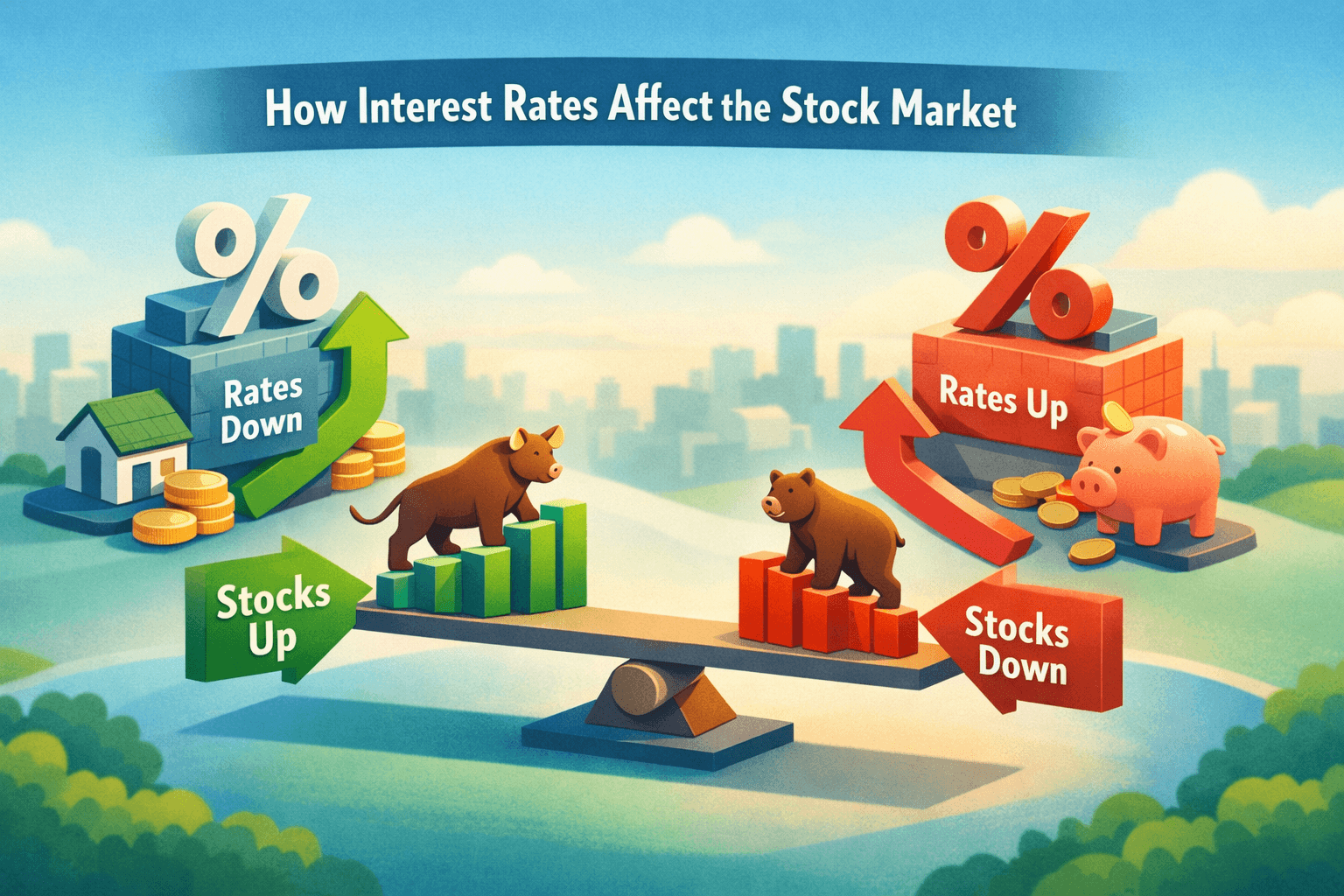
- Yield curve and interest rates: A flattening or inverted yield curve (short rates above long rates) is a classic leading indicator of recession risk. Changes in policy rates also affect valuation multiples and sector performance.
- Credit spreads and default signals: Widening spreads between corporate bonds and Treasuries signal rising credit stress. Rising non-performing loans and weaker covenant performance are early warning signs of systemic stress.
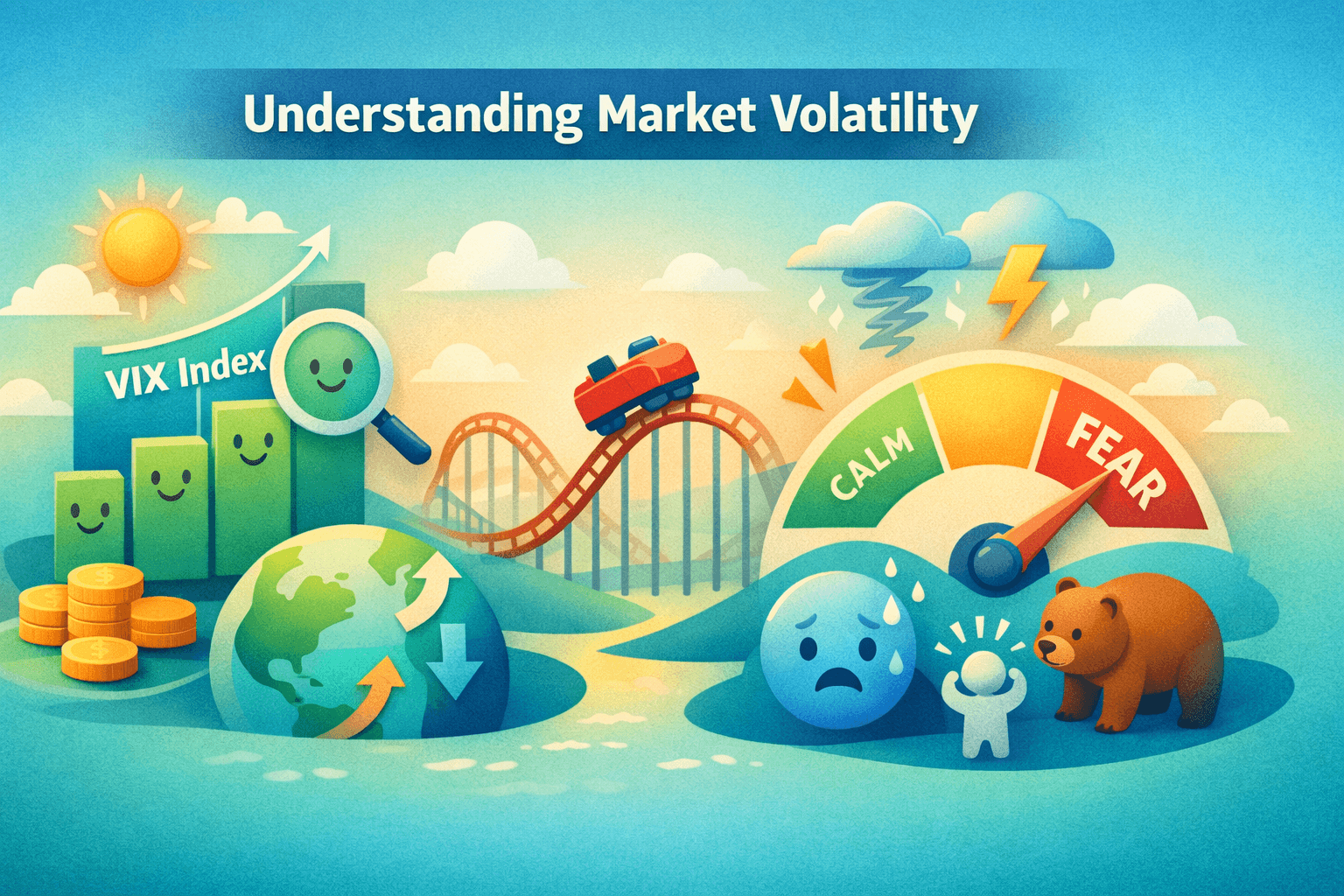
- Volatility and VIX: A sustained rise in implied volatility and realized volatility often precedes or accompanies market drawn-out declines. Spikes in VIX tend to mark short-term panic; a rising baseline suggests a regime shift.
- Economic data flow: Employment, manufacturing, consumer spending and PMI data help confirm whether a slowdown is transient or broad-based. Weakening labor market trends typically lag initial equity declines but confirm recessions.
Practical Positioning by Cycle Phase
Positioning is about aligning portfolio structure with the prevailing risk-return environment while maintaining diversification and liquidity. The goal is resilience: to survive severe drawdowns and participate in recoveries.
Below are intermediate-level actions investors can consider for each phase. These are examples of risk management, not prescriptive buy/sell orders.
During a bull market (expansion)
- Maintain exposure to growth assets but monitor concentration risk, mega-cap leadership can inflate index returns while many stocks lag.
- Use systematic rebalancing to capture gains and enforce discipline; consider trimming positions that run far above target allocation.
- Evaluate earnings and valuation trends; rotating toward higher-quality companies (strong cash flows, low leverage) can reduce downside when momentum fades.
During a correction or early weakness
- Assess whether the pullback is breadth-limited or broad-based. Breadth-led declines deserve closer attention.
- Avoid panic selling; consider dollar-cost averaging or selective rebalancing into weakness if your long-term thesis is intact.
- Maintain cash or liquid reserves to take advantage of opportunities if weakness deepens.
During a bear market or recessionary risk
- Prioritize capital preservation: shift toward higher-quality bonds, shorter-duration fixed income, and companies with strong balance sheets and resilient cash flows.
- Use hedges where appropriate, options strategies or inverse exposures can protect downside but carry costs and complexity.
- Reassess assumptions: update earnings sensitivity to slower growth and higher defaults; stress-test positions for deeper shocks.
Real-World Examples: How Cycles Played Out
Historical episodes illustrate how indicators and positioning interact. Use these examples to recognize patterns, not as templates for exact repetition.
Dot-com bubble (1999, 2002)
A narrow rally in technology stocks drove valuations to extreme levels while many traditional sectors lagged. When earnings failed to meet expectations, the market experienced a deep bear market that disproportionately hit speculative, high-multiple companies. Investors who ignored valuation and quality paid the heaviest price.
Global Financial Crisis (2007, 2009)
Leading signs included widening credit spreads and rising mortgage defaults, then sharp liquidity contractions. The S&P 500 fell dramatically as earnings collapsed. Those with diversified fixed income exposure, and cash reserves, had sources of stability and could allocate into depressed assets over time.
COVID shock and V-shaped recovery (2020)
In early 2020 equities plunged rapidly as economic activity stopped. Monetary and fiscal responses were swift and large, which supported a relatively fast recovery in asset prices. The episode shows how policy responses can shorten downturns but also create asymmetric risk between winners and losers.
Technology-led recovery (2020s)
After 2020 many large-cap technology stocks led a multi-year rally. Narrow leadership and stretched valuations introduced vulnerability, periods of breadth deterioration signaled increased risk, even as headline indices made new highs.
Common Mistakes to Avoid
- Timing the exact top or bottom: Trying to predict precise turning points is exceptionally difficult and often costly. Instead, focus on signal-based risk management and position sizing.
- Ignoring breadth and concentration risk: Relying solely on headline indices can mask systemic weakness when gains are concentrated in a few stocks. Track equal-weight indexes or breadth measures.
- Overreacting to single indicators: No metric is perfect. Avoid making major allocation shifts based on one signal; use confirmatory data and trend persistence.
- Neglecting liquidity and time horizon: Illiquid investments and short time horizons amplify risk during downturns. Match asset liquidity to your investment horizon and liquidity needs.
- Forgetting cost and tax implications: Frequent tactical moves can incur trading costs and tax consequences that erode returns over time. Evaluate the net benefit of a change, not just the theoretical improvement.
FAQ
Q: How long do bull and bear markets usually last?
A: There is high variability. Historically, bull markets have tended to last several years while bear markets are shorter on average, but large economic shocks can alter those patterns. Use cycle signals rather than calendar-based assumptions.
Q: Can economic recessions and market bear markets be unlinked?
A: Yes. Markets often lead the economy, so equities can enter bear markets ahead of recessions or decline without a formal recession. Conversely, markets can recover before economic indicators turn positive.
Q: What is market breadth and why is it important?
A: Breadth measures how many stocks participate in a market move. Strong breadth (many stocks rising) supports a durable rally; weak breadth (few leaders driving gains) increases the risk of a reversal because leadership is narrow.
Q: Should I move entirely to cash during bear markets?
A: Moving entirely to cash eliminates market risk but introduces opportunity cost and inflation risk. A better approach is calibrated risk reduction, raising cash modestly, increasing high-quality fixed income, and using hedges or rebalancing to manage exposure.
Bottom Line
Market cycles are natural and recurring, understanding their phases and the signals that accompany transitions helps investors manage risk and participate in recoveries. No single indicator predicts every turning point, so combine market internals, macro signals and prudent portfolio rules.
Actionable next steps: track breadth and credit spreads, maintain a documented rebalancing and risk management plan, keep liquid reserves, and stress-test portfolios for slower growth. These practices build resilience so you can navigate whatever phase comes next without trying to perfectly time markets.