
 Alpha Breaking
Trump GDP Revision Probe Demand - Nov 26
Share this article
Spread the word on social media
The Big Picture
A 1.3 percentage-point upward revision to third-quarter 2025 GDP changes the growth picture, but it doesn’t establish that the original estimate was manipulated. President Donald Trump called the change a “record setting error” on Thursday and demanded an investigation, while the Bureau of Economic Analysis attributed the revision to missing or late source data and updated estimates.
For your portfolio, the immediate question is how much weight to put on the revised growth figure when assessing the economy, inflation and interest rates. U.S. stock markets are closed for Thanksgiving on Thursday, November 26, so there is no U.S. equity trading move to report. The provided information includes no stock price; the last trading day was Wednesday, November 25.
What's Happening
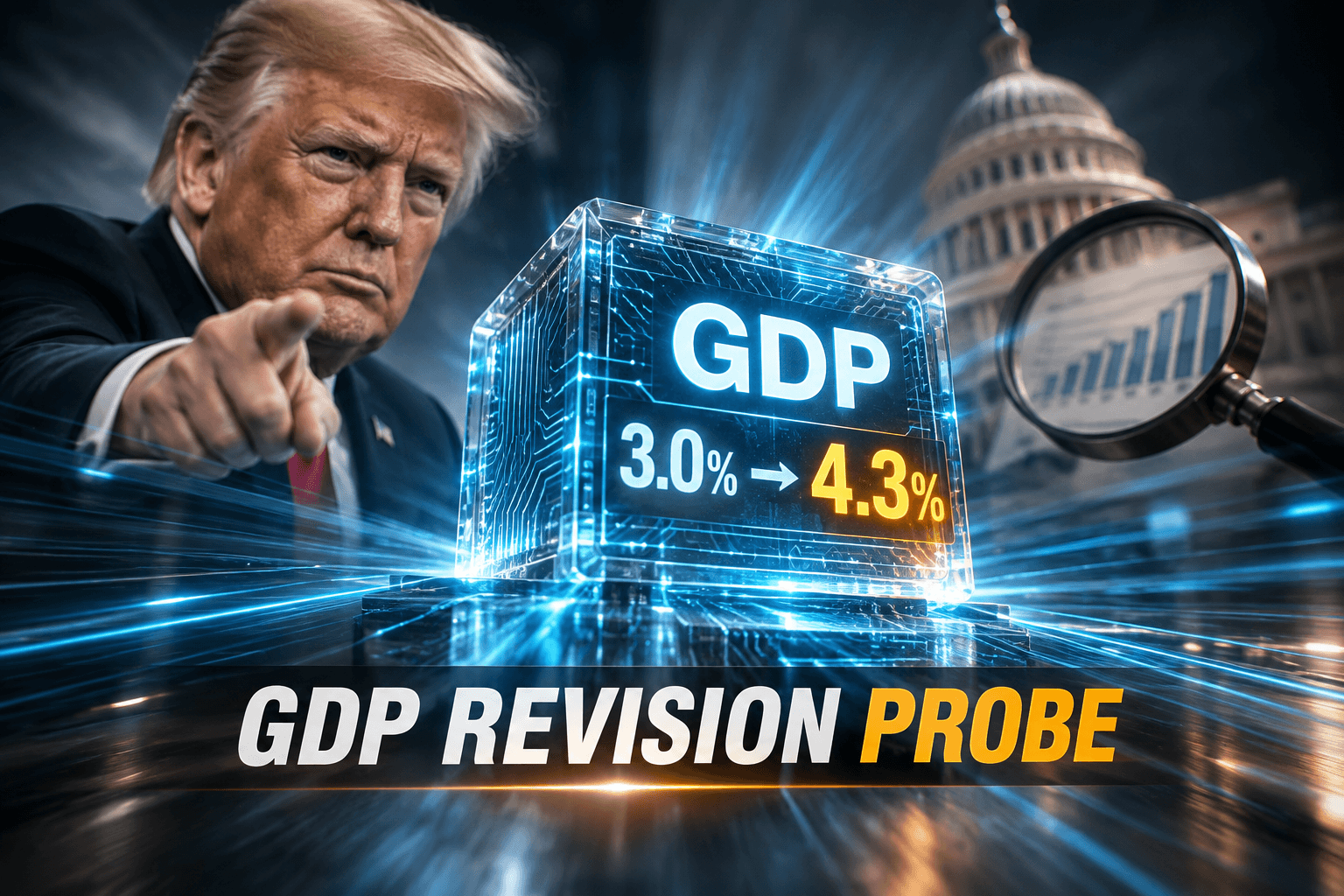
The BEA revised its estimate of real GDP growth for the third quarter of 2025 sharply higher. The annualized growth estimate increased from 3.0% to 4.3%, a change of 1.3 percentage points. The revision followed delays to federal data collection during the government shutdown.
The agency said missing or late source data and updated estimates contributed to the change. GDP estimates are routinely revised as more complete information becomes available, and a revision by itself is not evidence of misconduct. Trump nevertheless described the revision as an error and called for an investigation.
- Initial annualized real GDP growth estimate: 3.0% for the third quarter of 2025.
- Revised annualized real GDP growth estimate: 4.3% for the same quarter.
- Size of the upward revision: 1.3 percentage points, calculated from the two reported estimates.
- Data period at issue: the third quarter of 2025, not a new reading of current-quarter growth.
The change is meaningful for interpretation, but it is not a new standalone measure of corporate earnings or a direct forecast for any individual company. For investors, the practical distinction is between a stronger estimate of past economic activity and the separate question of whether that pace will persist. Upcoming GDP releases and revisions will provide more evidence, while inflation data and Federal Reserve decisions will shape how markets interpret the growth picture.
Why It Matters For Your Portfolio
Growth estimates help investors evaluate the economic backdrop behind company revenue, consumer demand and borrowing conditions. A higher GDP estimate can be read as evidence of stronger activity in the quarter measured. But if strong growth contributes to inflation staying elevated, interest rates could remain higher for longer, which may weigh on rate-sensitive stocks and raise borrowing costs. The supplied information does not identify a particular company, sector forecast or analyst rating, so this is a macroeconomic signal rather than a stock-specific call.
Growth-focused investors may want to distinguish the revised historical figure from forward-looking evidence of demand. Value and income investors can also monitor the rate implications, since borrowing costs and the discount applied to future cash flows matter across different investment styles. Traders may focus on upcoming economic releases, but the timing and direction of any market reaction are uncertain. With U.S. markets closed today, investors can assess the report without interpreting it as a same-day equity move.
Risks To Consider
The revision offers a stronger growth reading, but uncertainty around the data and the possible rate consequences create competing considerations. The bear case is that confidence in official economic data weakens while stronger growth reinforces concern about inflation or higher rates. That combination could make it harder to value assets using the original growth assumptions.
- Data confidence: The size and timing of the revision may undermine confidence in economic statistics and complicate investment decisions. The shutdown-related collection delays are part of the explanation given for the change, but investors will still want to see whether future estimates are more consistent.
- Interest-rate exposure: Stronger growth could keep inflation or interest rates higher for longer, weighing on rate-sensitive stocks and increasing borrowing costs. The provided information does not establish that rates will rise, only that this is a risk to monitor.
- Persistence: One revised quarterly estimate does not show whether the stronger growth pace will continue. If upcoming GDP releases or revisions do not support it, investors may need to reassess how much significance to assign to this figure.
What To Watch Next
The next useful evidence will come from the data itself, not from the political demand alone. Watch upcoming BEA GDP releases and revisions for whether stronger growth persists, and compare those readings with inflation data and Federal Reserve decisions. No specific release dates or rate-decision dates were provided, so investors should check the official schedules rather than assume a timing.
- BEA GDP releases and revisions: Look for whether subsequent estimates continue to show stronger growth and whether the agency’s data explanations clarify the revision process.
- Inflation data: Assess whether price pressures appear consistent with the risk that stronger growth could keep rates elevated.
- Federal Reserve decisions: Consider how policymakers respond to the combination of growth and inflation information. The supplied facts do not establish a policy outcome.
- Portfolio exposure: Review sensitivity to borrowing costs and the assumptions used to value future earnings, especially if your holdings depend on lower rates.
These are the relevant checkpoints for assessing the report, rather than a specific stock price level. No company-specific price targets, valuation measures or security data were included in the available information.
The Bottom Line
- The BEA raised its annualized third-quarter 2025 real GDP estimate from 3.0% to 4.3%, a substantial revision that signals stronger activity for that period.
- The BEA cited missing or late source data and updated estimates following shutdown-related collection delays. The revision alone is not evidence of misconduct.
- Trump’s call for an investigation adds attention to data confidence, but it does not resolve the technical question of why the estimate changed.
- For an investment decision, weigh the stronger growth figure against the risks of higher inflation, rates and borrowing costs, and watch for confirmation in upcoming data.
- This report does not support a blanket buy, sell or hold conclusion. Use the next GDP, inflation and Federal Reserve updates to test your own assumptions; this is general information, not personalized investment advice.
FAQ
Q: How much was third-quarter 2025 GDP revised?
A: The BEA raised annualized real GDP growth from an initial estimate of 3.0% to 4.3%, an increase of 1.3 percentage points.
Q: Does the revision prove that the GDP data were mishandled?
A: No. The BEA cited missing or late source data and updated estimates, and revisions are routine as more complete data become available. A revision by itself is not evidence of misconduct.
Q: What should investors monitor after this GDP revision?
A: Watch upcoming BEA GDP releases and revisions, inflation data and Federal Reserve decisions. Together, those developments will help show whether stronger growth persists and how investors should assess rate risks.