
 Alpha Breaking
Trump Demands Probe After GDP Revision - Nov 26
Share this article
Spread the word on social media
The Big Picture
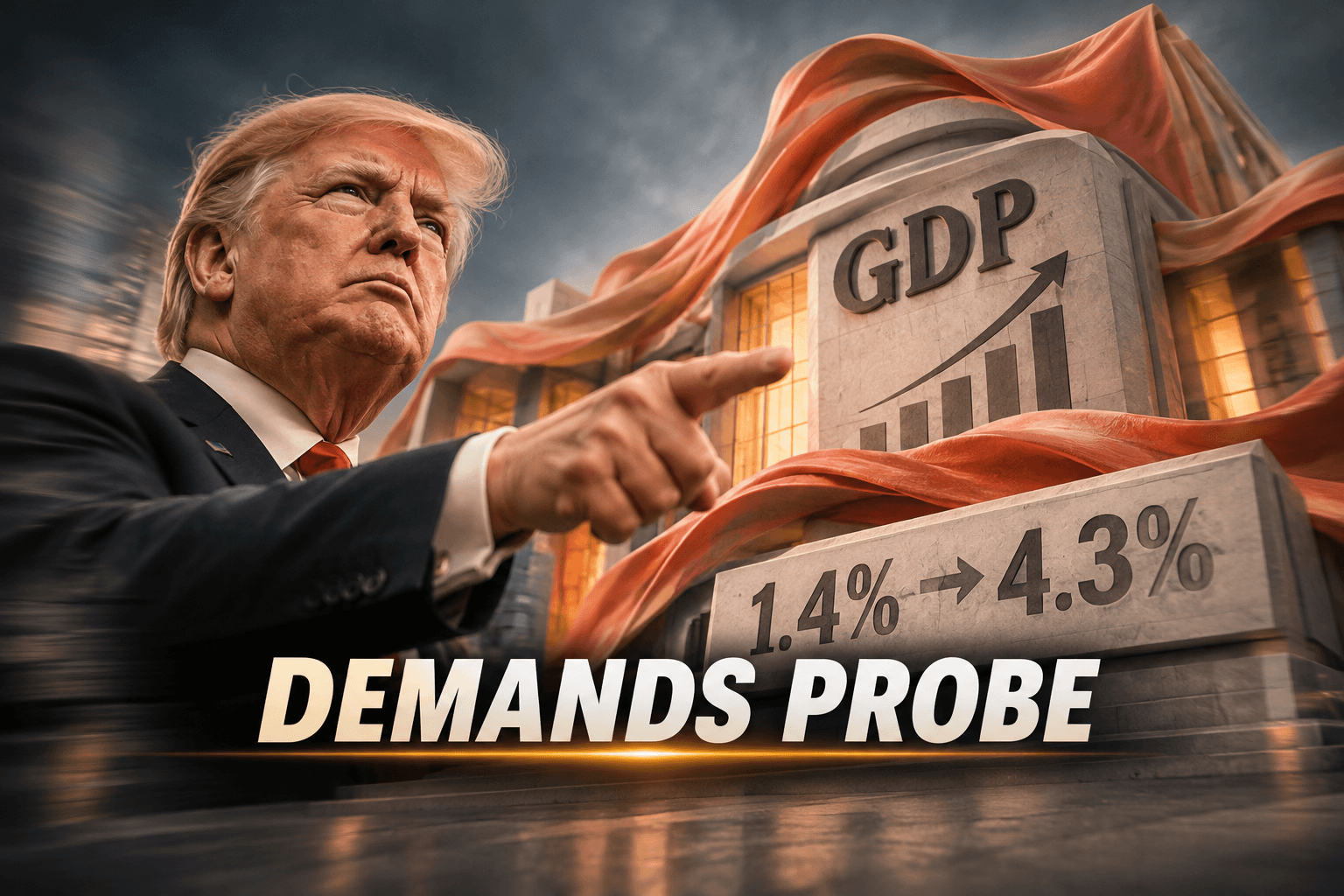
A 2.9-percentage-point upward revision to third-quarter 2025 GDP changes the picture of economic momentum, but it doesn’t prove that the original estimate was a record-setting error. President Donald Trump called the revision a “record setting error” on Thursday and demanded an investigation, while the Bureau of Economic Analysis attributed the stronger estimate mainly to consumer spending, exports and government spending.
For investors, the figures offer a stronger growth signal, but not a settled verdict on the economy or a reason by themselves to change a portfolio. US stock markets are closed for Thanksgiving, and the available information provides no current stock price or equity-market move to report. The next estimates and other economic releases will matter for assessing whether the growth signal holds up.
What's Happening
The BEA revised its second estimate of real GDP growth for the third quarter of 2025 sharply higher. The change is meaningful for anyone using economic growth to evaluate earnings prospects, inflation pressure or the direction of interest rates. It is also important to distinguish a revision from proof of wrongdoing: GDP estimates are routinely updated as more complete source data become available.
- Initial annualized real GDP growth estimate: 1.4%.
- Revised second estimate: 4.3% annualized growth.
- Size of the upward change: 2.9 percentage points.
- Inflation-adjusted personal consumption expenditures rose at a 3.5% annual rate.
- The BEA identified consumer spending, exports and government spending as the main contributors to the stronger estimate.
Those details provide several inputs for economic and valuation analysis, but they don’t tell the whole story. Consumer spending growth can inform judgments about demand, while exports and government spending contributed to this particular estimate. The supplied figures do not quantify each source’s contribution, so it would be premature to treat one factor as the dominant driver or to assume the same pace will continue.
Trump’s demand for an investigation adds a political dispute to the release. His description of a “record setting error” is a claim, not a finding from the BEA data provided here. The size of the revision merits attention, but a substantial change between estimates alone does not establish that the agency acted improperly.
Why It Matters For Your Portfolio
Growth and inflation readings can affect how investors assess corporate revenue prospects, borrowing costs and the valuations assigned to future earnings. A stronger GDP estimate may support a more constructive view of demand, but the 3.5% annualized rise in inflation-adjusted personal consumption expenditures is only one measure in this report. It does not establish that inflation is accelerating, nor does it settle how the Federal Reserve will respond.
Growth-oriented investors may focus on whether future data confirm that spending is broad-based. Value investors assessing company fundamentals can weigh the revised growth picture alongside earnings and valuation data, rather than treating GDP as a substitute for company-level analysis. Traders may watch for changes in policy expectations as economic reports arrive. The information provided includes no analyst ratings, stock-specific outlooks or company results, so it does not support a conclusion about a particular ticker or sector.
For portfolio decisions, the practical takeaway is to use this report as one data point. It offers a different view of third-quarter 2025 activity than the initial estimate did, while leaving questions about durability, inflation and future revisions open.
Risks To Consider
GDP revisions can change again. If later estimates or underlying source data alter the picture, investors who rely too heavily on the 4.3% figure could misread the economy’s momentum.
Strong growth alongside persistent inflation could keep interest rates higher for longer. Higher borrowing costs can weigh on companies that depend on financing and may pressure valuations, making the growth signal less favorable for some assets.
The political allegation may draw attention away from the underlying data. The available information does not establish misconduct, and treating the demand for an investigation as proof of an error could lead to conclusions the evidence does not support.
The bear case is that the upward revision proves less durable than it first appears, while inflation remains firm enough to constrain the outlook for interest rates. In that scenario, stronger reported activity would not automatically translate into an improved valuation backdrop. The current figures alone cannot confirm or rule out that possibility.
What To Watch Next
The next BEA estimate and any revisions to its underlying source data are the most direct checks on this release. Upcoming inflation, employment and consumer-spending reports can help investors judge whether growth is broad-based and whether inflation pressures are persisting. No specific release dates are provided here, so investors should check official schedules rather than assume a timing.
Compare the BEA’s subsequent GDP estimate with the 4.3% second estimate and note any changes to the underlying data.
Track consumer-spending readings against the reported 3.5% annualized increase in inflation-adjusted personal consumption expenditures.
Assess inflation and employment reports together with growth data for clues that could influence Federal Reserve policy expectations.
Use company earnings, cash flows and valuation measures alongside macroeconomic releases. The GDP figures are not a stock-specific price target or an entry level.
Because US markets are closed on Thanksgiving, there is no US equity session today to reflect this news. The next trading day is Friday, November 27, but the provided sources do not establish how stocks will respond.
The Bottom Line
The BEA raised third-quarter 2025 real GDP growth from 1.4% to 4.3%, a 2.9-percentage-point revision.
Consumer spending, exports and government spending were the main contributors identified by the BEA; inflation-adjusted personal consumption expenditures grew at a 3.5% annual rate.
Trump’s demand for an investigation is an allegation, not evidence that the revision involved misconduct.
For investors, the signal is mixed: stronger reported activity may inform growth analysis, while possible further revisions and inflation-related rate risks warrant caution.
Rather than treating this report as a stand-alone buy, sell or hold signal, monitor the next GDP estimate and inflation, employment and consumer-spending data. The information is general analysis, not personalized investment advice.
FAQ
Q: How much did the BEA revise third-quarter 2025 GDP growth?
A: It raised the annualized estimate from 1.4% to 4.3%, a 2.9-percentage-point increase.
Q: Does the revision prove there was a record-setting error?
A: No. Trump called it a “record setting error” and demanded an investigation, but a large revision by itself does not establish misconduct. GDP estimates are routinely updated as more complete data become available.
Q: What should investors watch after this GDP revision?
A: Watch the BEA’s subsequent estimate and source-data revisions, along with upcoming inflation, employment and consumer-spending reports. Those releases can help clarify whether growth is broad-based and inform expectations for Federal Reserve policy.