
 Alpha Breaking
POET's CEO Just Told You How to Grade Him Through 2029
Share this article
Spread the word on social media
POET Technologies POET Technologies (POET) just closed out its three-part CEO Q&A. Part one was the numbers. Part two was the factory & the laser. Part three is the one where Dr. Suresh Venkatesan zooms all the way out, and he doesn't stop until he's past 2029.
He takes on TSMC, the bond market and the question every $POET holder has been chewing on since the print. Then he draws a map. It has four phases, and each one comes with a proof point you can check. We like maps with checkpoints. Those are the ones you can hold a CEO to.
TSMC just crashed the interposer party
Interposers are the hot word in chips right now. TSMC has one for optics called COUPE, and it's all over the co-packaged optics chatter. So the first question was the obvious one. Did the biggest foundry on earth just park on POET's lawn?
Venkatesan says no, & his reason is worth slowing down for. He says POET pioneered the interposer for optics back in 2017 and the market is only now catching up. But the two platforms serve different markets. Co-packaged optics puts the silicon photonics right beside the switch or the processor. And it relies on a laser that sits somewhere else.
POET's interposer goes after the other side of the room. That's pluggables, near-packaged optics and new formats like XPO, the liquid-cooled design Arista kicked off this year that packs 12.8 terabits into one module. In all of those the engine has to carry its own laser. So you need lasers, modulators, photonic chips and tiny optics married on one platform. That's the thing POET built.
CPO was supposed to bury POET. It still needs a laser
The bears skip this part. That outside laser co-packaged optics leans on? Somebody has to make it. Venkatesan says POET supports that roadmap with its high-power lasers. So if CPO wins big, POET has a product for it. If pluggables & near-packaged optics keep the crown, POET has the engine. He's sitting on both sides of the table.
And with Blazar, the interposer stops being only the way a device gets put together. It becomes part of the laser itself. In his words, that "turns a platform into a product." We walked through the Blazar math in part two, so we won't replay it here.
The monster under AI's bed is the bond market
Now the tape. AI names have been thrown around like rag dolls, and analysts keep asking who's paying for all of this. Venkatesan didn't blame the chips. He pointed at credit.
A lot of the AI buildout is being paid for with debt, and the cost of insuring that debt has climbed sharply. The numbers back him up. Oracle's default protection ran to 322 basis points in October from 144 at the start of the year, according to Investing.com. Morgan Stanley counted about $466 billion of AI-linked debt sold in 2026 by then. Same stretch of 2025? $101 billion.
"That is a financing question, not a demand question," he said. Sound familiar? We've been telling this bond horror story since the summer, when we wrote that the chip selloff wasn't about the AI trade. Nobody's canceling the need to move more data, faster, on less power. They're fighting over who holds the IOU.
Scared of debt? POET's sitting on $774 million in cash
So what does a company do in a market that's scared of debt? It helps to have cash. POET closed Q3 with $774.3 million in cash and short-term investments, per the Q3 release. Venkatesan says the growth plans are funded from POET's own balance sheet.
That cash does more than sit there. Customers want to know a supplier can buy the parts, build the order & keep filling it as volumes grow. Lead times are ugly across the industry, so POET went shopping early. It locked in roughly 10 times its wafer capacity at its foundry partner, the indium phosphide chips it needs and the equipment to build its engines.
Then came a detail we hadn't heard before. Some of POET's larger customers helped it secure that supply, because they trust the balance sheet. In our book, customers don't go to bat for a supplier they plan to drop.
The cash also lets POET ramp today's products and pay for the next ones at the same time. A lot of companies at this stage have to pick one. We've already run the cash math if you want the napkin version.
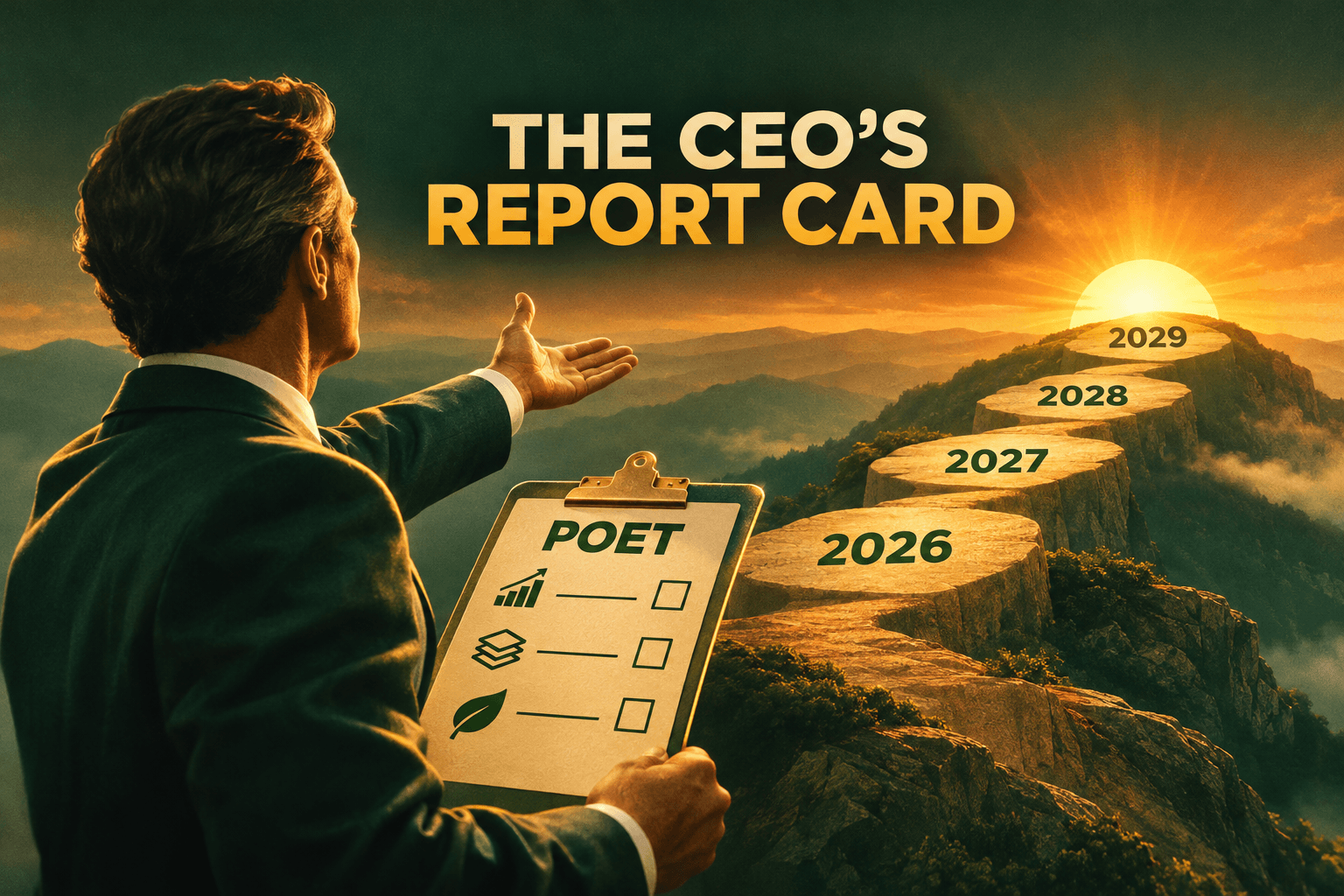
The map to 2029 has four stops. Each one owes you a receipt
Then the map. "I think of it as an arc in four phases," Venkatesan said, "each with one proof point that unlocks the next."
1. 2026 through 2027: prove the volume. New capacity comes online and today's engines ramp while the next technology matures. The proof point is customers qualifying POET and coming back with repeat orders. He says that's already happening in some cases.
2. 2028: "Built on POET." Tier 1 module makers and laser companies ship products built on the platform, under their own names, into hyperscaler deployments. High-power lasers become a second growth engine.
3. 2029: products turn into a platform. Customers design each new generation around the POET interposer. Near-packaged optics, 400 gig per lane and high-power lasers all ramp at volume.
4. After that: a platform company. POET has more major programs, no single customer dominating revenue and what he called semiconductor-class margins.
One line stuck with us. The products that carry POET through 2027 aren't the ones that will carry it through 2029, and he says they're investing in both. That's a CEO telling you the cash has a job.
Talk is cheap. The first receipt comes due March 1
Let's be straight. A map isn't the trip. Every date up there is a management target, and targets slip in this business. Phase two has POET-built products inside hyperscaler deployments in 2028. That's the plan. It hasn't happened yet & we won't write like it has.
But he gave us the checkpoints, so we'll use them. The release says Q4 shipments should top the first nine months of 2026 combined. If they do, phase one has its first receipt. Seven of nine active customers are expected to enter production in 2027, and each one that does moves phase one closer to done. And March 1, 2027 brings POET's first quarterly earnings call. That's where analysts finally get to ask which customers came back for more.
His word to rattled shareholders was plain. Share prices in young tech markets swing hard, and what POET can control is execution. Fair enough. We'd add one thing. He just told you how to grade him.
Parts one and two covered the Q3 numbers, the factory & Blazar. Go back to them if you missed either.