
 Alpha Breaking
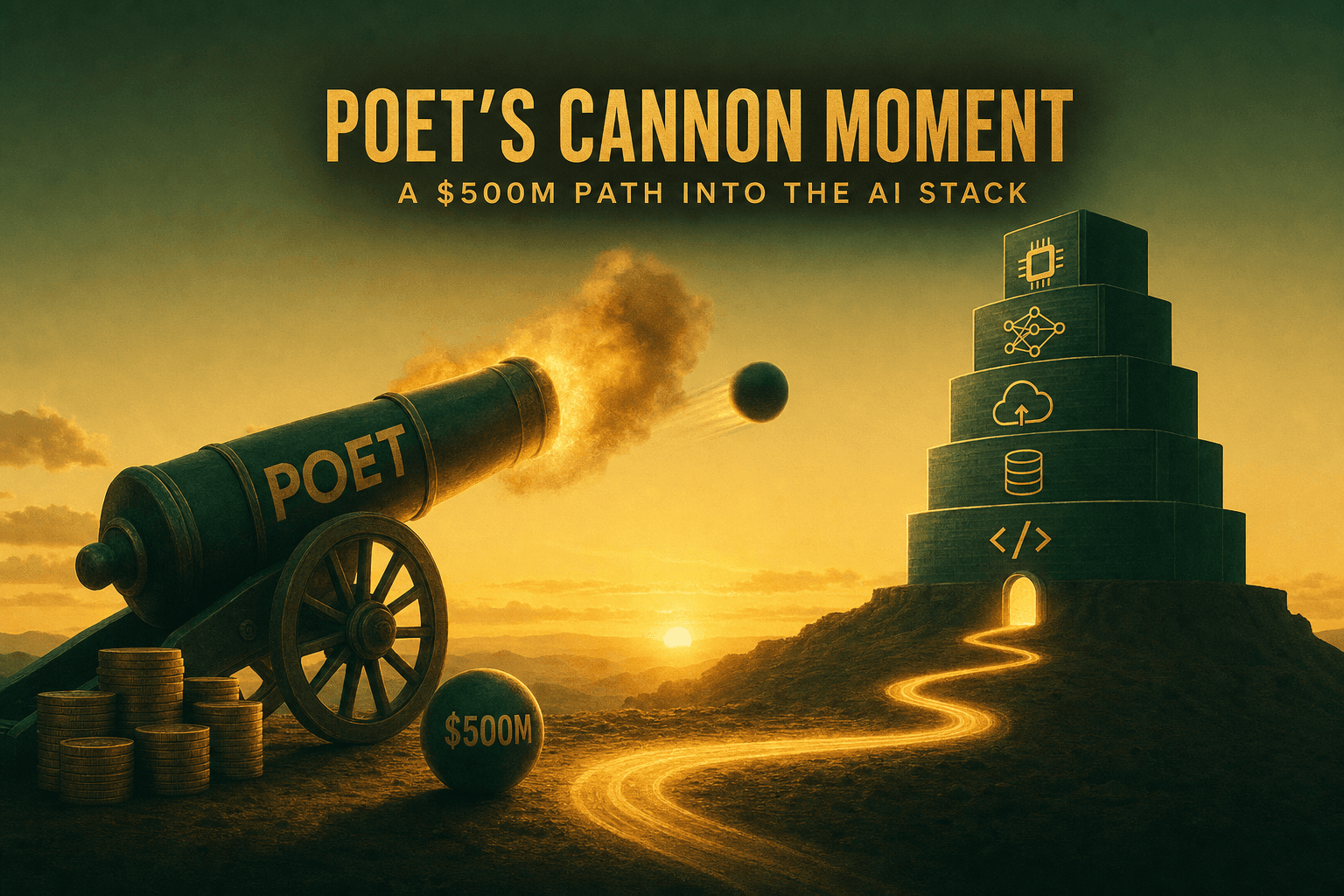
POET's Cannon Moment: A $500M Path Into the AI Stack
Share this article
Spread the word on social media
For more than seven years, POET Technologies $POET has been building toward a specific moment in the evolution of data center infrastructure — the moment when copper interconnects and first-generation pluggable optics could no longer keep pace with the bandwidth, latency, and power demands of frontier AI compute. That moment has arrived. And with the supply agreement and joint development partnership announced this week with Lumilens Inc., POET’s long bet on wafer-level photonic integration has converted from technology platform into commercial trajectory.
This is a cannon moment for POET. Lumilens has placed an initial $50 million purchase order with the Company for the manufacturing of optical engines based on a new jointly developed platform, the Electrical-Optical Interposer (EOI). That initial order represents the first phase of a broader supplier relationship that, per the companies’ announcement, could scale to more than $500 million in cumulative purchases from POET over five years.
For a company whose investor narrative has been dominated by platform validation and capital structure, the meaning of those numbers is straightforward: the conversation now shifts to execution.
The EOI Platform: A Third Wafer-Level Leap
The technical centerpiece of the announcement is the EOI platform itself. To understand why it matters, it helps to situate it in the history of semiconductor packaging.
Modern AI computing was made possible by two prior leaps in wafer-level integration. The first was the 2.5D electrical interposer, which brought GPUs and high-bandwidth memory (HBM) into a single package and enabled the dense compute architectures that train today’s largest models. The second was hybrid bonding, which enabled the modern HBM stacks and 3D logic that have pushed memory bandwidth to its current frontier. Both transformed the industry. Both began as wafer-level integration problems that conventional packaging could not solve.
The optical layer — now the defining bottleneck for scaling AI — has not yet made that leap. EOI is designed to be it.
POET and Lumilens have structured the joint EOI platform to deliver enhanced performance and density for next-generation AI and data center architectures, active-alignment-free wafer-level manufacturing that replaces the single largest cost, yield, and throughput constraint in optical engine production, and capital-efficient high-volume manufacturing that allows optical supply to scale with hyperscaler GPU fleet growth rather than against the labor-bound limits of conventional optical assembly.
That third point is the one that matters most for the commercial story. Optical engine production today is rate-limited by active alignment — a precision step traditionally performed module-by-module, which caps throughput and inflates cost. A wafer-scale, alignment-free process is what allows photonic supply to keep pace with hyperscaler demand on the timeline the AI buildout requires. It is, in the language of semiconductor manufacturing, a structural shift from craft to scale.
A Roadmap Across the Full Architectural Transition
The joint platform is being built to address the entire arc of the photonics shift now underway in AI data centers. The companies have committed to a multi-year roadmap that spans from 800G and 1.6T pluggable transceivers — the dominant form factor for today’s scale-out networks — into next-generation high-density Near-Package Optics (NPO) and Co-Packaged Optics (CPO) for tomorrow’s scale-up GPU fabrics. Engineering samples from the joint development program are expected in late 2026, with production ramp aligned to hyperscaler customer deployments in 2027.
That timeline matters. It places POET’s first material commercial revenues from the EOI platform inside the same window in which hyperscaler CPO procurement decisions are expected to begin in earnest. The Company is not building toward a future market; it is building toward a market the largest cloud operators are already provisioning capital against.
The Commercial and Capital Structure
The supply agreement establishes the commercial framework for the joint development program. Lumilens’ initial $50 million purchase order is the first phase. Per the announcement, the relationship “could scale to $500+ million in cumulative purchases from POET over five years.”
In connection with the agreement, POET has granted Lumilens a warrant to purchase up to 22,921,408 common shares. The warrant is immediately exercisable for 2,292,140 shares, with the remaining shares vesting and becoming exercisable in tranches based on cumulative payments by Lumilens toward future purchase orders totaling up to $500 million. The warrant is exercisable over nine years at an exercise price of $8.25 per share. The structure is designed, in the companies’ words, to align both parties to the long-term value created through the partnership.
Two observations on that structure. First, the warrant vests against commercial performance — additional shares become exercisable only as Lumilens places and pays for additional purchase orders, which means dilution scales with revenue rather than ahead of it. Second, the nine-year term and the $8.25 strike together communicate that both parties expect this to be a long, productive relationship — short-dated warrants and at-the-money strikes look very different.
Fulfillment of the purchase orders and associated revenues remains subject to the successful development and ultimate qualification of the modules, as well as the successful scaling of manufacturing capability. Those are not trivial conditions. They are also exactly the conditions POET has spent the last seven years preparing to meet.
What the CEOs Are Saying
The statements from both companies’ leadership frame the deal in the same terms. “GPU interconnects are emerging as the defining bottleneck for scaling AI,” said Ankur Singla, CEO and Founder of Lumilens, “and addressing it requires rethinking the full optical stack — silicon, photonics, and packaging — together. This joint development partnership with POET combines Lumilens’ next-generation chipset and advanced optical manufacturing capabilities with wafer-level photonic integration to build a clear path to the performance, density, and economics that frontier AI deployments will demand over the next decade.”
Dr. Suresh Venkatesan, Chairman and CEO of POET Technologies, framed the integration thesis directly. “Our focus has always been on redefining the integration paradigm in photonics. This new EOI platform will allow us to jointly bring semiconductor-style manufacturing discipline to optical engines — delivering precision, scalability, and cost structure advantages that are essential for AI infrastructure at scale. Working jointly with Lumilens enables us to translate these capabilities into high-volume production and end-customer deployments for the next generation of AI data centers.”
The shared language — “rethinking the full optical stack,” “semiconductor-style manufacturing discipline” — points to the same thesis from two sides. Photonics is moving from craft to industrial scale. The companies building the wafer-level processes that make that transition possible will define the next decade of optical infrastructure.
What This Means for POET
For POET investors, the meaningful questions now shift decisively from platform validation toward commercial cadence. Will engineering samples ship on the late-2026 schedule? Will qualification proceed cleanly? Will Lumilens’ production ramp track hyperscaler deployments through 2027 and beyond? Will additional purchase orders materialize on the timeline implied by the $500 million ceiling? Each of those is now a discrete, observable milestone — and each, if met, draws additional shares under the warrant into the money and revenue onto POET’s income statement.
The structural significance of the deal runs deeper than any single line item. The EOI platform places POET inside the most strategically important transition in semiconductors at exactly the moment that transition is being capitalized. The Lumilens supply agreement converts that positioning into contracted commercial activity. The warrant structure aligns the relationship over a nine-year horizon. The roadmap runs through the architectural shift that will define hyperscaler procurement for the rest of the decade.
The question is no longer whether photonics will replace copper in the AI data center. That answer is settled. The question is which companies will build the platforms, the supply, and the manufacturing economics to meet hyperscaler demand on the timeline the market requires. With the EOI platform and the Lumilens supply agreement now in place, POET has materially strengthened its claim to be among them.