
 Alpha Breaking
POET's $15 Wall: Gamma, Dealer Hedging, and the Triggers
Share this article
Spread the word on social media
POET's $15 Wall: Gamma, Dealer Hedging, and the Trigger That Would Have to Fire
POET Technologies opened Tuesday's session printing $14.26, holding the gains from Monday's 19.9% rip and continuing a rebound that has carried the stock roughly 265% off the April low of $3.87. The chart story is straightforward. The options chain is telling a separate story, and it is the one worth watching over the next three trading days.
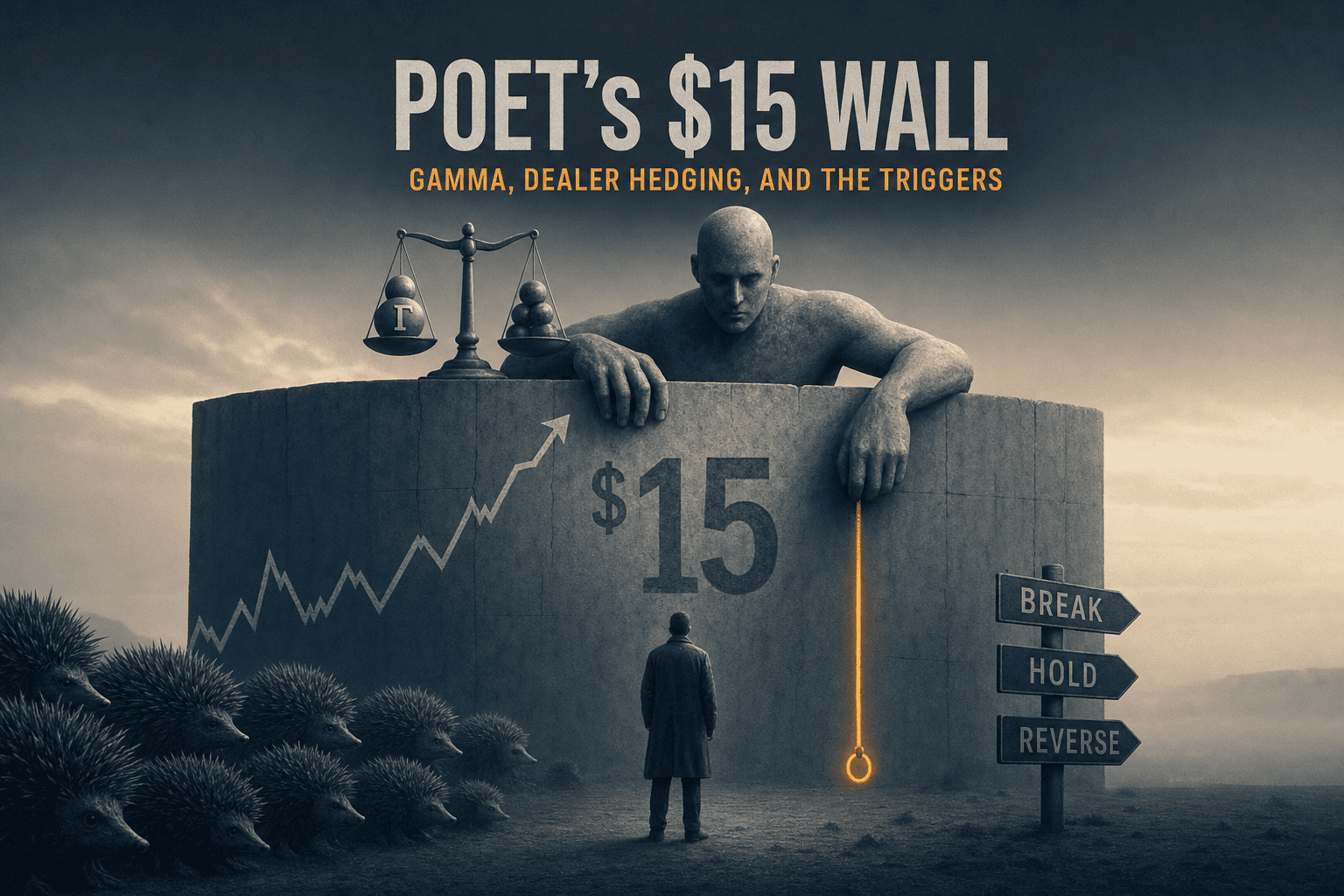
Stacked into Friday's May 15 expiration is a single strike carrying 20,308 contracts of open interest. That is the $15 call, sitting roughly 5% above spot. Around it sit 4,586 contracts at $18, 6,531 at $20, and another 1,214 at $25. The May 15 chain is loaded with out-of-the-money call open interest in a configuration that, under the right conditions, is exactly the kind of structure that can produce violent upside moves when dealers are forced to chase delta.
It is important to be direct about what is and is not happening right now. Tuesday morning's trade looks like ordinary spot-driven momentum on a stock that has been in a sharp rebound. There is no observable evidence yet of fresh dealer hedging cascading into the tape. The potential structure exists. The squeeze itself has not started.
Whether it does depends on three things: price, volume, and time. All three converge by Friday.
The mechanics, briefly
When a retail trader buys an out-of-the-money call, somebody has to sell it. That somebody is almost always a market maker, who is now short the option. To stay risk-neutral, the dealer buys some quantity of the underlying stock to hedge the delta of that short call. The further out-of-the-money the call, the less stock the dealer needs to buy initially.
As the stock rises toward the strike, the call's delta increases, meaning the dealer is suddenly under-hedged and must buy more stock. The closer to the strike and the closer to expiration, the more violent that adjustment becomes. This is gamma. And when an entire wall of open interest exists at a single strike just above spot with only days to expiration, the cumulative hedging demand can dwarf normal daily volume in the stock itself.
The buying begets price action. The price action forces more buying. The feedback loop is what people are referring to when they say gamma squeeze. Importantly, the loop requires a trigger to start. It does not run on its own.
What POET's chain actually looks like
The May 15, 2026 expiration call and put open interest by strike, with spot at $14.20:
BELOW SPOT (CALLS ALREADY IN THE MONEY)
• $11.00 strike: 9,218 call OI / 14,622 put OI
• $12.00 strike: 6,656 call OI / 5,013 put OI
• $13.00 strike: 3,692 call OI / 1,403 put OI
• $14.00 strike: 2,174 call OI / 1,747 put OI
ABOVE SPOT (OUT-OF-THE-MONEY CALLS — THE RELEVANT ZONE)
• $15.00 strike: 20,308 call OI / 1,075 put OI — the wall
• $16.00 strike: 1,787 call OI / 70 put OI
• $17.00 strike: 1,094 call OI / 203 put OI
• $18.00 strike: 4,586 call OI / 60 put OI
• $20.00 strike: 6,531 call OI / 97 put OI
• $25.00 strike: 1,214 call OI / 2 put OI
Two things stand out. First, the $15 strike is a structural outlier — roughly ten times the open interest of any adjacent strike, and well over twice the size of any other call strike on the entire May 15 board. Second, the $18 and $20 strikes form a secondary shelf that would matter on any continuation move beyond $15.
Roughly 32,000 contracts of out-of-the-money call open interest sit between $15 and $20 on the May 15 expiration. That is the equivalent of approximately 3.2 million shares of potential dealer hedging demand concentrated above current spot, with three trading days to expiration. The structure is loaded. The trigger has not pulled.
The triggers
Gamma squeezes do not happen on price alone. They happen when price, volume, and time pressure converge. The levels worth watching this week, in order of importance:
• $15.00 — Primary trigger. The line. Calls at this strike currently carry a delta in roughly the 0.25 to 0.35 range. A clean break through $15 on rising call volume pushes that delta toward 0.50 to 0.70, forcing dealers to buy roughly 700,000 to 1 million shares to stay hedged on this strike alone.
• $15.50 — Confirmation. Through-and-hold above $15.50 by Wednesday close converts the wall from resistance into a floor. Charm and vanna start working for the longs. Dealer hedging accelerates rather than fades.
• $18.00 — Acceleration. The next shelf. Combined OI between $18 and $20 represents another 11,000-plus contracts. A push through $17 into $18 brings a second round of forced buying that can decouple the stock from any fundamental anchor.
• $13.80 — Squeeze killer. Loss of the $14 handle on Wednesday or Thursday is the death knell. Theta destroys the $15 calls, dealers unwind hedges, charm flips against the longs, and the wall becomes a ceiling instead of a launchpad.
THE VOLUME COMPONENT
Price alone will not do it. The squeeze requires new call buying — fresh open interest layered on top of what is already there, ideally on the at-the-money and just-out-of-the-money strikes. The 20,308 contracts at $15 represent positioning that already exists. For the structure to actually ignite, today's tape needs to show meaningful call volume on the $15s and above with call volume substantially outpacing put volume.
The signal will be visible by mid-session. If the $15 strike trades 3,000 to 5,000 contracts in a single day with POET holding above $14.50, the setup is live. If volume is quiet and the stock fades into the close, this is a structure that will likely expire worthless.
The rollover question
Here is a piece of the analysis that most retail commentary misses entirely.
Assume $POET pushes through $15 this week. The holders of those calls — many of which would then be deeply in the money — face a choice: exercise, sell, or roll. Sophisticated traders sitting on profitable, near-dated positions often choose to roll when they want to extend the trade without taking delivery of the stock or paying short-term capital gains.
A roll looks like this: sell the May 15 $15 call (now in the money and worth, say, $2 to $3 of intrinsic plus residual extrinsic value) and use the proceeds to buy a longer-dated, higher-strike call — for example the May 22 $18, the May 29 $20, or the June $25.
This is where the dealer dynamic gets fascinating.
WHAT DEALERS HAVE TO DO WHEN CALLS ROLL
When a holder sells their May 15 $15 call back to the market maker, the dealer is now long that call (or, equivalently, has had their short position closed). They no longer need to maintain the hedge they had built up against it — so they sell stock. Selling stock. This is the part that catches retail traders by surprise: a stock can experience real selling pressure on the unwind of a position that was previously driving it higher.
But there is a second move. The same trader is now buying a longer-dated, higher-strike call. The dealer who sells them that new call is short again — and has to hedge it. That requires buying stock.
The net effect depends on three things:
• Delta differential. The in-the-money May 15 $15 call has a delta near 1.0; the new out-of-the-money call (say May 29 $20) might have a delta of 0.30. The dealer was hedging roughly 1 share per contract on the old position and needs to hedge only about 0.30 shares on the new one. Net effect: dealer sells stock.
• Volume of the roll. If a meaningful slice of those 20,308 contracts rolls in a coordinated way, the net delta unwind could be substantial.
• New positioning created. The roll plants fresh OI further out in time and higher in strike. The gamma exposure does not disappear; it migrates. The May 22 and May 29 chains start carrying weight that was not there before.
The counter-intuitive takeaway: a successful initial squeeze can plant the seeds of the next one. Rolls do not end the gamma story — they relocate it forward in time and higher in strike. If POET makes $15 stick, the May 22 and May 29 chains become the next battlegrounds.
This is also why the May 22 $14 strike (currently 2,605 contracts of call OI) and the May 29 $14 strike (2,850 contracts) matter more than they look on the surface. They are already at the money. If the stock holds above $14 into next week, that is where the next wave of forced dealer activity would sit.
What kills the trade
Three scenarios end this conversation before Friday:
• Stall and fade. POET ranges $14.20 to $14.80 through Wednesday without breaking $15. Theta accelerates against the call holders, dealer hedges unwind in slow motion, and the wall becomes ceiling. Calls expire worthless and the structural force dissipates.
• Covered-call writers absorb the move. Long-term POET holders who have been writing calls against their stock get assigned and do not replace the position. Dealer buying gets absorbed by natural supply. The squeeze never builds momentum.
• Macro risk-off. A broad market sell-off pulls every speculative name lower regardless of strike-specific positioning. POET trades with the tape rather than against it.
There is also a fundamental wildcard. POET's Q1 earnings are expected sometime between May 13 and May 22, with public sources differing on the exact date. If earnings land before or during the May 15 expiration window, the gamma dynamics get overwritten by event risk. An earnings miss, particularly given the Marvell/Celestial AI cancellation overhang and the active securities class action, could collapse the structure in a single session.
The bottom line
Today's move looks like spot-driven momentum on a stock that has been in a sharp rebound. There is no evidence yet of the kind of dealer hedging cascade that defines a true squeeze. The 20,308 contracts of open interest at the May 15 $15 strike are not, in themselves, a squeeze. They are a loaded structure. The squeeze, if it happens, requires the stock to break $15 on rising call volume before Thursday's close, with the market broadly cooperating and no earnings event blowing up the setup.
If those conditions converge: the dealer hedging math creates real, observable buying pressure that compounds on itself. The secondary shelf at $18 and $20 provides the fuel for a second leg. And the rolls that follow plant new positioning into May 22 and May 29 that could keep the gamma story alive well past Friday's expiration.
If those conditions do not converge: this is a structure that will be remembered as a setup that did not fire — which happens most of the time. Most loaded option chains expire without incident. The mechanics only matter when price and volume cooperate.
Three trading days. One level. The mechanics are what they are.