
 Alpha Breaking
Jamie Dimon Says Markets Underestimate Risks - Jul 21
Share this article
Spread the word on social media
The Big Picture
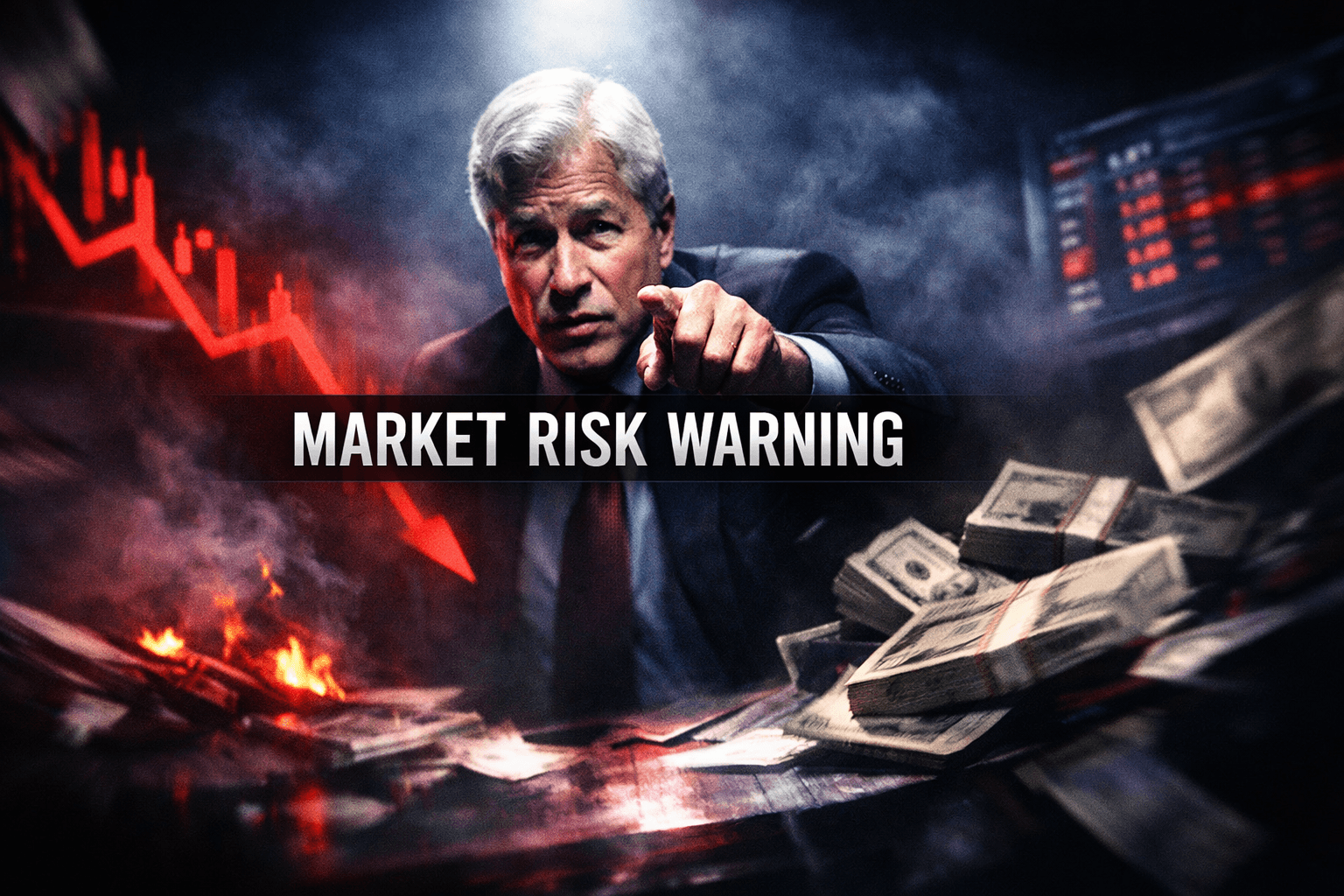
Jamie Dimon says markets underestimate risks and he wouldn't buy stocks or Treasurys at current prices, a blunt warning that should make you rethink portfolio complacency. The JPMorgan Chase CEO contrasted his caution with investors' recent willingness to look past wars, tariffs and other shocks, raising the prospect of renewed volatility.
For investors, that statement is a reminder that headline calm can mask vulnerability in valuations and fixed-income markets, and that risk management may need to move up the priority list.
What's Happening
Dimon told reporters and investors that current market pricing underestimates economic and geopolitical risks, and he explicitly said he would not buy stocks or Treasurys at today's prices. That comment stands out because it comes from the CEO of the country's largest bank, whose views often influence market sentiment.
- Dimon's core statement: he would not buy stocks or Treasurys at current prices, signaling a cautious stance for both equities and government bonds.
- CNBC noted his remarks contrast with investor behavior that has largely shrugged off wars, tariffs and other shocks, implying a gap between headline stability and underlying risk.
- Available data points for valuation analysis cited by markets or analysts include 67.92%, 29.59%, 0.09% and $25, which investors can use to test different downside and upside scenarios.
- The remarks arrived amid continued debate over whether markets have fully priced in macro and geopolitical shocks, making near-term positioning and liquidity a focus for traders.
Each of those numbers can feed into different valuation models and stress tests. For example, a 67.92% figure could represent a peak-to-trough move or a sector return under a stressed scenario, while 0.09% may indicate a narrow yield spread or marginal rate change in a sensitive instrument. The $25 figure is available as a reference point investors may use in scenario work on small-cap or single-stock exposure.
Why It Matters For Your Portfolio
Dimon's public caution matters because it shifts the narrative away from untroubled market breadth and toward potential repricing. If institutions follow his lead, liquidity and risk premia could widen, which would affect both growth and income strategies.
Who should care: growth investors should watch stretched multiples, value investors should monitor credit spreads and cyclical exposure, income investors need to check duration and yield pickup in fixed income, and traders should be alert for increased volatility. Analysts note his comments highlight the need to test how sensitive your holdings are to lower prices and wider spreads.
Risks To Consider
- Market Overreaction: Dimon's warning could trigger a short-term pullback driven by sentiment rather than fundamentals, creating volatile entry points.
- Policy and Geopolitical Shocks: If wars, tariffs or unforeseen events intensify, valuations could rerate sharply and liquidity could tighten, deepening downside.
- Misreading the Signal: Markets are forward looking. If data stays resilient, the economy could absorb shocks and prices could continue higher, leaving overly defensive positions underperforming.
What To Watch Next
Investors should focus on concrete metrics and upcoming catalysts that will test Dimon's thesis and market complacency. Pay particular attention to valuation, credit conditions and macro data that could force a reassessment of prices.
- Valuation Metrics: Watch price-to-earnings, forward revenue growth and the specific data points investors are using in scenario analysis, including 67.92% and 29.59% as inputs for stress tests.
- Fixed Income Signals: Monitor yield moves and spreads where a 0.09% change could be meaningful for short-dated instruments or relative-value trades.
- Single-Name/Entry Prices: For individual stocks or smaller issues, note reference levels such as $25 when running downside exposure scenarios.
- Market Reaction: Track trading volume and breadth after Dimon's comments to see whether institutional flows shift to cash, hedges or alternative assets.
The Bottom Line
- Jamie Dimon's warning underscores a gap between headline calm and underlying risks; treat current prices with caution and re-run downside scenarios.
- Use available data points such as 67.92%, 29.59%, 0.09% and $25 in valuation and stress tests to quantify exposure across equities and bonds.
- Adjust position sizing, liquidity buffers and stop-loss rules where appropriate, and monitor credit spreads and yield moves closely.
- Consider tactical hedges or staggered entry plans rather than committing large new allocations at current levels.
- Analysts note Dimon's view adds to the case for selective, data-driven risk management rather than blanket optimism.
FAQ
Q: What did Jamie Dimon actually say?
A: He said markets underestimate risks and that he would not buy stocks or Treasurys at current prices, contrasting his caution with investors' tendency to look past wars, tariffs and other shocks.
Q: How should I use the numbers 67.92%, 29.59%, 0.09% and $25?
A: Treat them as sample data points for valuation and stress tests. Run scenario analyses using those figures to estimate potential downside, liquidity needs and rebalancing triggers.
Q: Does this mean you should sell everything now?
A: The comment is a cautionary signal, not a directive. Use it to reassess risk, check exposures and consider staged adjustments rather than making abrupt, blanket decisions.