
 Alpha Breaking
Berkshire Hathaway Stock Vs. Index Fund - Nov 25
Share this article
Spread the word on social media
The Big Picture
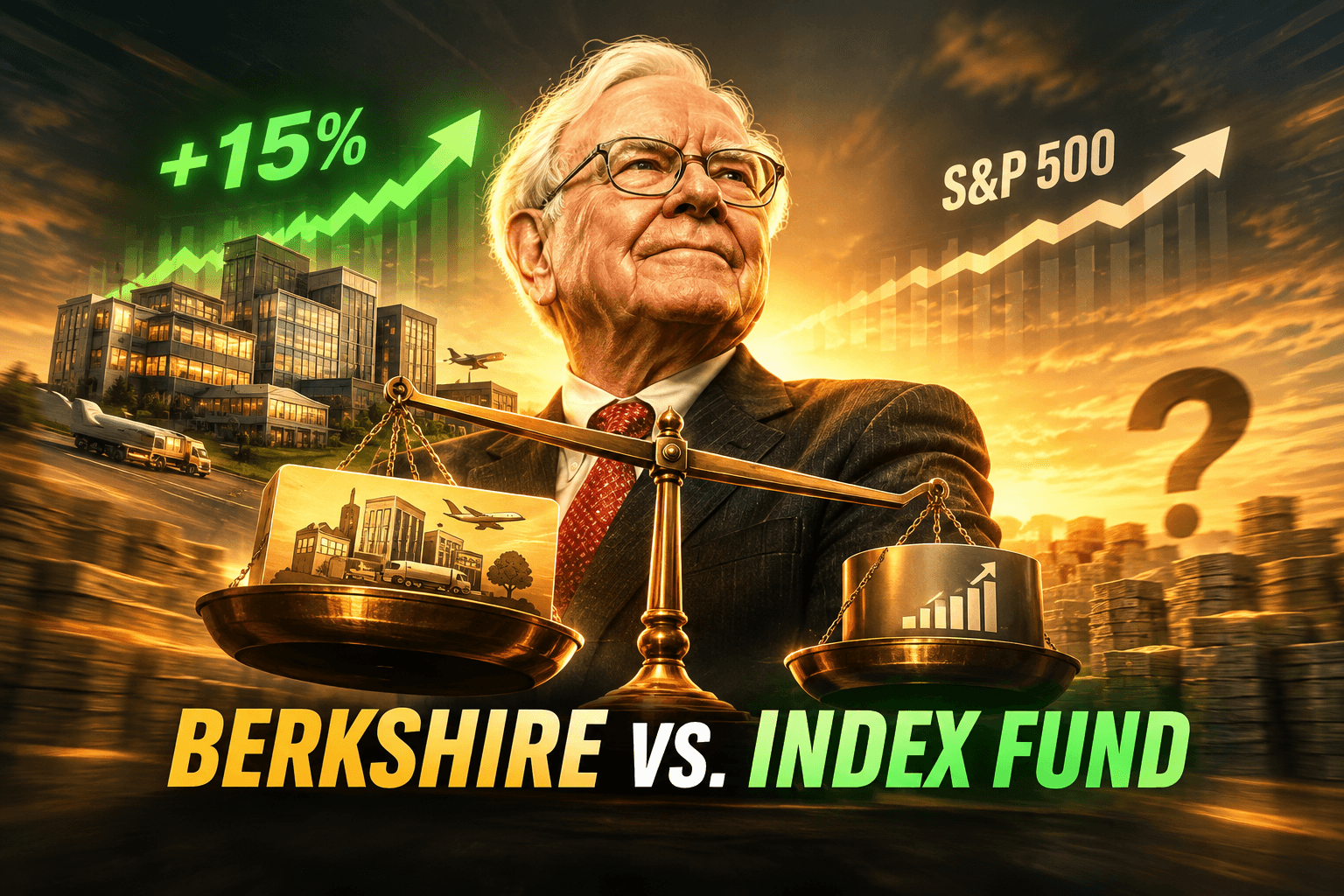
Berkshire Hathaway is up 15% in 2026 and easily beating the S&P 500, a strong showing that puts the stock in focus for investors deciding whether to own an individual company or an index fund. The performance is encouraging, but one year's outperformance alone doesn't show that Berkshire is a better long-term fit for your portfolio.
The available source doesn't provide Berkshire's current share price, the S&P 500's return for the comparison period or valuation multiples, so those figures can't be compared here. The central portfolio trade-off is clearer: Berkshire offers exposure to a collection of operating businesses and publicly traded stocks, while an index fund offers broad market exposure. Whether that concentration and mix suit you depends on your goals and tolerance for periods of underperformance.
What's Happening
The reported gain has come as AI-related jitters weigh on tech-heavy index funds, while Berkshire has held up better. The source describes the company as continuing to pull ahead under Greg Abel's leadership. That gives Berkshire a favorable momentum story, but the source doesn't supply a return breakdown by business, stock holding or period beyond 2026.
- Berkshire's reported 2026 gain is 15%, the clearest performance figure in the available reporting.
- The source says Berkshire is easily beating the S&P 500, but doesn't state the index's exact return. The size of the gap therefore can't be quantified here.
- Berkshire reported roughly $348 billion in cash, cash equivalents and U.S. Treasury bills at the end of 2024. That historical figure signals financial flexibility, but the cash balance changes over time and shouldn't be treated as a current balance.
- The cash figure refers to the end of 2024, not the end of 2026. Investors comparing Berkshire with an index fund should avoid using it as a live measure of deployable capital.
Berkshire is a diversified holding company rather than a pure-play operating business. Its major interests span insurance, railroads, utilities, energy, manufacturing and a large portfolio of publicly traded stocks. That breadth may spread exposure across different kinds of businesses, but it also means the company's results won't track one industry or the S&P 500 in a consistent way.
Berkshire doesn't pay a regular dividend. If you rely on investments to distribute cash, that difference is important: an index fund or another investment that pays distributions may better match an income-focused plan. The source provides no earnings, revenue or valuation figures for the current period, so a deeper comparison of business performance and price multiples isn't possible from the reported data.
Why It Matters For Your Portfolio
For growth-oriented investors, Berkshire's 2026 performance shows that a diversified company can outperform a tech-heavy index during a period of AI-related uncertainty. But its gains don't establish that the same pattern will continue. If technology stocks rebound or Berkshire's value-oriented holdings fall out of favor, relative performance could change.
For investors who want broad market exposure, an index fund and Berkshire aren't interchangeable. Berkshire combines operating businesses with public-stock investments, while an index fund is designed to track its benchmark. The right comparison depends on what exposures you already hold and whether you want a single-company position alongside diversified funds. Income-focused investors should also account for Berkshire's lack of a regular dividend. The available source gives no analyst ratings or price targets, so there is no reported consensus view to weigh against the performance story.
Risks To Consider
- Leadership succession remains a long-term consideration as Warren Buffett ages. Greg Abel is designated to lead the company after Buffett, making the transition and execution under future leadership important issues to monitor.
- Berkshire's large cash balance can be difficult to deploy at a scale that materially moves results. A substantial reserve creates flexibility, but it doesn't guarantee attractive acquisitions or investment returns.
- Berkshire can lag the broader market when its sectors or value-oriented holdings are out of favor. The 2026 gain doesn't remove the risk of future relative underperformance.
The bear case is that Berkshire's mix of businesses and investments fails to keep pace with a rising index, while cash remains underused and the leadership transition draws investor attention. That would weaken the argument for choosing Berkshire over a broad-market fund, even if the company's underlying businesses remain diversified.
What To Watch Next
Investors can track whether the current performance advantage persists, but a meaningful comparison requires current figures for both Berkshire and the S&P 500. The source doesn't provide a share-price level, valuation target or specific upcoming reporting date, so there are no verified price thresholds or calendar catalysts to cite.
- Watch for market downturns or attractive acquisition opportunities that could let Berkshire deploy cash at favorable prices.
- Monitor insurance underwriting and investment income, identified as potential supports for operating earnings.
- Follow performance at BNSF and Berkshire Hathaway Energy, two major businesses highlighted as operating-earnings drivers.
- Pay attention to leadership succession and the company's ability to invest its cash productively. The roughly $348 billion figure is from the end of 2024 and isn't a current cash update.
These developments could affect Berkshire's ability to sustain its performance, but the available information doesn't establish when any catalyst will occur or how it would change the stock's valuation.
The Bottom Line
- Berkshire's reported 15% gain in 2026 and outperformance of the S&P 500 are positive signals, not proof of future outperformance.
- Its mix of insurance, railroads, utilities, energy, manufacturing and public stocks differs from the exposure provided by an index fund.
- The reported roughly $348 billion cash reserve dates to the end of 2024. Check for updated company figures before treating it as current.
- Consider your need for broad diversification and investment income. Berkshire does not pay a regular dividend.
- There isn't enough information here to make a buy, sell or hold call. Compare current valuation and performance data, and decide whether Berkshire's specific business mix complements your portfolio.
FAQ
Q: Is Berkshire Hathaway a better investment than an index fund?
A: The reported 2026 outperformance is notable, but it doesn't establish that Berkshire will outperform over a longer period. The two choices offer different exposures, and the available source doesn't provide enough current valuation data for a full comparison.
Q: Does Berkshire Hathaway pay a dividend?
A: Berkshire doesn't pay a regular dividend. Investors seeking cash distributions may prefer an index fund or another investment that pays them.
Q: How much cash does Berkshire Hathaway have?
A: Berkshire reported roughly $348 billion in cash, cash equivalents and U.S. Treasury bills at the end of 2024. The balance changes over time, so this historical figure shouldn't be read as its current cash position.