
 Alpha Breaking
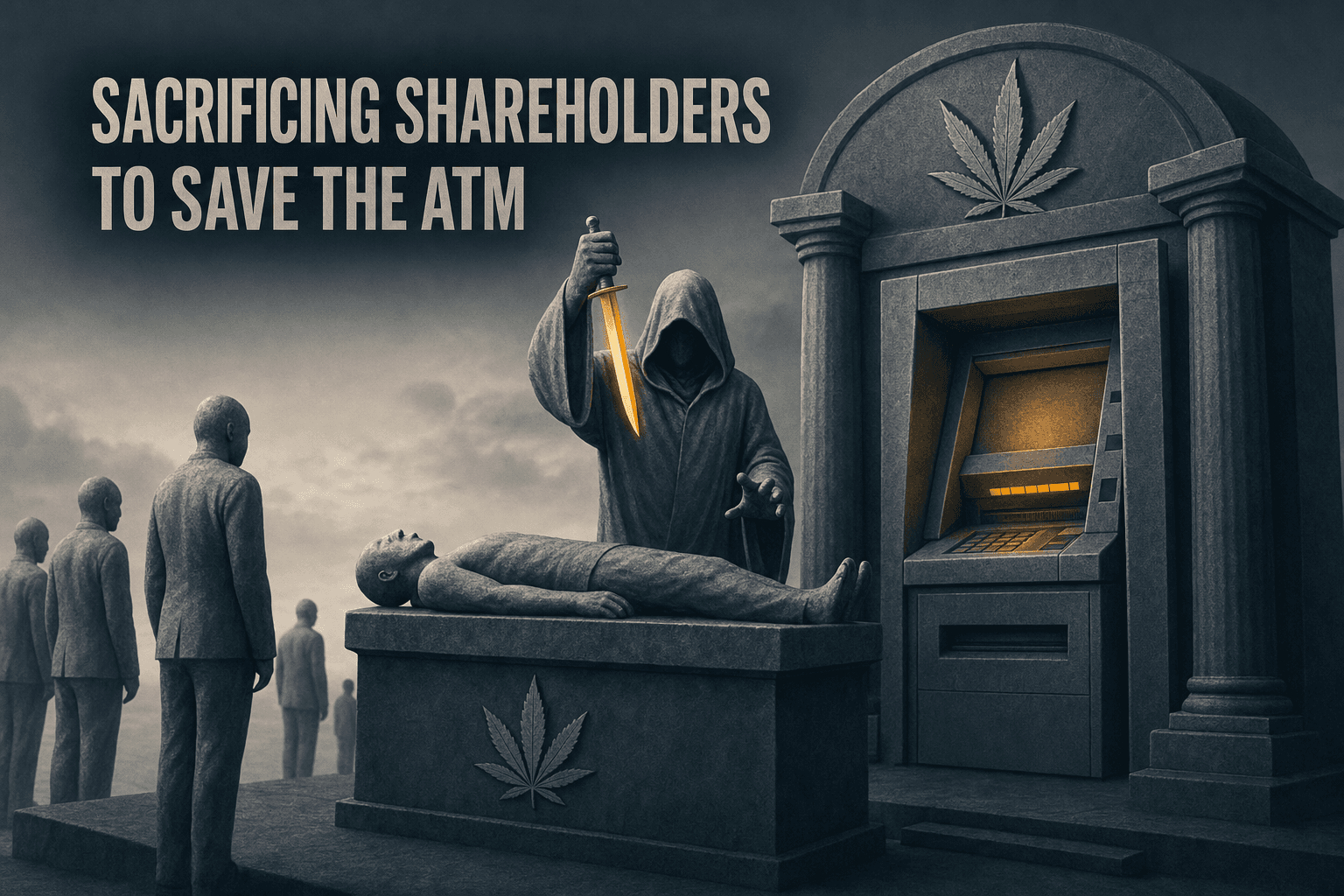
Aurora Cannabis Sacrificing Shareholders to Save the ATM
Share this article
Spread the word on social media
Aurora Cannabis’s shareholder blood sacrifice only makes sense one way
Aurora Cannabis $ACB sold its own stock through an at-the-market program for as low as US$2.60 a share in July. Six weeks later the same board looked at a US$4.00 to US$5.00 bid from Curaleaf $CURLF and called it inadequate. Curaleaf has now come at them twice in public and at least twice in private. The October 5 bump is worth about US$5.00 a share, an 86% premium to where the stock sat before Boris Jordan showed up with a checkbook. Aurora's response: take no action, the special committee is reviewing.
You can't have it both ways. If the stock was worth five bucks, why was the company dumping it at $2.60? And if it wasn't worth five bucks, what exactly is the board protecting? We've got a theory. It's the paychecks. We pulled every filing we could find, and they back it up.
Two reverse splits and a 120-for-1 haircut
If you bought $ACB at the October 2018 top and held, you're down more than 99%. The split-adjusted high was about US$1,503 a share. Sit with that number for a second. Aurora got there with two reverse splits. The first was 1-for-12 on May 11, 2020, after the stock sat under a buck for more than 30 days and the NYSE came knocking. That one took the share count from north of 1.3 billion down to about 110 million. The second was 1-for-10 on February 20, 2024, the same morning they announced the CFO was leaving. The stock printed an all-time low that day.
So 120 old shares became one new share. A thousand shares in 2018 is eight shares now. A reverse split doesn't create a dime of value. It moves the decimal so the ticker doesn't get kicked off the exchange. And before anyone says Curaleaf did one too: yes, a 1-for-3 in June, to clear the price bar for a U.S. listing. That's a listing mechanic on the way up. Aurora's were a survival mechanic on the way down. Not the same thing.
Where the money went
The balance sheet keeps the receipts, so we don't have to guess. At March 31, 2026, the accumulated deficit was C$6.44 billion. Share capital, which is the money shareholders actually put in over the years, was C$7.0 billion. Ninety-two cents of every dollar investors handed this company is gone. Total equity is C$512 million, and the deficit was still growing at June 30.
It wasn't always like this. At June 30, 2018, Aurora had retained earnings of C$88 million. Positive. Eight years later the hole is C$6.4 billion, so roughly C$6.5 billion got lit on fire in under eight years. Most of it was goodwill and asset write-downs from the acquisition spree: MedReleaf, CanniMed, Whistler, Reliva and the rest of the collection. They paid top of the market for growth, mostly in stock, then wrote the whole thing off.
And it's still bleeding. Fiscal 2026, the year ended March 31, 2026, was sold to the Street as a record year. Net revenue came in at C$321 million, up 11%. Adjusted EBITDA hit C$54 million. Net loss from continuing operations? C$58.6 million, with C$27.6 million of that in the fourth quarter alone. "Record" is doing some heavy lifting in that press release. Aurora has lost money in five of its last six fiscal years, and we'd bet on six of seven.
The revenue reality
We'll give them this: the international medical business is real. Germany and Poland are growing. Medical was 91% of fourth-quarter net revenue, and 55% of fiscal 2026 sales came from outside Canada. That footprint is the whole reason Curaleaf wants the company. The Canadian consumer business is basically gone: C$3.6 million in Q4, down from C$8.2 million a year earlier. They sold the controlling stake in Bevo, the plant business, in February 2026.
Then the June quarter hit. Net revenue fell 9% to C$67.6 million. Adjusted EBITDA dropped 68% to C$3.4 million. Free cash flow went negative. Veterans Affairs Canada cut its reimbursement from C$8.50 a gram to C$6.00 on April 1, and Canadian medical revenue fell 25% right there. Management is now guiding total net revenue down for the full year. The record year was the top, at least for now. When Curaleaf says Aurora is a smaller, less profitable company than it was in 2025, that's not spin. That's Aurora's own guidance.
Two more things from the fine print. Aurora disclosed a new material weakness in internal controls for fiscal 2026, this one in biological assets and inventory valuation. For a grower, that's the whole ballgame. The ERP system meant to fix the control problems started in fiscal 2023 and is in year five. And Ernst & Young billed C$4.8 million in audit fees for the privilege.
The ATM is the business model
This is the part retail feels most. After the 2020 reverse split Aurora had about 110 million shares. Restate that for the 2024 split and it's 11 million shares in today's terms. At June 15, 2026, there were 61,956,924 shares outstanding. The float is up 5.6 times in six years. Through two reverse splits.
It isn't slowing down. Shares went from 56.2 million at March 31, 2025, to 58.9 million a year later, to 62.0 million by mid-June 2026. Ten percent more paper in 15 months. Some of it was the Safari Flower deal in April: 2,417,180 shares worth C$11.6 million, plus C$15 million in cash. The rest is the ATM. Aurora has a C$100 million at-the-market program and sold C$6.8 million of stock through it in the June quarter. Curaleaf's filings add the part Aurora didn't put in a press release: some of those shares went out as low as US$2.60 in July. There's C$87.1 million of room left on the program.
Hold that number. US$2.60. That's what management took for the stock in July, six weeks before the board told shareholders US$5 "significantly undervalues" it. A company with C$149 million of cash and no debt was selling shares at the lows. There's one reason to do that. Keep the treasury full while the business burns, because the treasury is what pays everybody. The ATM fed the house. Shareholders picked up the tab.
Curaleaf shows up with a checkbook
The timeline, from both sides' filings. Curaleaf sent a first letter June 22, no price. A priced proposal landed July 7. Aurora's board rejected it July 10, three days later. Lead independent director Michael Singer kept writing back to Jordan through July 24, saying Aurora was focused on executing its plan over the short to medium term. Nobody opened a data room.
August 11, Curaleaf went public: 0.3463 Curaleaf shares plus US$0.75 cash per Aurora share, call it US$4.00, capped at US$5.00. Aurora's same-day response said the cap was below where the stock traded as recently as December 18, 2025. That's the whole defense. Anchor to a price from eight months earlier, before the VAC cut, before revenue rolled over, before EBITDA fell 68%. The formal bid landed August 18. On September 2 the board rejected it unanimously and Miguel Martin called it harmful and inadequate.
October 5, Curaleaf came back: 0.4013 shares plus US$1.00 cash, about US$5.00, cap raised to US$6.00, offer open through December 4. Jordan says he's met a significant chunk of Aurora's holder base and they all back the deal. He says Aurora still won't let him do diligence, so the bid was built off public filings, and he wants a fair process if anyone else is getting a look under the hood. Curaleaf filed the variation on October 6. Aurora says the special committee will review it. The stock moved to about US$4.48. Every dollar of that move is Curaleaf's, not management's.
Some of Aurora's pushback is legit. Curaleaf carries more than US$1 billion in liabilities, by Aurora's count, against Aurora's C$149 million in cash and zero debt. Jordan controls Curaleaf through multi-voting shares, so Aurora holders would own about 7.7% of the combined company with 3.2% of the vote. Mostly paper, with a cap. We get it. Those are reasons to negotiate the price and the mix. They aren't reasons to refuse diligence and reject everything on sight. This is the first hostile deal in cannabis since 2019, and the target still hasn't named a number it would take.
About that "strong shareholder support"
Aurora's August 18 release leaned on the strong support it got at the 2026 annual meeting. We looked. At the 2025 meeting, say-on-pay was defeated with 39.36% in favour. Director Theresa Firestone got more votes withheld than for and had to resign under the majority voting policy. That's a revolt.
At the 2026 meeting on August 7, 26.86% of the shares bothered to show up. Martin was re-elected with 5,076,096 votes. That's about 8% of the shares outstanding. Say-on-pay passed with 82.97% of votes cast, after the CEO handed back half of one PSU grant and ISS blessed the new design. So the "strong support" being waved at a US$5 bid is five million shares. Curaleaf claims more than that already wants a sale. We'll see who shows up by December 4.
What Miguel got paid
Miguel Martin took over as CEO in September 2020 with the stock north of US$40, split-adjusted. It was around US$2.75 the day before Curaleaf's plans went public. Down more than 90% on his watch, before a bidder rescued the tape. The pay, in Canadian dollars, straight from the circulars. Fiscal 2021, about C$4.4 million. Fiscal 2022, C$4.86 million. Fiscal 2023, a nine-month year, C$6.72 million. Fiscal 2024, C$8.02 million. Fiscal 2025, C$6.37 million. Fiscal 2026, C$4.90 million.
Thirty-five million Canadian in under six years. The fiscal 2024 number included C$4.18 million of "all other compensation," which was the last payout from Aurora's 2020 purchase of Reliva, Martin's old company, plus a cash retention bonus. So he got paid for selling his company to Aurora, then got paid to run the company that bought it. In fiscal 2023, nearly 40% of his comp was a C$2.5 million retention bonus in RSUs. The stock fell 52% that year.
Base salary has been flat at US$573,609 since 2022, and the 2026 management information circular says that like it's a virtue. The salary was never the problem. The equity was. After the 2025 vote the board hired Mercer as a new comp consultant, hired Hansell McLaughlin to review the board, kept Kingsdale on a global retainer to run investor campaigns, and had Martin give back half of one PSU grant worth C$737,913. For fiscal 2027 they cut his target long-term incentive from 375% of salary to 325%. Still more than three times salary in stock, every year, at a company that loses money.
One more from Mercer's first assignment: the new fiscal 2027 peer group puts more weight on similarly sized pharmaceutical and biotech companies. In English, benchmark the CEO against pharma, where pay runs higher, instead of against cannabis companies that are also under water. Martin also holds both chairs. Executive Chairman and CEO. Four of five directors are independent on paper. In practice one guy runs the boardroom and the business, and that's the guy calling Curaleaf's bid inadequate.
The board
Five seats, four of them paid as outside directors. The audited financials show cash director fees of C$378,000 in fiscal 2026 and C$383,000 in fiscal 2025, with deferred share units on top. The fiscal 2025 circular shows what a seat pays. Singer: C$75,333 in fees and C$161,228 in share-based awards, C$236,562 total. Rajesh Uttamchandani, on the board since May 2024: C$185,705.
Singer is the one to watch, and he's the one who was trading letters with Jordan. He's been on the board since May 2016. Non-Executive Chairman, then Executive Chairman, then Interim CEO through the 2020 collapse, then Executive Chairman again until May 2021. Today he chairs the comp committee and he's the lead independent director. The board calls him independent. In fiscal 2018 he was paid C$1.1 million, part of it advisory fees routed through a company he controls. Fiscal 2019, C$2.2 million. Fiscal 2020, the year of the C$3.3 billion loss, C$2.86 million. Add his director pay for fiscal 2023 through 2025 and the documented total is about C$6.8 million, and that skips two fiscal years we couldn't pull. The man who sat at the top through the worst of it is now the one telling you the pay plan is fixed and the bid is too low.
Norma Beauchamp has been there since July 2018. She came over with MedReleaf, the C$3.2 billion all-stock deal Aurora later wrote down. She chairs the governance committee. Between the two of them, Singer and Beauchamp have overseen almost the entire C$6.4 billion deficit. Both got re-elected in August with about five million votes apiece.
Add it up. Key management compensation, meaning the executives plus the board, was C$15.1 million in fiscal 2026 for eight people. C$18.0 million in fiscal 2025 for ten. C$33 million in two years. At the unaffected share price, fiscal 2026 insider pay alone was more than 6% of the whole company. And it resets every April 1.
Pay vs. the peer group
On raw dollars Aurora isn't the worst in the sector. Tilray $TLRY owns that. Irwin Simon's fiscal 2026 package came in around US$22 million, roughly US$19 million of it in stock awards, with a CEO-to-median-worker ratio of 528 to 1. SNDL $SNDL paid Zach George C$8.7 million for 2024 on a retail-heavy business several times Aurora's size. Bigger companies, bigger checks, their own problems.
The closer comps hurt more. Canopy Growth $CGC paid Luc Mongeau US$3.6 million for fiscal 2026 at a 76-to-1 ratio. Cronos Group $CRON paid Mike Gorenstein US$4.07 million for 2025 with a flat salary and 94% say-on-pay support. Aurora only got down into Canopy's neighborhood in fiscal 2026 because Martin handed half a grant back after the vote. The two years before that he made C$8.02 million and C$6.37 million while the company got smaller.
Zoom out and it's worse. When Martin's fiscal 2024 pay came out, Simply Wall St screened Canadian pharma names with market caps between C$277 million and C$1.1 billion. Median CEO package: C$1.5 million. Martin's: C$8.0 million. Five times the median at a company that lost money that year. The Globe and Mail pointed out in January 2025 that Tilray, Canopy, Aurora and SNDL all caught heat on pay in 2024. Aurora's 2025 vote says the heat went up. Cronos got 94%. Aurora got 39%.
Who loses if Curaleaf wins
Our theory, plainly. Say Curaleaf closes. Aurora stops being a public company with its own board, its own comp committee and its own LTI plan paying out at 325% of salary. Four outside director seats vanish, and with them C$185,000 to C$240,000 a year each. The executive team gets folded into Stamford's org chart, and whoever doesn't make the cut gets severance. Martin's deal pays him 24 months of base plus a pro-rated bonus if he's terminated after a change of control, and the RSU plan now has a double trigger that vests his unvested stock in that scenario. A few million, once.
Against that, the standalone plan pays the top eight people about C$15 million a year, every year, with the board approving its own grants. Three more years of that is C$45 million. One check versus an annuity. We know which one we'd be defending from those chairs.
We can't see inside the boardroom, and we're sure the special committee's lawyers papered every step. We're saying the incentives all point one way and the behavior lines up: a priced offer killed in three days in July, no diligence, a defense anchored to a December stock price, and an ATM selling shares at US$2.60 the same summer the board decided five bucks was inadequate. Then "strong shareholder support" that adds up to five million votes. Draw your own conclusion. We've drawn ours.
How we're playing it
The bull case is one line: international medical is growing, Germany and Poland are real, there's cash and no debt. That's also the bull case for selling the company, which is why Boris Jordan is standing in the driveway with a boom box over his head playing “Money” by Pink Floyd as if he was John Cusack in “Say Anything.” At about US$4.48 against an implied US$5.00, the tape is pricing real doubt this gets done. Fair enough. The consideration is mostly Curaleaf paper, the cap is real, and the target's board is hostile.
Our standing rule in this sector applies: always assume the news doesn't happen. So ask the only question that matters. Would you own $ACB at US$4.48 if Curaleaf walked tomorrow? Revenue is guided down, EBITDA fell 68% last quarter, the share count is up 5.6 times since the first reverse split, and the stock was US$2.75 before the bid. We wouldn't. The only thing holding this price up is a bidder the board won't talk to. If the board says no a third time with nothing better in hand, the stock goes right back toward where the ATM was selling it. We'd rather trade around a core position in the names that actually earn money, and for us that's the U.S. operators.
And if Aurora's board really thinks the stock is worth more than US$5, there's an easy way to prove it. Stop selling shares at US$2.60 and open the data room.
If you want the deeper work, we laid out the Curaleaf reverse split and uplisting math and we took apart the rescheduling opposition's briefs when they landed.
Subscribe to StockAlpha for the receipts before the headlines.
Disclosure
Jefferson AI and the author hold no direct position in $ACB or $CURLF at the time of writing. The author holds positions in U.S. cannabis ETFs that may include Curaleaf. Neither Jefferson AI nor the author has a business relationship with Aurora Cannabis or Curaleaf. This article is for informational purposes only and is not investment advice. Figures come from company filings on SEDAR+ and EDGAR, company press releases and public proxy analyses, and are in Canadian dollars unless noted. Do your own work.