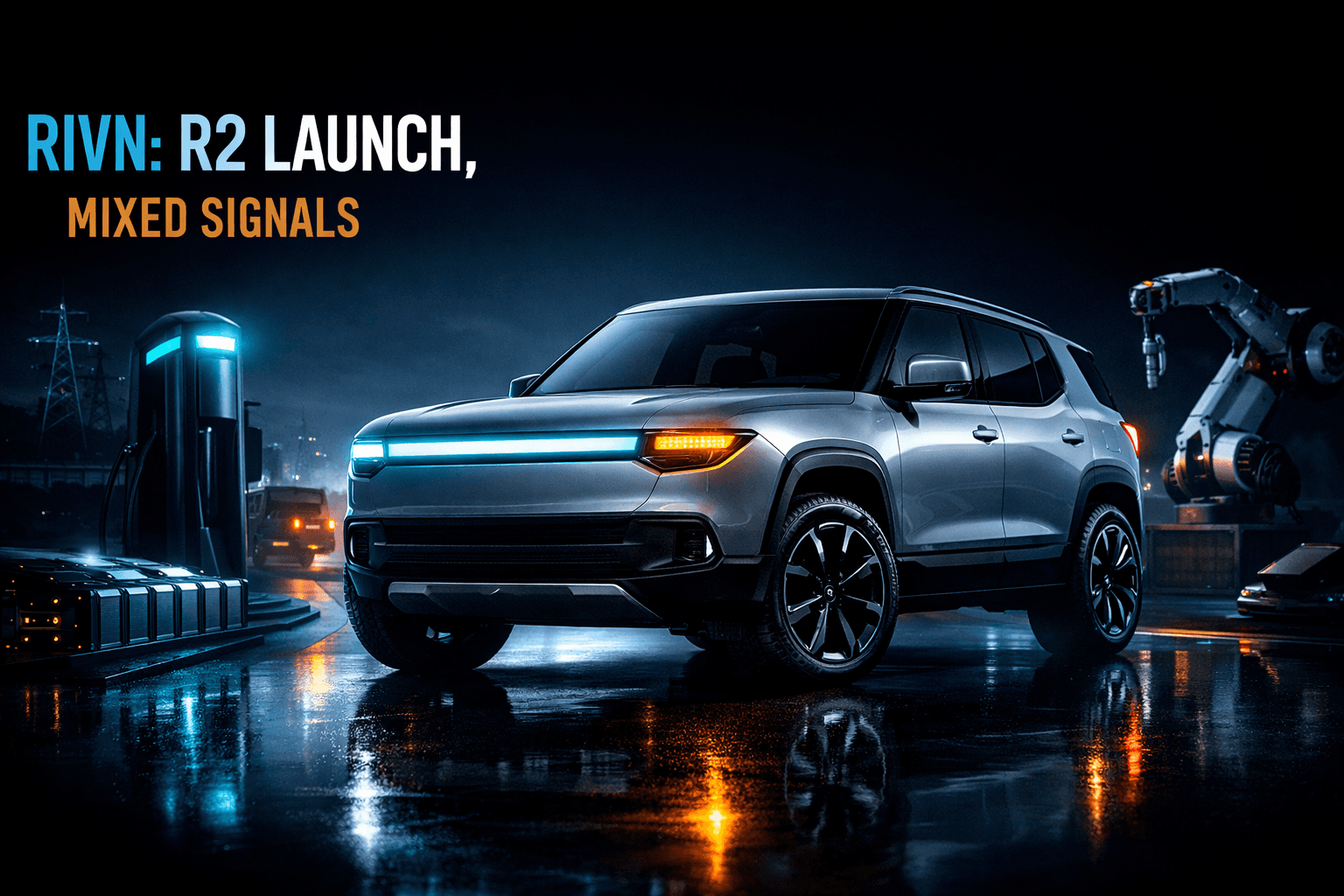
RIVN: R2 Launch, Mixed Signals
Rivian's R2 unveiling expands addressable market but brought pricing and timing questions that pressured the stock. The company shows solid liquidity and growth momentum, yet losses and execution risk keep the outlook mixed.
Executive Summary
Investment Thesis: Rivian is expanding from premium EV trucks into the higher-volume midsize SUV market with the new R2 lineup, which could materially broaden unit potential if margins and production timing hold. The R2's starting price of about $45,000 targets a larger consumer segment, but the delayed cheaper configuration and near-term cash burn raise execution questions. Balance sheet liquidity and a large addressable market provide optionality, however negative earnings and high capital intensity mean the growth story hinges on execution and cost control.
Current Price: $14.86 | Key Metric: Market Cap $18.44B | Stance: NEUTRAL
Company Overview
Rivian Automotive, Inc. ($RIVN) designs, develops and manufactures electric adventure vehicles and related services. The company has been best known for its R1T pickup and R1S SUV, and now aims to scale into the mainstream with the R2 midsize SUV.
Key Products & Competitive Position
- Core Business: Design, manufacturing and sales of battery electric vehicles and related charging and subscription services.
- Key Products: R1T pickup, R1S SUV, delivery vans for commercial customers, and the newly unveiled R2 SUV lineup targeting higher volume consumers.
- Competitive Moat: Strong brand for outdoors and adventure EV buyers, vertically integrated vehicle architecture, proprietary vehicle control software, and a growing charging ecosystem partnership network.
Recent Developments
Rivian unveiled the R2 midsize SUV with pricing starting around $45,000 across Performance, Premium and Standard trims. Management pushed a more affordable variant out to 2027, which created investor concern about the initial price gap relative to competitors. The company faces intensified comparisons to Tesla's Model Y, and the stock has traded lower after the unveiling as analysts and investors weighed timing and margin implications.
Financial Snapshot
Revenue & Earnings Trends
Rivian reported Q4 FY25 revenue of $1.29 billion and a GAAP loss of $811 million in that quarter. Revenue growth has shown promising top line expansion as production ramps, yet earnings remain deeply negative on a trailing twelve months basis. The EPS (TTM) at negative $3.07 reflects continued operating losses driven by high R&D, SG&A and capital costs tied to scale up.
Balance Sheet Highlights
The company carries a current ratio of 2.33, which indicates liquidity to fund near-term obligations. Cash burn remains a watch item given capital spend on the R2 launch and planned capacity expansion. Book metrics include a P/B of 5.29, which implies the market is pricing significant growth and intangible value into equity.
Valuation Analysis
Current Valuation Metrics
Historical Comparison
RIVN's current multiple profile is higher than historical averages for legacy automakers given it is valued more like a growth technology name. The P/S ratio is elevated because free cash generation is still negative and the market is pricing future growth. Compared with the 5-year window since IPO era levels, the share price is below its 52-week peak but well above its low, reflecting cyclical sentiment swings tied to product announcements and execution cues.
Fair Value Estimate
Valuing Rivian requires forecasting vehicle unit ramps, gross margins and capital intensity. Using a range-based approach, fair value midpoints align with the analyst average price target near $18, assuming successful R2 scale and progressive margin improvement toward mid-term guidance. If the R2 rollout is delayed or margins compress because of pricing pressure, fair value skews materially lower. The current market price of $14.86 suggests some of the upside is already priced in, while significant execution risk remains.
Competitive Landscape
Market Position
Market Share: Small for overall EV market, growing in niche adventure and truck segments | Ranking: Emerging challenger in EV auto manufacturing
Key Competitors
Competitive Advantages
- Moat 1: Brand identity tied to outdoor lifestyle and premium EV utility design, which resonates with a defined customer niche.
- Moat 2: Vertical integration and proprietary vehicle architecture that allow differentiated features and software updates.
- Moat 3: Early commercial van contracts and service network buildout provide diversification away from consumer-only sales.
Earnings Track Record
Last 4 Quarters: Mixed / Mixed
Recent Earnings History
Guidance Trend
Management has guided toward growing production and lowering per-unit costs as volume scales, but recent R2 timing and trim rollout updates imply guidance could be revised if supply chain or pricing dynamics change. Investors should watch management commentary in the next quarterly report for updated production and margin assumptions.
Analyst Sentiment
Consensus Rating:
Price Targets
- Low: $9.00
- Mean: $18.00 (+21% upside)
- High: $25.00
Recent Analyst Actions
TD Cowen upgraded $RIVN to Buy on 3/10/2026 and raised its price target from $17 to $20 citing the R2 introduction as a constructive long term volume catalyst. Other analysts have expressed mixed views because initial R2 pricing and the delayed lower priced variant push some volume out to 2027.
Recent News & Catalysts
Key Developments
- R2 Launch (Mar 12-13, 2026): Rivian unveiled the R2 midsize SUV with base pricing around $45,000. The lineup includes Performance, Premium and Standard trims. A lower priced configuration was delayed to 2027 which pressured shares.
- Investor Sentiment: Stock traded down roughly 16% in March amid concerns over R2 pricing and timing. Some analysts responded with upgrades citing long term potential, while others emphasized margin and cash burn risk.
- Macro and Regulatory: Broader regulatory news on emissions and semiconductor investment continues to influence the EV supply chain environment and cost outlook for manufacturers including Rivian.
Upcoming Catalysts
Next Earnings: Expected Q1 2026 on 2026-05-04 After Market | Key Events: Production guidance updates, R2 production timing, margin commentary, cash flow and capex plan
Technical Outlook
Current Price: $14.86 vs 52-Week High: $22.69 (-34.5% from high)
Trend Analysis
Price action year to date has been positive with RIVN up about 24.6% YTD, reflecting optimism on product expansion. The longer term trend remains choppy, with a recovery off the April 2025 low of $10.36 but the name has not reclaimed its 52-week high. Momentum indicators show short-term selling pressure following the R2 announcement, while the mid-term trend depends on visible progress toward volume production.
Key Levels
- Resistance: $17.50, $22.69
- Support: $12.50, $10.36
Bull vs Bear Case
Bull Case
- Catalyst 1: R2 successfully ramps with improving gross margins as scale reduces unit cost.
- Catalyst 2: Brand and differentiated EV features capture meaningful share in the midsize SUV market, expanding TAM.
- Catalyst 3: Execution reduces cash burn through higher volumes and manufacturing efficiencies, validating higher multiples.
Bull Target: $25 (+68%)
Bear Case
- Risk 1: R2 pricing and delayed lower priced variant push meaningful volume into 2027, compressing near-term revenue growth.
- Risk 2: Continued negative earnings and high capex needs force further equity dilution or borrowing on unfavorable terms.
- Risk 3: Intense competition from Tesla and scaled OEM EV programs reduces pricing power and squeezes margins.
Bear Target: $9 (-39%)
Risks to Consider
- Valuation Risk: The stock trades on expectation of future scale and margin improvement. If those assumptions slip, multiples could re-rate lower quickly.
- Competitive Risk: Tesla and legacy automakers have scale advantages and pricing flexibility which can pressure Rivian's market share and margins.
- Macro Risk: Interest rates, consumer demand sensitivity for discretionary autos, and input cost volatility can significantly affect profitability and demand.
- Execution Risk: Manufacturing ramp, supply chain constraints, and the timing of lower priced trims are critical. Delays or quality issues would materially impact revenue growth and cash flow.
Bottom Line
Investment Verdict: NEUTRAL
Rivian presents a classic high-optionaliy growth case, with the R2 rollout meaningfully expanding the addressable market. At the same time, persistent losses, elevated capital needs and intensifying competition make outcomes binary in the near term. The next few quarters of production data and margin commentary will be decisive for whether the company can convert product promise into consistent profitability.
Action Items for Investors
- Long-term investors: Monitor quarterly production and gross margin trends, and use material negative surprises on volume or margins to reassess thesis. Consider dollar cost averaging to smooth entry if you believe in the long-term market opportunity.
- Short-term traders: Watch for volatility around the next earnings date on 2026-05-04 and trade reaction to R2 production timing and price mix updates. Volatility may create intraday and swing opportunities, but risk is high.
- Risk management: Keep position sizes aligned with the high uncertainty profile, set stop levels for downside and define target exits if near-term catalysts fail to materialize.
What to Watch This Week
- Analyst commentary and model updates following the R2 announcement, including any changes to price targets.
- News on supply chain or production partners that could accelerate or delay R2 volume deployment.
- Macro headlines that move consumer discretionary sentiment, such as interest rate updates or consumer confidence data.
Sources
Share this report
Share this article
Spread the word on social media
Think RIVN will outperform? Prove it.
Free practice contests — earn Alpha CoinsExplore More Content
Disclaimer: StockAlpha.ai content is for informational and educational purposes only. It is not personalized investment advice. Sentiment ratings and market analysis reflect data-driven observations, not buy, sell, or hold recommendations. Always consult a qualified financial advisor before making investment decisions. Past performance does not guarantee future results.
Spotted something wrong? Report an error.