Sponsored company: POET Technologies Inc. is a paying sponsor of StockAlpha.ai. This report is not independent analysis. See our disclosures.
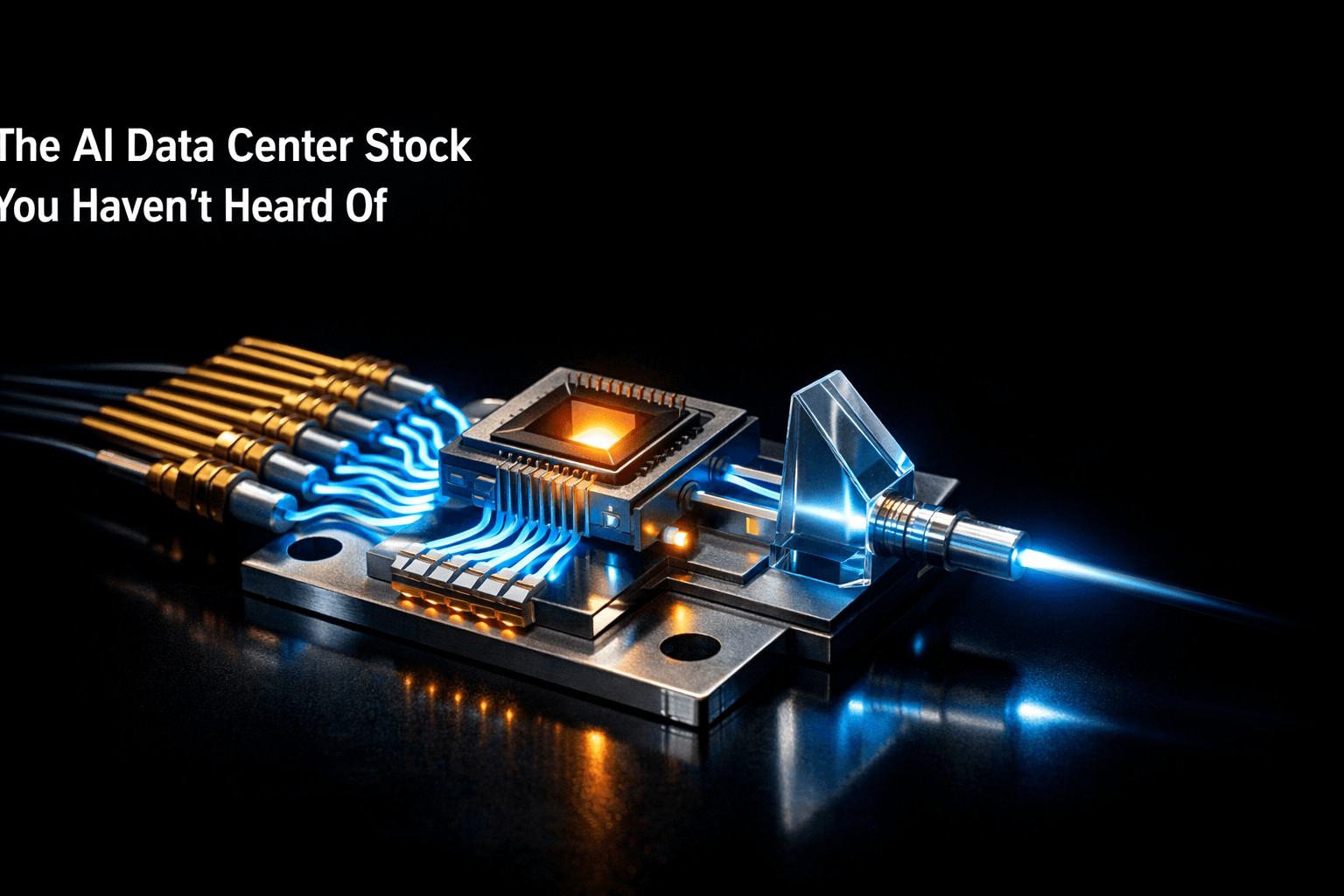
The AI Data Center Stock You Haven't Heard Of: POET
POET Technologies, a small-cap photonics player building Optical Interposer tech, backed by nearly $400M cash and major industry tie-ups
Why POET Deserves A Spot On Your AI Infrastructure Radar
Most retail and many institutional investors focus on the obvious names when they talk about the AI data center buildout, companies like Nvidia (NVDA), Marvell Technology (MRVL), Broadcom (AVGO), and $ANET.
But there’s a quieter, highly technical corner of the stack where photonics companies are solving the next communications bottleneck, and $POET is one of the few small-cap names directly positioned there.
What POET Does: Photonic Integrated Circuits And The Optical Interposer
$POET Technologies develops photonic integrated circuits, leveraging an Optical Interposer platform to combine optical and electronic functions in a compact package.
The goal is simple to state but hard to execute, build small, cost-effective optical engines that scale to multi-terabit speeds while keeping power and footprint down. That’s essential for AI racks where every watt and millimeter counts.
Why 1.6T Transceivers Are The Next Bottleneck
AI training and inference clusters are moving rapidly from 100G and 400G links to 800G and beyond, pushed by exponential model sizes and multi-GPU nodes.
Industry roadmaps point to 1.6T per lane as the next step to sustain bandwidth demands across switch fabrics and GPU interconnects. Without economical 1.6T and higher optical interfaces, compute scaling will be limited by I/O, not raw processing.
How POET Fits Into The Ecosystem
$POET sits upstream in the same ecosystem that powers $NVDA GPUs, $MRVL and $AVGO networking silicon, and $ANET cloud switches.
Those companies design compute and switching fabrics that need dense, low-power optical I/O to connect racks, pods, and disaggregated systems. POET’s Optical Interposer targets precisely that interface, potentially supplying optical engines and transceiver components that plug into merchant optics and module suppliers.
Partnerships And Product Direction: The $QUBT Tie-Up
POET’s collaboration with $QUBT is aimed at developing 3.2Tbps optical engines, an architecture that doubles the bandwidth envelope relative to 1.6T links.
That partnership is the kind of co-engineering many hyperscalers and switch silicon vendors prefer, because it pairs startups’ innovation with complementary IP and route-to-market benefits.
Market Opportunity: Optical Transceivers Going Big
Analysts and industry reports project the optical transceiver market to roughly double from about $5 billion to $10 billion by 2026, driven by hyperscale AI deployments and network upgrades.
That headline figure understates the high-margin opportunity at the leading edge, where multi-Tbps optics command premium pricing and are mission-critical to customers willing to pay for density and power efficiency.
Why POET Matters To Bigger Players
Large networking and silicon vendors need supply diversity and innovation to hit aggressive bandwidth and power targets. If POET’s optical interposer approach proves manufacturable at scale, companies like $MRVL, $AVGO, and switch OEMs such as $ANET could source next-gen optical engines instead of relying solely on incumbent photonics firms.
For $NVDA and hyperscalers, cheaper, more efficient optical I/O reduces system-level cost and power per inference or training step, directly improving ROI on new clusters.
"The optical interface is quickly becoming the gating factor for AI scaleouts, not compute alone."
Balance Sheet And Institutional Support
$POET is not a hobby project, it’s a capitalized company sitting on nearly $400 million in cash at the time of this article, providing a meaningful runway for R&D, pilot manufacturing, and customer qualification.
The firm also counts institutional and strategic partnerships that validate the approach and can accelerate commercialization if technical milestones are met.
Near-Term Catalyst: OFC 2026 In March
POET’s planned appearance at OFC 2026 in March is a notable near-term catalyst, providing a forum for demonstrations, partner announcements, and early customer engagement.
Trade-show activity can translate into press, design wins, and pilot programs that lift the company out of the noise for an audience of engineers and procurement teams who matter most.
Risks And Counterpoints
Execution risk. Photonics integration and scaling to volume manufacturing are technically difficult and capital intensive, even with cash on the balance sheet.
Competition. Large incumbents and vertically integrated players can outspend smaller firms on fabs, packaging, and customer programs, creating adoption hurdles.
Timing. Even with a compelling product, design cycles at hyperscalers and switch makers can be long, meaning revenue inflection may lag sentiment.
Multiple Viewpoints: Why Bulls And Skeptics Might Both Be Right
Bulls see POET as a rare small-cap way to access photonics innovation that aligns directly with AI infrastructure demand, with a clear path to supply multi-Tbps engines and a $300M cash cushion to fund the climb.
Skeptics point to the hard realities of manufacturing scale, incumbent relationships, and the risk that the market consolidates around a handful of suppliers, leaving niche players sidelined.
Potential Catalysts For 2026
OFC 2026 demos and press, which could reveal working prototypes and partner testimonials in March.
Progress on the $POET x $QUBT 3.2Tbps engine, including customer trials or design wins with switch OEMs and hyperscalers.
Qualification milestones with merchant optics houses or module integrators that would signal a path to volume shipments.
Continued cash runway management and potential strategic investments or offtake agreements from larger players seeking supply diversity.
Macro demand signals: if the optical transceiver market trajectory continues toward the projected $10 billion mark by 2026, adoption timing could accelerate materially.
Bottom Line
$POET Technologies is not a household name, but it occupies an important niche at the intersection of photonics and AI-scale networking.
With demonstrable technology around photonic integrated circuits and an Optical Interposer platform, institutional support, about $300 million in cash, and a public partnership to pursue 3.2Tbps engines with $QUBT, POET is worth watching as the industry moves toward 1.6T and beyond.
The upside depends on execution and timing, and the March OFC show and 2026 qualification milestones will be the clearest near-term tests of whether POET can convert technical promise into commercial traction.
Share this report
Share this article
Spread the word on social media
Think POET will outperform? Prove it.
Free practice contests — earn Alpha CoinsExplore More Content
Compensation Disclosure: Jefferson Equity Derivatives & Intelligence LLC has been compensated for the promotion of POET Technologies Inc. (NASDAQ: POET). POET Technologies Inc. paid five hundred five thousand dollars ($505,000) USD Cash for a marketing program (March 1, 2026 through December 31, 2026). As a result, our opinion is neither unbiased nor independent. The publishers hold no securities of the Company. This marketing may increase investor awareness, trading volume, and share price, which may be temporary. Full disclaimers.
Disclaimer: StockAlpha.ai content is for informational and educational purposes only. It is not personalized investment advice. Sentiment ratings and market analysis reflect data-driven observations, not buy, sell, or hold recommendations. Always consult a qualified financial advisor before making investment decisions. Past performance does not guarantee future results.
Spotted something wrong? Report an error.