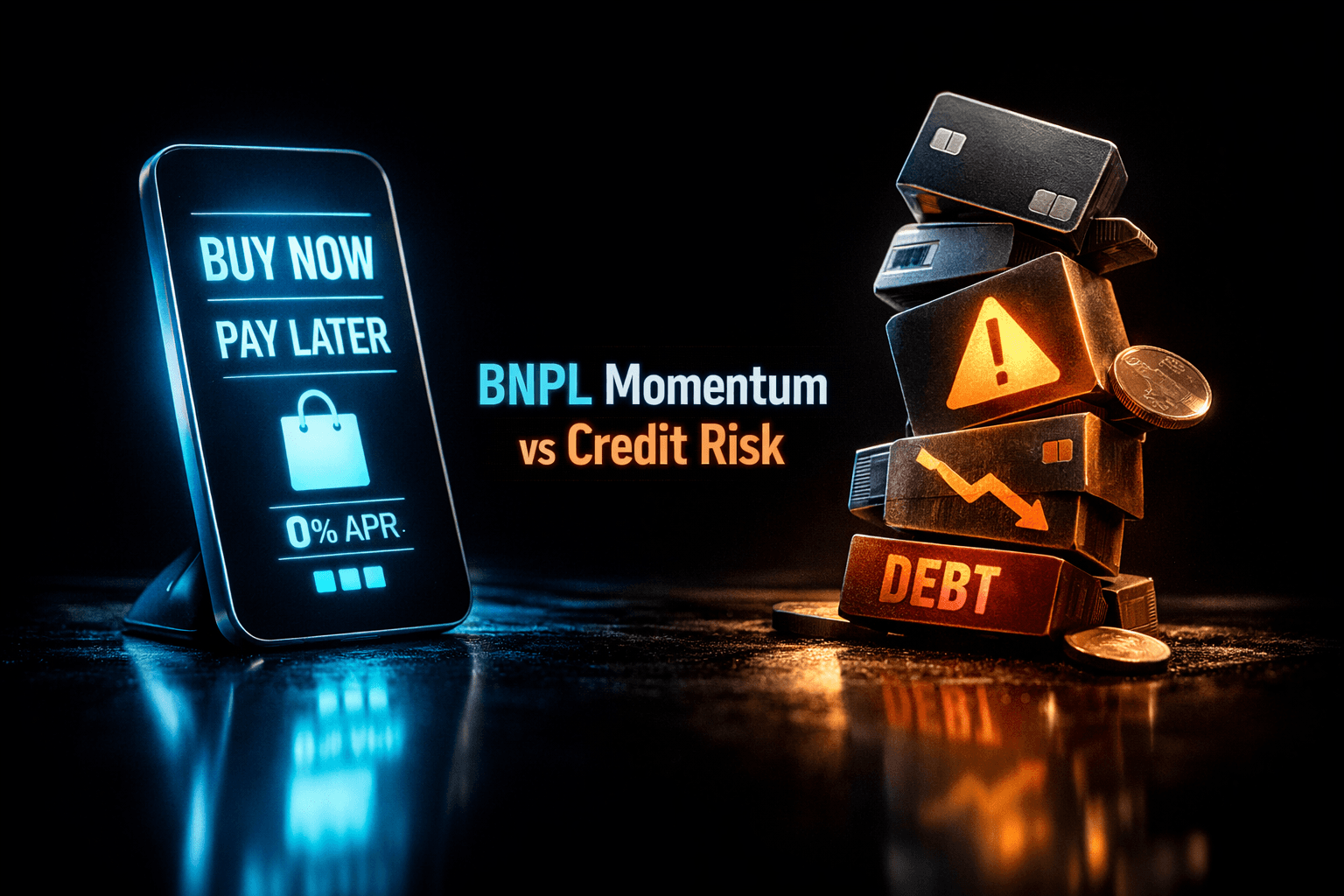
AFRM: BNPL Momentum vs Credit Risk
Affirm ($AFRM) shows strong product traction in cards and merchant adoption, but funding and credit cycle pressure create a mixed risk/reward for investors heading into Q3 2026 earnings.
Executive Summary
Investment Thesis: Affirm ($AFRM) is a leading BNPL and consumer payments platform that has broadened product mix into the Affirm Card and merchant partnerships. Unit economics and card adoption point to durable revenue expansion, while an elevated beta and lending exposures create meaningful cyclicality. Liquidity metrics look healthy today, but funding and macro credit stress could compress margins and increase delinquency if the economy weakens.
Current Price: $43.82 as of Friday, March 20 | Key Metric: P/E 51.69 | Stance: NEUTRAL
Company Overview
Affirm Holdings, Inc. ($AFRM) operates a point-of-sale lending platform that lets consumers split purchases into installment payments, and it has expanded into card products and broader payments infrastructure. The company connects consumers, merchants, and financing partners to offer flexible payment options and data-driven underwriting.
Key Products & Competitive Position
- Core Business: Consumer point-of-sale lending and payments, with underwriting and loan servicing tied to merchant transactions.
- Key Products: Installment loans at checkout, Affirm Card, merchant integration tools, and loyalty/analytics services for partners.
- Competitive Moat: Merchant relationships, underwriting dataset, and integrated checkout tools that increase conversion and stickiness for merchants.
Recent Developments
Management has emphasized card growth and improved unit economics in recent quarters, and some guidance for FY2026 was reportedly raised. The company has also discussed consumer demand trends and macro risks publicly. At the same time, there are rising concerns in the private credit market and commentary questioning BNPL extensions like rent payments given strained household finances.
Financial Snapshot
Revenue & Earnings Trends
Affirm has been expanding top-line via the Affirm Card and deeper merchant penetration, and year-to-date returns outpaced the market. Trailing EPS is positive at $0.78, but the trailing P/E of 51.69 implies high growth expectations. Recent commentaries point to improving unit economics at higher margins, though the company remains sensitive to credit performance and funding costs.
Balance Sheet Highlights
Liquidity appears strong on a short-term basis, with a current ratio of 5.29 suggesting ample working capital. The balance sheet is asset-light on the payments side, but the lending book and receivables expose Affirm to credit losses and funding market stress. The company’s ability to access capital markets and securitization channels will be a determinant of growth resilience.
Valuation Analysis
Current Valuation Metrics
Historical Comparison
Current multiples remain elevated relative to broad financials because Affirm is priced on growth rather than current earnings power. The stock’s 52-week drop from $100 to the mid-$40s has lowered implied expectations, but multiples still sit above many legacy payments names. Historically, valuation expanded with accelerating card adoption and compressed when credit metrics deteriorated.
Fair Value Estimate
Combining a multiples approach and conservative DCF inputs that assume gradual margin expansion and a normalization of delinquency rates, a fair value range of roughly $55 to $80 emerges, with a midpoint near $67. This range assumes access to securitization markets and modest deleveraging of funding costs. If credit stress intensifies, fair value would drift lower.
Competitive Landscape
Market Position
Market Share: material share of US BNPL checkout volume | Ranking: top 3 in BNPL/payments integrated at checkout
Key Competitors
Competitive Advantages
- Moat 1: Merchant integrations that improve conversion and retention for partners.
- Moat 2: Underwriting dataset and pricing ability that can improve loss-adjusted margins over time.
- Moat 3: Product diversification, notably the Affirm Card, which increases lifetime value per customer.
Earnings Track Record
Last 4 Quarters: 3 beats / 1 miss
Recent Earnings History
Guidance Trend
Management has pointed to improving acquisition and margin metrics and at least one analyst note referenced raised FY2026 guidance. Guidance has shown modest upward revisions tied to card and merchant momentum, but future guidance will be sensitive to credit quality and funding cost assumptions.
Analyst Sentiment
Consensus Rating:
Price Targets
- Low: $45
- Mean: $72 (+64% upside)
- High: $113
Recent Analyst Actions
Several analysts have reiterated bullish views following stronger card adoption and improving unit economics. Others have flagged credit and funding sensitivity after recent commentary from central bank officials and private credit stress in energy and leveraged lending. Net, the analyst base remains overweight but divided on timing.
Recent News & Catalysts
Key Developments
- The Coming Credit Crunch (3/21/2026): Industry pieces flagged cracks in private credit markets and tighter liquidity, which could raise funding costs for originators of consumer loans.
- Fed Signals Higher Inflation Outlook (3/18/2026): Markets reacted to Fed commentary suggesting inflation may linger, a backdrop that can keep funding costs elevated and pressure rates on retail balances.
- Company Transcript & BNPL Debate (3/17/2026): Management discussed consumer demand, credit trends, and macro risks while public commentary debated Affirm’s expansion into BNPL for rent payments.
Upcoming Catalysts
Next Earnings: Expected 2026-05-07 After Market | Key Events: Q3 2026 results, commentary on delinquencies, securitization and funding access, and merchant adoption metrics for the Affirm Card
Technical Outlook
Current Price: $43.82 as of Friday, March 20 vs 52-Week High: $100.00 (-56.2% from high)
Trend Analysis
Price action shows large moves driven by sentiment around credit and macro headlines. The stock is far off its 52-week high but sits comfortably above the 52-week low near $30.90. Momentum can flip quickly given the high beta of 3.77, so watch volume and changes in credit spreads for signs of direction.
Key Levels
- Resistance: $55, $68
- Support: $32, $30
Bull vs Bear Case
Bull Case
- Catalyst 1: Continued rapid adoption of the Affirm Card drives higher NTM revenue and improved lifetime value per customer.
- Catalyst 2: Unit economics improve as underwriting data reduces loss rates and origination costs fall with scale.
- Catalyst 3: Market underestimates the margin expansion potential from merchant fees and card interchange, leaving material upside to multiples.
Bull Target: $113 (+158%)
Bear Case
- Risk 1: A tightening funding environment or higher securitization costs compress margins and slow loan originations.
- Risk 2: Credit deterioration increases loss rates, pushing reserves higher and weighing on earnings.
- Risk 3: Regulatory or competitive pressure on BNPL terms reduces merchant economics or volume growth.
Bear Target: $30 (-31%)
Risks to Consider
- Valuation Risk: High trailing P/E and premium multiples mean the stock is sensitive to any slowdown in growth or worsening credit metrics.
- Competitive Risk: Large payments and tech companies can deploy resources to copy or undercut BNPL features at scale.
- Macro Risk: Elevated inflation and private credit stress could tighten funding and raise borrowing costs for loan originations.
- Execution Risk: Expanding into new products like rent BNPL increases customer credit exposure and may worsen delinquency metrics if the economy softens.
Bottom Line
Investment Verdict: NEUTRAL
Affirm is a growth-oriented fintech with strong product momentum and improving unit economics, especially around the Affirm Card. At the same time, high valuation multiples and outsized exposure to credit and funding markets create meaningful downside risk if macro conditions deteriorate. For many investors, the current price reflects a mix of opportunity and risk rather than a clear buy or sell signal.
Action Items for Investors
- Long-term investors: Monitor delinquency trends, funding access, and card adoption metrics before increasing exposure, and consider dollar-cost averaging if you believe in the long-term thesis.
- Short-term traders: Trade the high volatility with defined risk limits, track credit spread moves and Fed commentary, and be prepared for rapid intraday swings.
- Risk management: Use position sizing that reflects the stock's 3.77 beta, set stop-loss levels aligned with your risk tolerance, and watch securitization and funding announcements closely.
What to Watch This Week
- Any follow-up commentary or reports on private credit and funding market stress.
- Consumer credit and delinquency data that could foreshadow changes to Affirm's loss assumptions.
- Pre-earnings commentary from management ahead of the expected 2026-05-07 Q3 report, particularly on securitization access and card metrics.
Sources
Share this report
Share this article
Spread the word on social media
Think AFRM will outperform? Prove it.
Free practice contests — earn Alpha CoinsExplore More Content
Disclaimer: StockAlpha.ai content is for informational and educational purposes only. It is not personalized investment advice. Sentiment ratings and market analysis reflect data-driven observations, not buy, sell, or hold recommendations. Always consult a qualified financial advisor before making investment decisions. Past performance does not guarantee future results.