The Big Picture
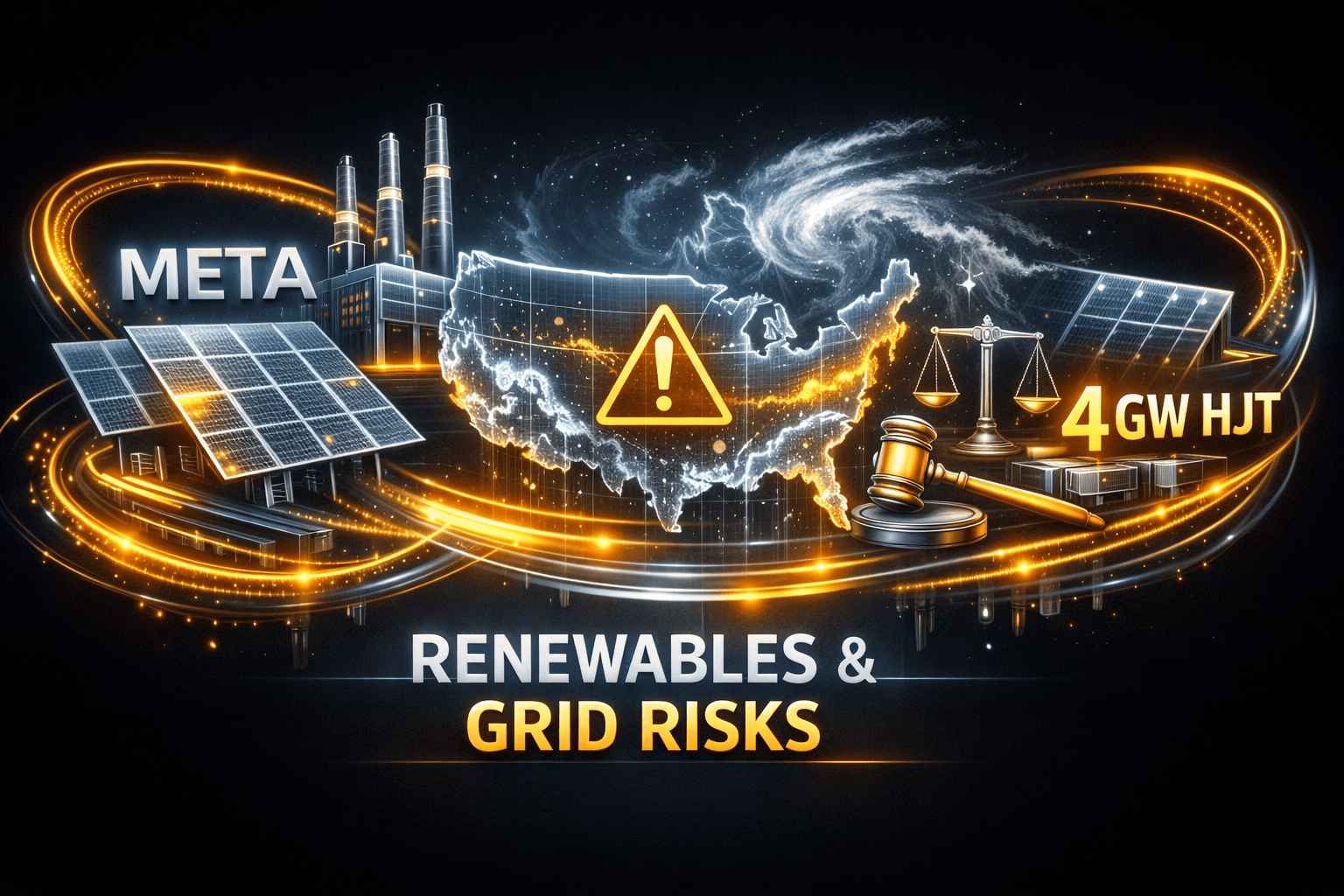
Renewables growth and industrial-scale manufacturing led overnight Utilities sector headlines, but reliability strains and policy fights kept the story balanced. You saw major moves in corporate procurement and module output that signal durable demand for clean power, yet grid stress from recent winter storms and fresh federal rules add near-term uncertainty.
That matters because your exposure to generators, project developers, and grid services will see both opportunity and risk as these trends play out. How will faster renewables deployment coexist with reliability needs? That's the central question investors should keep top of mind today.
Market Highlights
Quick facts and the items you'll want on your radar this morning.
- Apex Clean Energy signed a power purchase agreement with $META for the Starling Solar project in Gonzales County, Texas, securing exclusive rights to 144 MW of solar output and associated renewable energy credits.
- SEG Solar has begun commercial-scale heterojunction technology, HJT, panel production at its Tomball, Houston facility, a site designed for 4 GW of capacity with AI-enabled inspection and digital production management.
- Advocacy consolidation: the Solar Energy Industries Association and the Coalition for Community Solar Access announced plans to join forces, a move that could strengthen policy advocacy for solar deployment and community programs.
- Grid stress and resilience: Power Engineering reports winter storms Fern and Gianna exposed fuel and supply-chain strains even as winterization and generators performed better overall.
- Operational services: Climavision expanded weather forecasting services aimed at helping data centers and large loads respond to changing conditions, supporting grid management and demand flexibility.
Key Developments
Corporate demand and PPAs
The $META-Apex PPA for Starling Solar is a clear example of persistent corporate appetite for large, contracted renewable volumes. The 144-MW deal includes all renewable energy credits, a structure you should expect to see more often as tech and hyperscale buyers lock in clean power for sustainability goals.
For project developers, corporate credit and offtake provide financing certainty, and for buyers, PPAs hedge long-term power costs. Will more tech firms follow $META's lead? Likely, especially where grid access and interconnection timelines are favorable.
Manufacturing scale: SEG Solar's HJT plant
SEG Solar rolling out HJT panels at a 4-GW Tomball facility is one of the more concrete supply-side developments this week. HJT technology combines high efficiency with potentially lower degradation, and commercial output at scale could ease module supply tightness and push down long-term system costs.
This move matters to developers, EPCs, and module suppliers because it adds capacity and signals industrialization of advanced cell technologies. If production ramps smoothly, you could see faster project build cycles and tighter competition on module pricing.
Grid reliability and policy headwinds
Power Engineering's review of winter storms Fern and Gianna shows winterization helped, but multi-day cold exposure revealed fuel and logistics vulnerabilities. Grid planners and utilities are being reminded that rising demand and extreme weather are a two-sided coin: more renewables reduce emissions, but they also change operational needs for dispatchable capacity and fuel logistics.
At the same time, new federal regulatory moves and environmental policy fights are heating up. CleanTech reports on rules that affect endangered species protections and groups like the Sierra Club publicly opposing legislative measures that would shield fossil fuel firms, creating a politically charged backdrop for permitting and siting of new projects.
What to Watch
Here are the catalysts and risks that should shape your focus in the coming days and weeks.
- Policy and permitting: follow developments around federal environmental rules and any legislative efforts that affect project siting or liability. Changes here can speed up or slow down build timelines, and they could affect project returns.
- Project pipelines and offtake: watch for more corporate PPAs similar to $META's deal. Renewed corporate demand often precedes project financings and construction starts.
- Manufacturing ramp: monitor SEG Solar's production metrics and any announcements on module shipments. Early output data will indicate whether HJT can scale without quality or yield issues.
- Grid reliability signals: utility winter readiness reports, fuel inventory updates, and ISO winter capacity studies will be important. You should ask how local utilities plan to manage longer, colder events as electrified demand grows.
- Market structure and consolidation: the SEIA and CCSA consolidation could reshape advocacy wins around incentives and interconnection. That may influence state-level policy momentum and permitting reform timelines.
Bottom Line
- Renewables demand looks resilient, supported by corporate PPAs and growing domestic module manufacturing capacity.
- Manufacturing scale-ups like SEG Solar's 4-GW HJT line could ease supply constraints and pressure module prices over time.
- Grid reliability remains a real constraint, as winter storm analysis shows fuel and logistical gaps that need attention.
- Policy and regulatory fights add uncertainty to permitting and siting, so expect volatility around rule changes and advocacy outcomes.
- Be selective and focus on companies with integrated supply chains, proven operations, and clear exposure to corporate offtake or grid services.
FAQ Section
Q: How does a corporate PPA affect utility and project developers? A: A corporate PPA provides stable long-term revenue for developers, enabling financing and construction, while utilities may see load and procurement impacts depending on contract terms.
Q: Will new module manufacturing reduce solar costs this year? A: Increased domestic capacity, like SEG Solar's 4-GW plant, should help ease supply-side pressure, but timing and yield will determine near-term price effects.
Q: What immediate risks should I watch related to grid reliability? A: Monitor fuel inventories, ISO winter readiness reports, and utility winterization updates, all of which signal near-term operational risk to generation and delivery.