The Big Picture
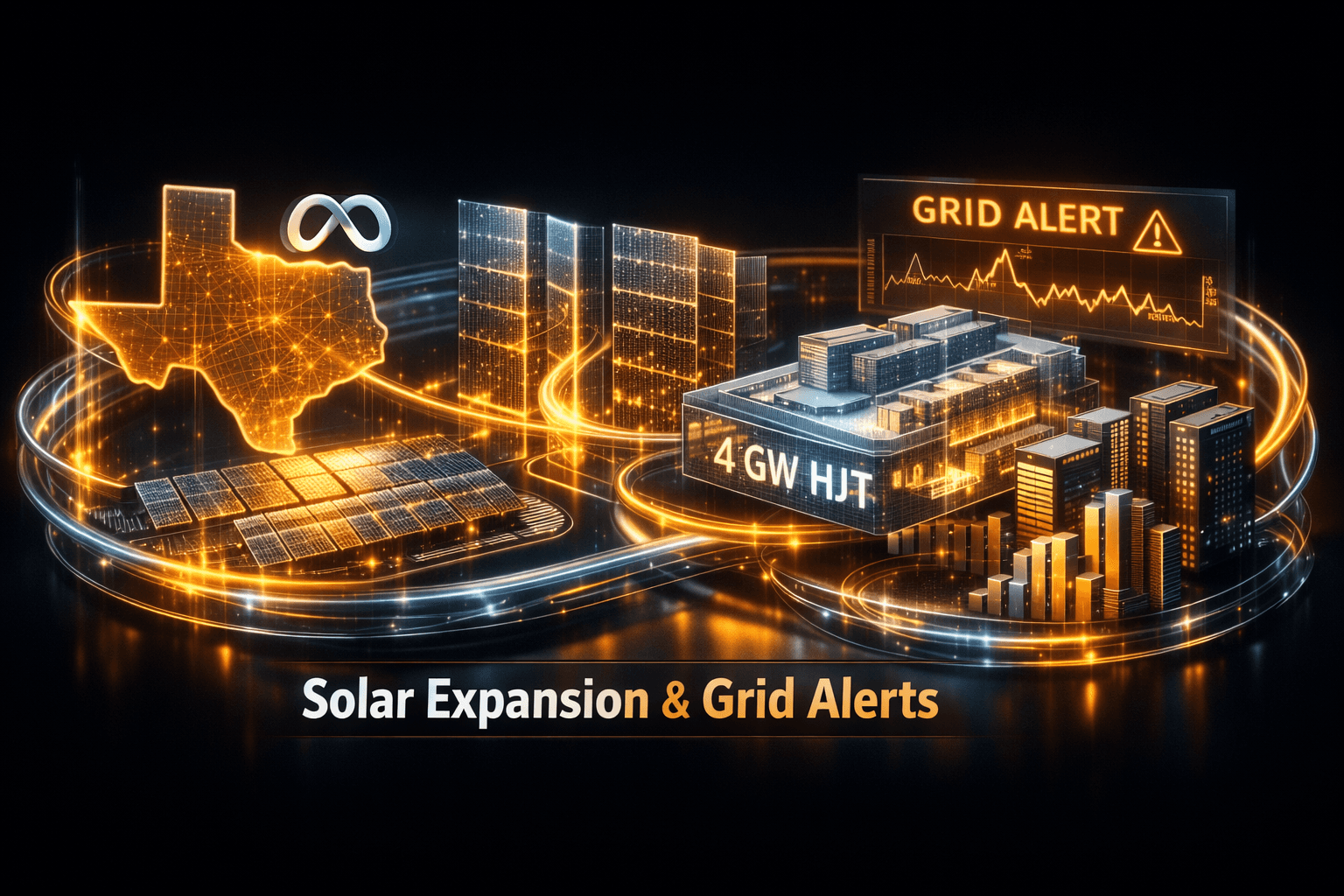
Renewables took center stage today as advocacy, project development and manufacturing moves signaled accelerating deployment across the utilities landscape. You saw deals and factory scale-up that could materially increase supply of panels and contracted clean energy, and those developments matter because they change project economics and interconnection demand.
At the same time the sector got a reminder that reliability and fuel chains remain an operational constraint, after winter storms exposed vulnerabilities. So you should be watching both growth catalysts and grid stress points as this cycle unfolds.
Market Highlights
Quick facts and figures from today's headlines for investors to keep handy.
- SEIA and CCSA consolidation announced, combining the Solar Energy Industries Association and Coalition for Community Solar Access into a single advocacy platform.
- Apex Clean Energy signed a power purchase agreement with $META for exclusive rights to energy and RECs from the 144-MW Starling Solar project in Gonzales County, Texas.
- SEG Solar has started commercial-scale heterojunction technology panel production at its Tomball, Houston site, part of a 4-GW facility that came online last month.
- Panthalassa raised $140 million for autonomous ocean platforms that pair wave energy with at-sea AI computing, highlighting private capital flowing to climate tech experiments.
- New York City plans to add 600 Level 2 curbside EV chargers to its existing 88 stations, expanding urban EV charging infrastructure.
Key Developments
Solar advocacy consolidates to streamline policy and market access
SEIA and CCSA said they will join forces pending board approvals. The move consolidates national-scale lobbying for large solar developers with community solar advocates that focus on distributed and equitable access. Analysts note consolidation can sharpen messaging with regulators and legislators, which could move the needle on permitting, incentives and interconnection policy.
Major corporate offtake and manufacturing scale-up
Apex Clean Energy's PPA with $META for the 144-MW Starling Solar project includes all renewable energy credits. That commercial offtake is the kind of corporate demand that underwrites new builds, particularly in ERCOT where project timelines are compressed. At the same time SEG Solar starting HJT panel output at a 4-GW plant boosts domestic cell supply, which can ease lead times and price pressure for developers.
Grid reliability lessons from recent winter storms
Operators reported improved generator performance thanks to winterization, but multi-day cold events still revealed fuel logistics and supply chain constraints. Power Engineering warns 2027 could present a bigger reliability challenge as demand rises. That risk is not new, yet it remains a constraint on how quickly renewables and electrification can scale without parallel investments in storage, fuel security and transmission.
What to Watch
Here are the catalysts and risks that could shape utility-sector moves into tomorrow and beyond. You want to know which dates and metrics matter when you follow these stories.
- Board approvals and integration plan for SEIA and CCSA, which will determine timing and policy priorities for the combined group.
- Permitting and interconnection milestones for the 144-MW Starling Solar project in Texas. Watch grid-connection timelines in ERCOT for signals on project delivery risk.
- SEG Solar's ramp metrics, including first-quarter throughput and yield rates for HJT cells. Improved yields could relieve module supply tightness.
- Grid reliability indicators heading into the 2026-27 winter, including fuel inventories and regional reserve margins. Can operators convert winterization gains into systemic resilience?
- Adoption and impact of Climavision's expanded weather forecasting by data centers. Better forecasts could help large loads participate in grid flexibility programs.
- Municipal EV charger rollouts and siting plans like New York City's 600-station program. Local deployment policies will affect utility load shapes and distribution upgrades.
Which of these will move markets first, policy or project delivery? That question will shape near-term volatility and longer term capacity additions.
Bottom Line
- Solar sector momentum is visible across policy, corporate demand and manufacturing, which together suggest more project starts and shorter lead times ahead.
- Corporate PPAs such as the $META deal provide concrete underwriting for new generation in markets like Texas, which tends to move faster than other regions.
- Manufacturing scale-up at SEG Solar could ease module supply constraints if yields and costs meet targets, which analysts will watch closely.
- Grid reliability remains a key constraint, with winter storms exposing fuel and supply-chain weaknesses that could blunt transition benefits unless addressed.
- Municipal and commercial initiatives, from curbside EV chargers to data center forecasting, are changing load patterns and will require close coordination between utilities and developers.
FAQ Section
Q: What does the SEIA and CCSA consolidation mean for solar policy? A: The merger should centralize advocacy, making it easier to present a unified agenda to Congress and regulators, which may speed policy responses and funding priorities.
Q: How significant is the $META PPA for the 144-MW Starling Solar project? A: Corporate offtake like this provides guaranteed demand and REC revenue that de-risks project finance and can accelerate construction timelines in markets with ready interconnection capacity.
Q: Should I be worried about grid reliability after recent winter storms? A: The storms highlighted persistent vulnerabilities in fuel and supply chains. Data suggests winterization helped, but long term resilience will need investments in storage, transmission and fuel logistics.