The Big Picture
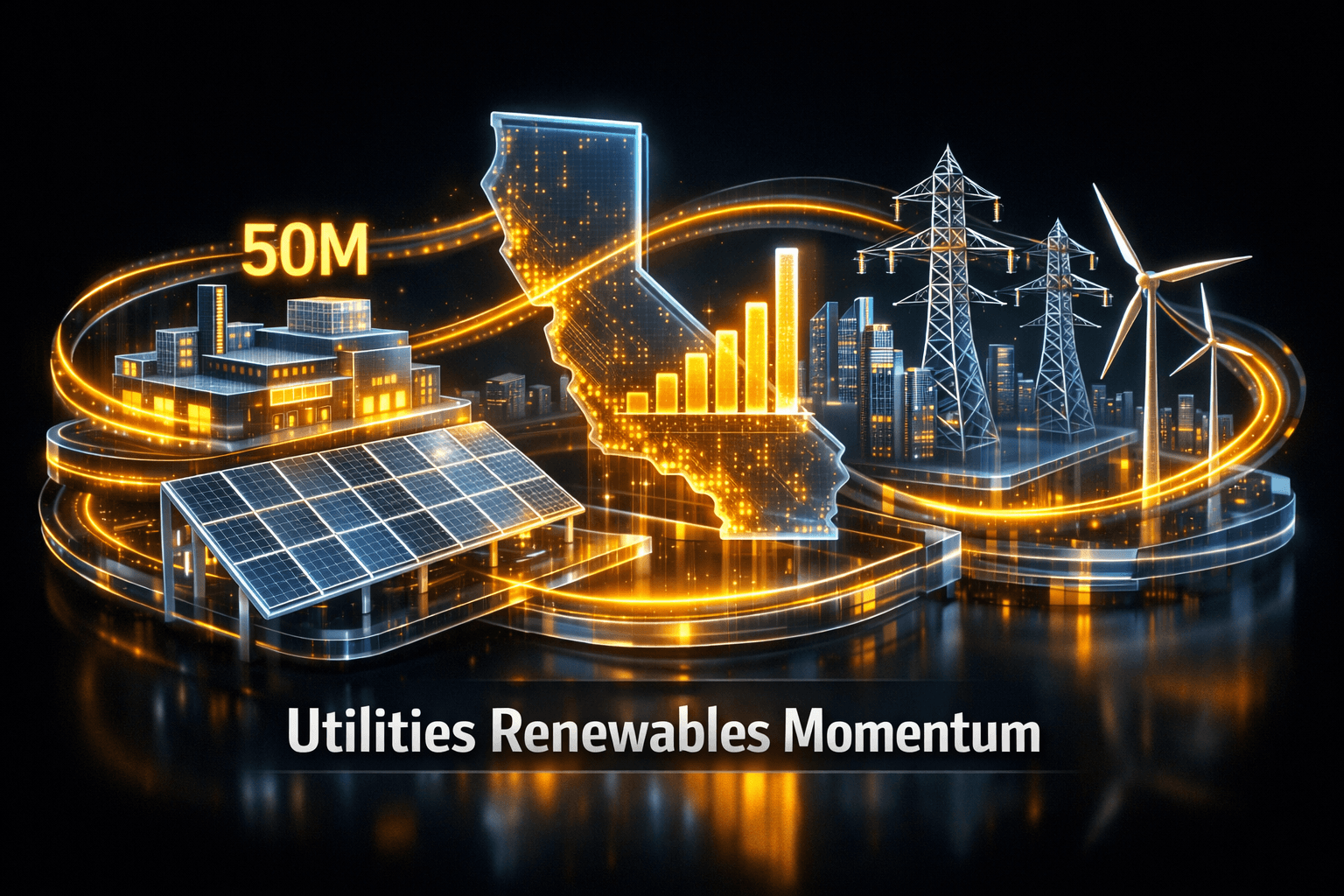
Renewables and grid innovation dominated utilities headlines today, and you felt the momentum if you follow solar and storage closely. ARRAY Technologies opened a $50 million, 216,000-square-foot factory in Albuquerque, signaling more domestic supply chain buildout and about 300 new jobs.
That expansion comes as studies and industry moves point to significant near-term demand for front-of-meter solar plus storage and faster interconnection pathways, while large corporates and ISOs push for reforms to speed projects. You should note legal disputes and regulatory questions remain, but the overall flow of capital and capacity is moving in one direction.
Market Highlights
Quick facts and price movers to watch today.
- ARRAY Technologies, $ARRY, opened a new 216,000-sq-ft factory in Albuquerque, a roughly threefold increase over its prior site, backed by a $50 million investment and about 300 jobs.
- Front-of-meter solar plus storage could meet 32% of California’s 2032 peak load, according to a study covering 3,100 distribution-connected projects.
- Utility and corporate backing: Google and $XEL joined others supporting MISO’s ‘zero injection’ large-load proposal aimed at faster reviews for projects that serve large colocated loads.
- Regulatory friction: West Virginia regulators rejected a delay in reviewing NextEra’s MidAtlantic Resiliency Link, keeping scrutiny on large transmission projects tied to $NEE.
Key Developments
ARRAY expands U.S. manufacturing in Albuquerque
ARRAY Technologies’ new $50 million plant triples the size of its previous Albuquerque footprint and will support roughly 300 jobs across production, assembly, design, engineering, and customer service. For you that means more domestic tracker capacity, shorter supply chains, and potentially quicker project build timelines for developers relying on U.S.-made tracking systems.
Front-of-meter solar and storage shows major capacity upside in California
A study commissioned by the Coalition for Community Solar Access finds front-of-meter solar plus storage could serve about 32% of California’s 2032 peak, leveraging some 3,100 distribution-connected projects. That datapoint suggests developers and utilities have a big addressable market ahead, and you can expect more procurement and interconnection activity in investor-owned utility territories.
Legal fights flare between tracker manufacturers
Two of the world’s largest solar tracker makers, GameChange Energy and Nextpower, have traded patent suits within months of each other. GameChange alleges Nextpower’s NX Horizon with Hail Pro infringes on a self-shielding tracker patent, US-12449161-B2. Litigation may slow specific product rollouts and create short-term vendor risk for project owners, so you should watch counterclaims and any injunctions closely.
Grid policy and corporate buyers push faster project paths
MISO’s ‘zero injection’ large-load proposal drew backing from Google, $GOOGL, $XEL, and others to fast-track review for projects that serve large colocated loads. This type of policy nudges the grid to accommodate big corporate consumers and their suppliers, which could move the needle on procurement timelines for large-scale renewables and storage.
Tech and project examples reinforce scale-up
AI-powered robotics are now on-site at a utility-scale solar build in McLean County, Illinois, showing how automation can boost safety and speed. Meanwhile Energy Vault’s gravity storage project in Rudong provides a reality check against lithium battery benchmarks, highlighting differences in cost and deployment context. These developments show innovation on both construction and storage fronts, which could improve project economics over time.
What to Watch
Here are the catalysts and risks that could move markets and project economics in the near term, and what you should be tracking.
- Earnings and procurement updates from major utilities and developers later this month, which will reveal project pipelines and margin trends.
- Regulatory rulings on the NextEra MARL project and patent litigation outcomes between GameChange and Nextpower. Can legal or permitting delays slow installations you’re expecting?
- California interconnection reforms and any move from utilities or CAISO to prioritize front-of-meter solar plus storage, which would directly affect the 32% capacity potential cited in the study.
- Supply-chain signals from manufacturers like $ARRY, and construction productivity gains from robotics deployments, which will shape lead times and capex.
- Comparative economics of long-duration gravity storage versus battery energy storage, especially as countries demonstrate high renewables penetration like Denmark’s 140% wind output episode.
Bottom Line
- Renewables momentum is building, underpinned by factory investment, corporate procurement, and ISO-level reforms.
- ARRAY’s new $50 million plant strengthens U.S. tracker capacity and could reduce delivery risk for domestic projects.
- Studies and corporate-ISO alliances point to material near-term demand for front-of-meter solar plus storage in key markets like California.
- Legal and regulatory headwinds remain, notably tracker patent fights and transmission scrutiny, so expect episodic volatility.
- Watch policy moves, procurement announcements, and litigation outcomes to gauge how quickly this momentum converts into visible project deliveries.
FAQ Section
Q: How will ARRAY’s factory opening affect project timelines and costs? A: Increased domestic production capacity often shortens lead times and eases shipping pressure, which can reduce schedule risk and potentially lower logistics costs for projects that use ARRAY trackers.
Q: Does the 32% California study mean developers can fully rely on front-of-meter solar and storage? A: The study highlights significant technical potential across 3,100 sites, but actual deployment will depend on interconnection reforms, permitting, and financing, so it’s an achievable target only with coordinated policy and market action.
Q: Should I worry about the tracker lawsuits affecting the whole sector? A: Legal disputes can create vendor-specific risk and slow some product rollouts, but they typically don’t halt industry growth. You should monitor case developments and any injunctions that could affect specific projects.