The Big Picture
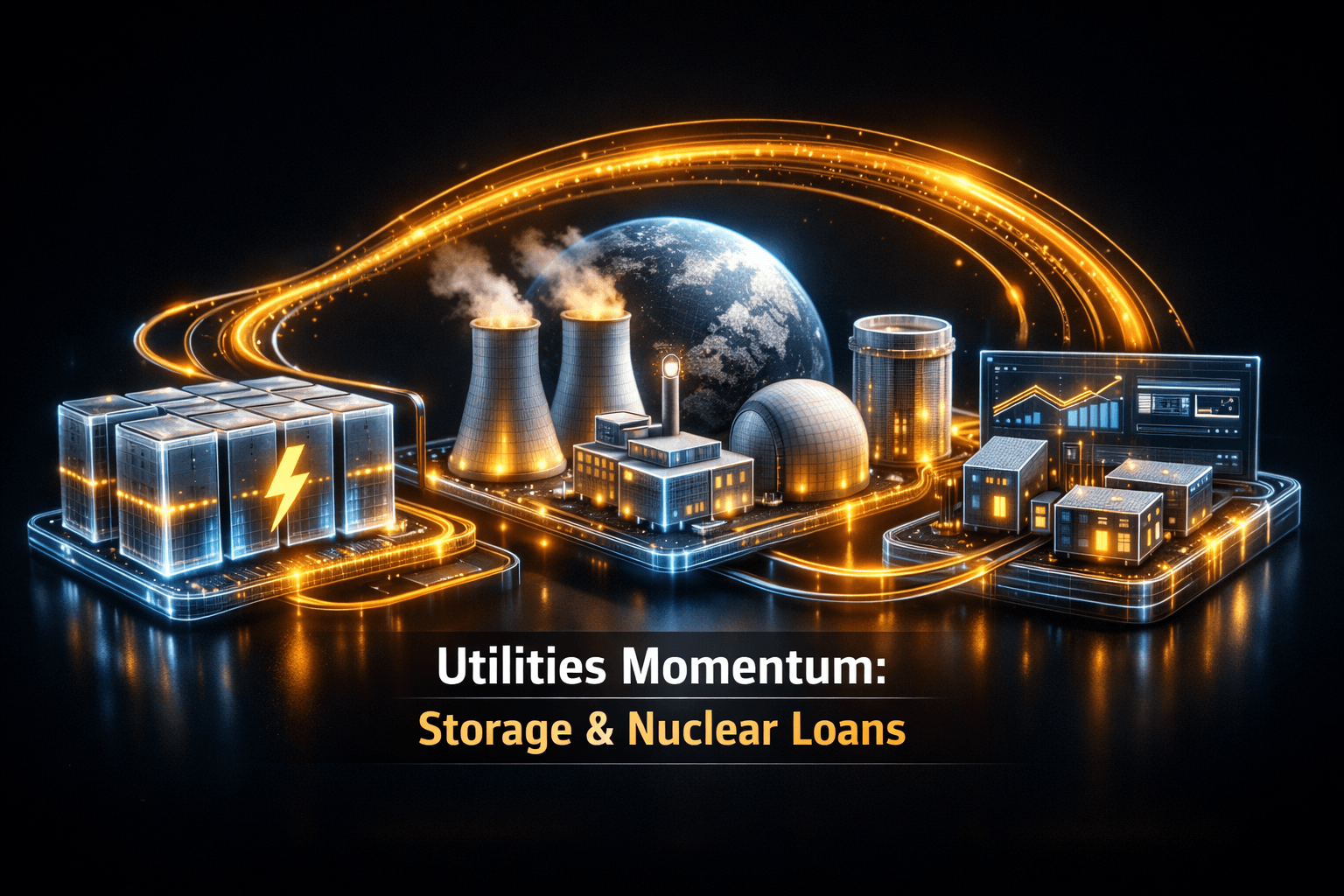
Today brought a string of developments that underline accelerating investment and technology deployment across the Utilities sector. An 86 MW solar project in West Virginia that pairs lithium batteries with 100 MWh of zinc long-duration storage and a $1.9 billion DOE loan to restart the Duane Arnold nuclear plant are the standout items.
Why should you care? These moves show utilities, corporate offtakers, and the federal government are scaling both short-duration and long-duration storage plus baseload capacity, and that will influence grid planning, equipment demand, and project pipelines for months to come.
Market Highlights
Quick facts and figures from today's top stories.
- West Virginia solar-plus-storage: 86 MW solar paired with 280 MWh of lithium-ion and 100 MWh of zinc long-duration storage, developed by MN8 to serve Google data centers, with zinc systems supplied by Eos Energy Enterprises, $EOSE.
- Federal financing: U.S. Department of Energy closed a loan of up to $1.9 billion to NextEra Energy, $NEE, to support restarting the Duane Arnold nuclear plant in Iowa.
- Commercial solar tech: SolarEdge Technologies, $SEDG, launched a UL 3141-certified Power Control System designed to simplify interconnection for U.S. commercial and industrial developers.
- Grid demand and supply: ERCOT weekly average peak loads have exceeded 2023 records for six straight weeks, and sources warn of two-year lead times on some high-voltage components tied to 765-kV expansion and data center demand.
- Regulatory and tariff shifts: Research shows large-load tariffs and associated upfront payments and exit fees have increased sharply since early 2025, raising contracting complexity for big customers.
- Note on prices: The reporting focused on project and policy developments, and did not include specific intraday price moves or percentage changes for the stocks mentioned.
Key Developments
Google-backed West Virginia project pairs lithium and zinc LDES
MN8 Energy's 86 MW solar installation will combine 280 MWh of lithium-ion storage with 100 MWh of zinc-based long-duration energy storage from Eos. The project is intended to provide dispatchable capacity into PJM, serving Google data centers in the region, and illustrates a hybrid approach to meeting both short peak needs and longer-duration firming requirements.
For investors, the mix of chemistries signals growing commercial acceptance of long-duration storage, and it highlights hyperscaler demand as a financing and offtake driver. What does this mean for storage suppliers and developers? It increases the addressable market for non-lithium technologies while keeping lithium demand strong.
DOE closes $1.9B loan to restart Duane Arnold, a win for nuclear capacity
The Department of Energy finalized a loan of up to $1.9 billion to NextEra Energy, $NEE, to support restarting the Duane Arnold Energy Center. The move reinforces federal willingness to back nuclear assets that can provide firm carbon-free generation and grid stability.
This financing could influence capital allocation across utilities and independent power producers, and it may accelerate similar public-private deals for other dormant or idled plants. If you follow large utility balance sheets and project pipelines, this is worth keeping an eye on.
Grid stress and supply-chain pressure collide with commercial tech and tariffs
ERCOT's record weekly peaks for six straight weeks underline ongoing load growth tied to hotter summers and electrification. At the same time, utilities and developers face supply pressure on high-voltage equipment, with some components reporting multi-year lead times as builds move toward 765-kV transmission upgrades.
Large-load tariffs have become more common and costly, adding upfront payments and exit fees for big customers. Those trends together pose near-term operational and procurement challenges, even as demand and investment create longer-term opportunity. Will the equipment supply chain scale fast enough to match transmission and data center growth? That's one of the key questions for tomorrow.
What to Watch
Look ahead to catalysts and risks that could shape the Utilities sector in the coming days and quarters.
- Earnings and corporate updates from major utility and storage suppliers, including companies tied to the large projects mentioned today. Analysts note quarterly reports will show how backlog and margins are evolving under supply pressure.
- Policy and permitting milestones for the Duane Arnold restart, and any follow-on federal financing announcements for other nuclear projects.
- Equipment lead times and procurement notices from transmission developers and OEMs, plus any supplier expansions aimed at easing two-year plus bushing and transformer waits.
- Contracting terms for large customers, and any regulatory reviews of large-load tariffs that could alter demand economics for commercial and industrial offtakers.
- Battery chemistry and recycling developments, such as new domestic lithium recycling capacity, which will affect supply chains and material costs over time.
Bottom Line
- Storage and firm capacity are getting concrete backing, from corporate offtakers to federal loans, which points to expanding project pipelines across the sector.
- Hybrid projects that mix lithium and long-duration chemistries are gaining traction, broadening technology winners beyond conventional lithium-ion.
- Grid demand is rising, and equipment supply chains are strained, so procurement and timeline risk will matter for project economics and stock-level performance.
- Solar and C&I controls, plus domestic recycling capacity, are practical advances that could ease interconnection and material constraints over time.
- Stay selective, and watch near-term policy, permitting, and supply developments, because they will determine whether momentum turns into sustained deployment.
FAQ Section
Q: What is long-duration energy storage and why is it important? A: Long-duration storage stores energy for many hours or days, allowing projects to provide firm capacity and cover extended demand periods, which complements short-duration lithium batteries and supports grid reliability.
Q: How does the DOE loan to NextEra affect the nuclear sector? A: The $1.9 billion loan shows federal willingness to finance restarts and could encourage similar public-private deals, increasing the likelihood that other nuclear projects seek federal support.
Q: Should I be concerned about equipment lead times and tariffs? A: Data suggests lead times for high-voltage components and rising large-load tariffs are real risks for project timelines and costs, so you should monitor supplier capacity and regulatory changes closely.