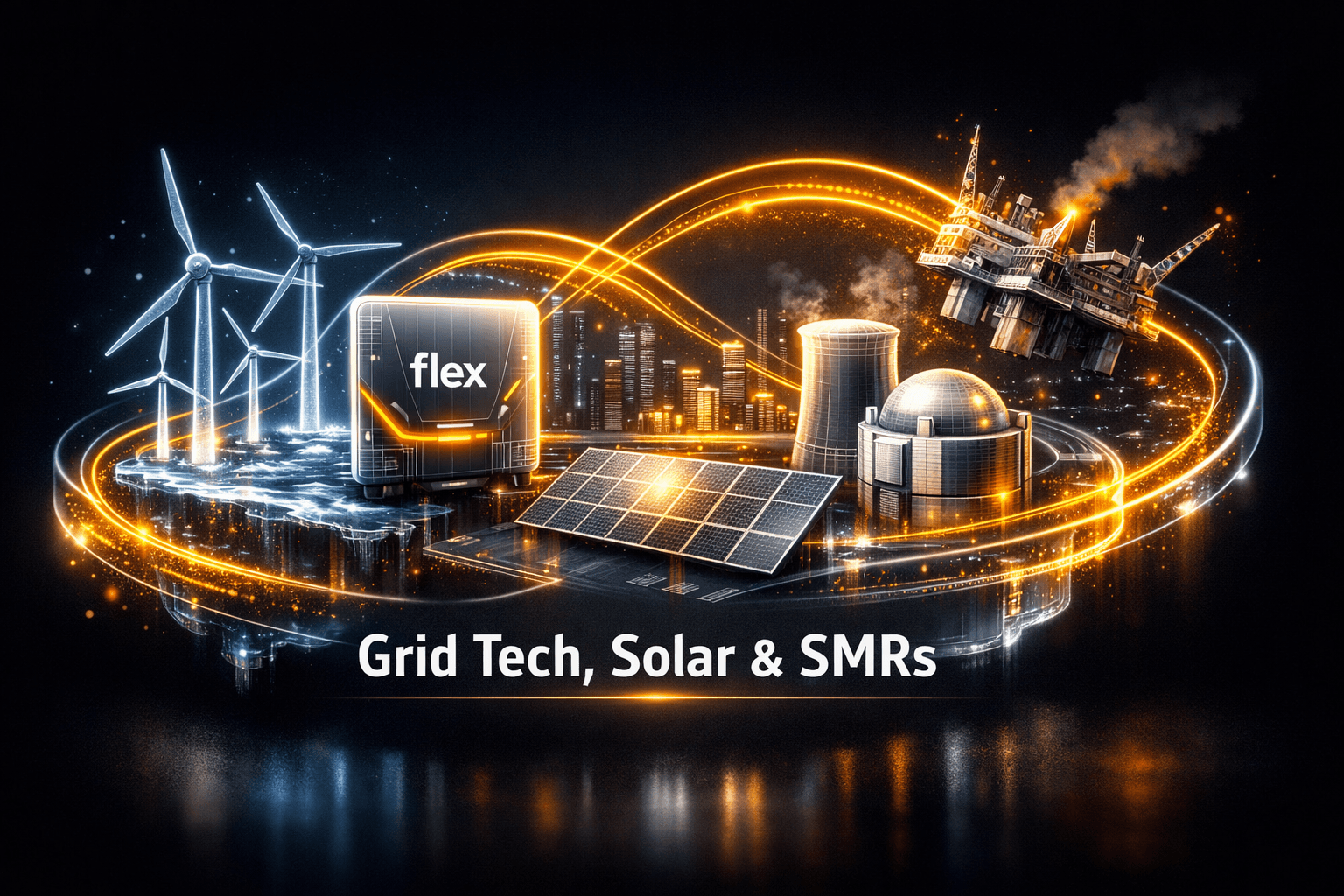
The Big Picture
Heading into the long weekend, the Utilities sector shows mixed signals, with clear momentum on clean energy supply chains and grid technology, offset by political and project-level risks. You should note that markets were closed on Sunday, Sept 6, so the last trade reference is Friday, Sept 4.
Big-ticket corporate moves and policy drama are dominating headlines. Flex's announced $4.4 billion purchase of inverter brand EPC Power underlines consolidation in the solar supply chain, while offshore wind cancellations and the RWE settlement are adding uncertainty for large-scale coastal projects. How should you think about the balance between these opposing forces?
Market Highlights
Key facts and takeaways from the top headlines, with the important caveat that U.S. markets were closed on Sunday.
- Flex to buy EPC Power for $4.4 billion, a deal expected to close in Q4 2026, with a plan to spin out Flex’s Cloud and Power Infrastructure segment as a public company in Q1 2027, signaling consolidation in the inverter market.
- RWE settlement tied to offshore wind cancellations involves roughly $1.2 billion, and new reporting highlights political winners and losers as leases are abandoned, raising questions about the future pipeline for U.S. offshore wind projects.
- Utilities are actively evaluating small modular reactors, and hyperscalers are emerging as early adopters, which could shift long-term reliability strategies for $EXC and other grid operators.
- Ball State research finds no statistically significant negative effect of utility-scale solar or wind on nearby residential property values in Indiana, a useful data point for site permitting and community engagement.
- Operational fixes are in focus: inlet fogging for gas turbines is being used to recover megawatts during heat events, helping protect capacity revenues when demand spikes.
Key Developments
Flex to acquire EPC Power, tightening the solar supply chain
Flex's $4.4 billion deal for EPC Power will fold the inverter brand into Flex’s Cloud and Power Infrastructure segment, which management plans to spin off into a separate public company in early 2027. For utilities and developers, a larger, vertically integrated supplier could improve procurement scale and reliability for large projects, but the deal also raises integration risk and regulatory scrutiny.
Offshore wind fallout and the RWE settlement
New coverage highlights political entanglements after the Trump administration's settlement required RWE to abandon some offshore wind leases in exchange for approximately $1.2 billion. The episode creates uncertainty for future federal offshore leasing, and it may delay or cancel projects already in planning, affecting supply chain partners and regional capacity forecasts.
Innovation push: SMRs, AI, and operational resilience
Utilities are showing growing interest in small modular reactors for reliability, with hyperscalers and defense customers acting as early adopters. At the same time, sessions at industry conferences and reports from Argonne, S&C, and Exelon highlight how AI is being integrated into planning and grid operations.
On the operations side, techniques like gas turbine inlet fogging are being deployed to offset heat-related output losses and to protect capacity payments. Those practical fixes matter when peak demand hits, and they show utilities are balancing long-term clean investments with short-term reliability tools.
What to Watch
Expect continued headlines that will move sentiment and project economics, and remember you won't be able to trade U.S. equities until the next session on Tuesday, Sept 8.
- Regulatory signals on offshore wind: any new federal or state guidance could change project viability, so watch updates related to the RWE settlement closely.
- Integration progress for the Flex-EPC Power deal: approvals, supply chain synergies, or pushback from regulators will determine whether the acquisition drives cost advantages in solar projects.
- SMR siting and cost recovery rulings: utilities need policy clarity if they are to move from pilot projects to commercial deployments, so follow state public utility commission statements and federal funding updates.
- AI pilots scaling to production: are utilities moving from proof of concept to operational use cases for planning and outage management? That will affect near-term capital allocation decisions.
- Weather-driven reliability risks: extreme heat episodes will continue to test gas turbine output and the value of mitigation like inlet fogging, which influences capacity revenues.
Bottom Line
- Neutral tone across the sector as innovation and consolidation meet political and project-level headwinds, analysts note mixed near-term signals.
- Flex's $4.4 billion acquisition is a major supply-chain development to watch for implications on inverter availability and prices.
- Offshore wind cancellations and the RWE settlement inject policy risk that could slow coastal renewables deployment and affect regional capacity planning.
- SMRs and AI represent longer term upside for reliability and planning, but siting and cost recovery remain unresolved questions.
- Practical operational measures, like turbine inlet fogging, are delivering near-term resilience benefits during heat events, which matters for capacity payments.
FAQ Section
Q: How will Flex's $4.4B purchase affect solar project costs? A: The acquisition could increase manufacturing scale and integration across inverters, which may lower procurement risk and improve lead times, but integration costs and regulatory approvals will influence the net effect.
Q: Does the RWE settlement mean offshore wind is over in the U.S.? A: Not necessarily, but the settlement raises policy and political uncertainty that may delay projects and raise financing costs for some developers, so expect a selective pipeline for the near term.
Q: Are small modular reactors a realistic option for utilities soon? A: Utilities see potential, particularly for reliability-sensitive customers, but siting, licensing, and cost recovery need clearer frameworks before widespread adoption.
Investment disclaimer: This article provides market and sector analysis for informational purposes only. It does not recommend buying, selling, or holding any security. Analysts note trends and data, and you should consult a licensed professional for personalized advice.