The Big Picture
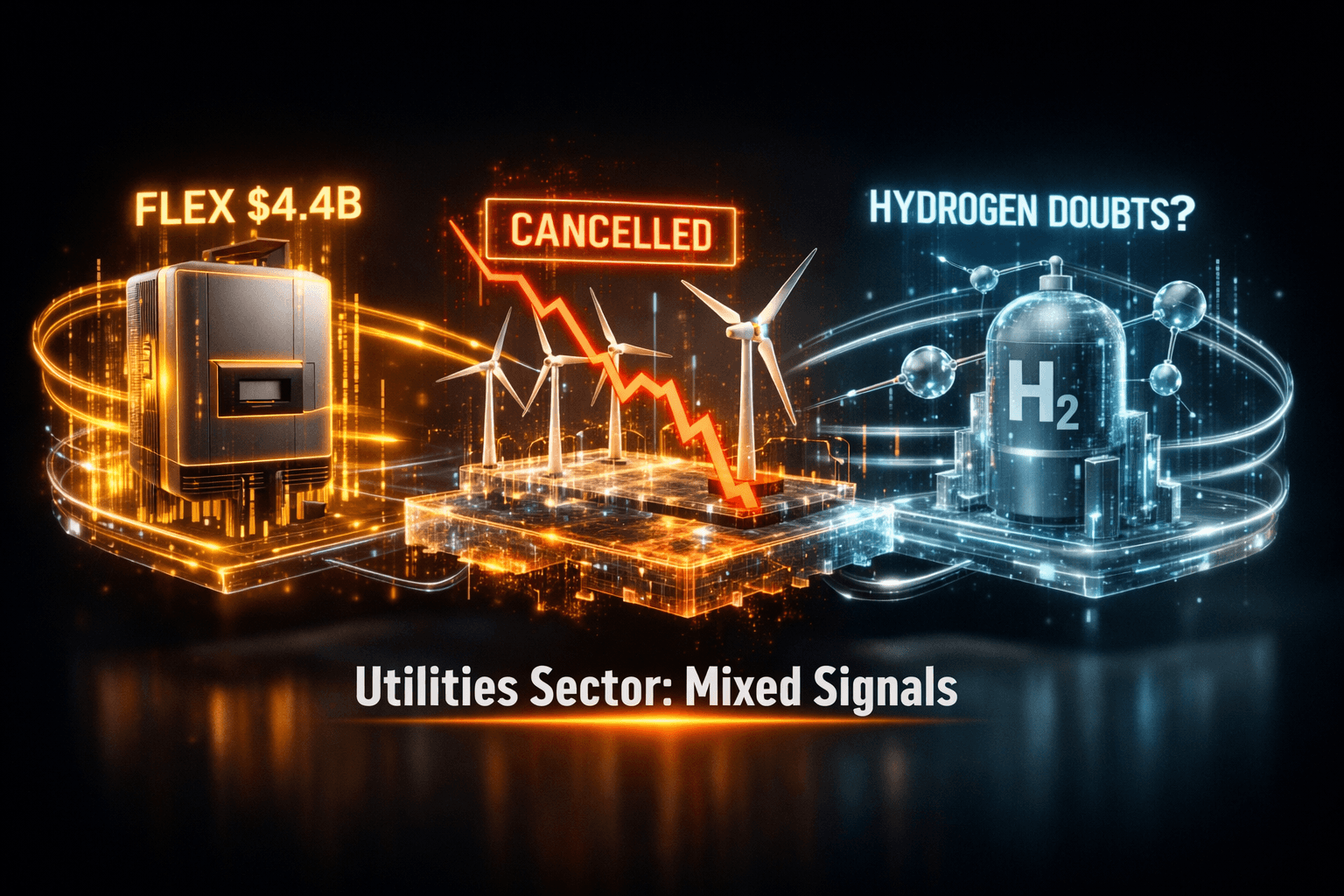
Utilities investors faced mixed signals today as concrete commercial moves collided with lingering policy and economic questions. A major corporate acquisition and growing interest in advanced technologies offered upside, while political drama around offshore wind and renewed skepticism about hydrogen kept risk front and center.
That mix matters because it affects project economics, permitting timelines, and the kinds of assets utilities and their customers will favor. If you own utility-adjacent stocks or follow project pipelines, today's developments give you a lot to unpack before markets open tomorrow.
Market Highlights
Key facts and company actions moved headlines rather than broad indices today. Here are the standout takeaways you can scan quickly.
- Flex announced a $4.4 billion agreement to acquire EPC Power, a move that folds a major inverter brand into Flex’s Cloud and Power Infrastructure segment. The deal is expected to close in Q4 2026 and support a CPI spinoff in Q1 2027, combining manufacturing scale with PV inverter supply chain capabilities. Ticker: $FLEX.
- Utilities and tech partnerships captured attention as panels at DTECH highlighted how AI is being applied to grid planning and resilience. Major utilities including Exelon were part of conversations about operationalizing AI. Ticker: $EXC.
- Policy and legal developments kept volatility on the table. Coverage of a settlement requiring RWE to relinquish offshore wind leases added political risk to the offshore pipeline and underscored how deals can be reshaped by administrations and litigation.
Key Developments
Corporate consolidation and the inverter supply chain
Flex’s $4.4 billion deal for EPC Power signals continued consolidation in the solar inverter market. That has implications for module-to-inverter integration, margin pressure for smaller suppliers, and vertical strategies inside broader industrial players.
For you that means supply chain risk could ease for large project developers if Flex scales production and integrates EPC Power technology. Analysts note that a stronger, consolidated supplier base can improve project timelines and cost predictability, but regulatory approvals and the planned CPI spin will be items to watch.
Policy, politics, and offshore wind uncertainty
The fallout from the settlement tied to RWE’s offshore leases and reporting that a politically connected buyer profited from cancellations highlight how policy shifts can rearrange project economics. That story raises fresh questions about permitting and counterparty risk for offshore projects in the U.S.
Can policy changes derail parts of the pipeline? Yes, they can. You should treat offshore wind exposure as more politically sensitive than onshore renewables until clarity returns on lease enforcement and compensation frameworks.
Tech and operational fixes: AI, SMRs, and gas turbine fogging
Utilities are increasingly pitching AI and small modular reactors as solutions for planning and reliability. Panels at DTECH and reporting on SMR interest show utilities eyeing advanced reactors where siting and cost recovery make sense, especially for hyperscalers and defense customers.
On the operations front, articles about inlet fogging for gas turbines highlight how plants can recoup lost output during heat waves via relatively low-cost interventions. These are pragmatic, near-term measures that help protect capacity payments and margins during peak demand.
What to Watch
Expect next‑day focus to cluster around permitting, supply chain cadence, and near-term reliability signals. Here are the concrete catalysts and risks to monitor.
- Flex integration timeline: Watch Q4 filings and any regulatory notices related to the $4.4 billion EPC Power acquisition. The CPI spinoff timing in Q1 2027 will affect capital structure and investor focus for $FLEX.
- Offshore wind legal and political developments: Monitor statements from federal agencies and litigation updates tied to the RWE settlement. Policy updates can reshape valuations for developers and utilities with offshore exposure.
- Hydrogen economics debate: New critiques of hydrogen’s viability for many end uses mean you should track project-level cost curves and near-term offtake contracts. Will hydrogen projects cross an economic threshold, or remain niche? Data suggests economics, not enthusiasm, will decide.
- SMR progress and cost recovery frameworks: Keep an eye on utility pilot projects, regulatory dockets, and early adopters among hyperscalers. Cost recovery rules will determine whether SMRs scale in the next decade.
- Operational resilience signals: Heat-driven output losses and solutions like turbine inlet fogging will matter as you track capacity revenues and summer performance metrics. These operational levers can be the difference for merchant assets during heat waves.
Bottom Line
- Today’s headlines delivered both growth signals and political risk, leaving the sector with neutral momentum for now.
- Corporate consolidation in solar inverters via $FLEX’s $4.4B move could stabilize supply and improve project predictability, but integration and spin timing are key.
- Policy and litigation around offshore wind remain a live negative, illustrating that political risk can overwrite project economics.
- Operational fixes, AI planning, and interest in SMRs point to pragmatic paths utilities are taking to protect reliability and revenues.
- Note: this summary is informational. Analysts note these developments change risk and timing, not an explicit recommendation to buy or sell specific securities.
FAQ Section
Q: How will Flex’s acquisition of EPC Power affect the solar supply chain? A: The deal could increase manufacturing scale and product integration, improving availability for large developers while pressuring smaller inverter suppliers.
Q: Should I be worried about offshore wind projects after the RWE settlement? A: The settlement raises political and legal risk for some projects. You should watch policy updates and lease resolution timelines to assess exposure.
Q: Is hydrogen dead as a utility fuel? A: Critics are questioning hydrogen economics for many uses, but some niche applications and long-term storage roles remain viable. Data suggests project-level economics will determine winners and losers.
For you who track utilities, this was a day of mixed but meaningful developments. Keep an eye on regulatory filings and operational performance when markets open tomorrow.