The Big Picture
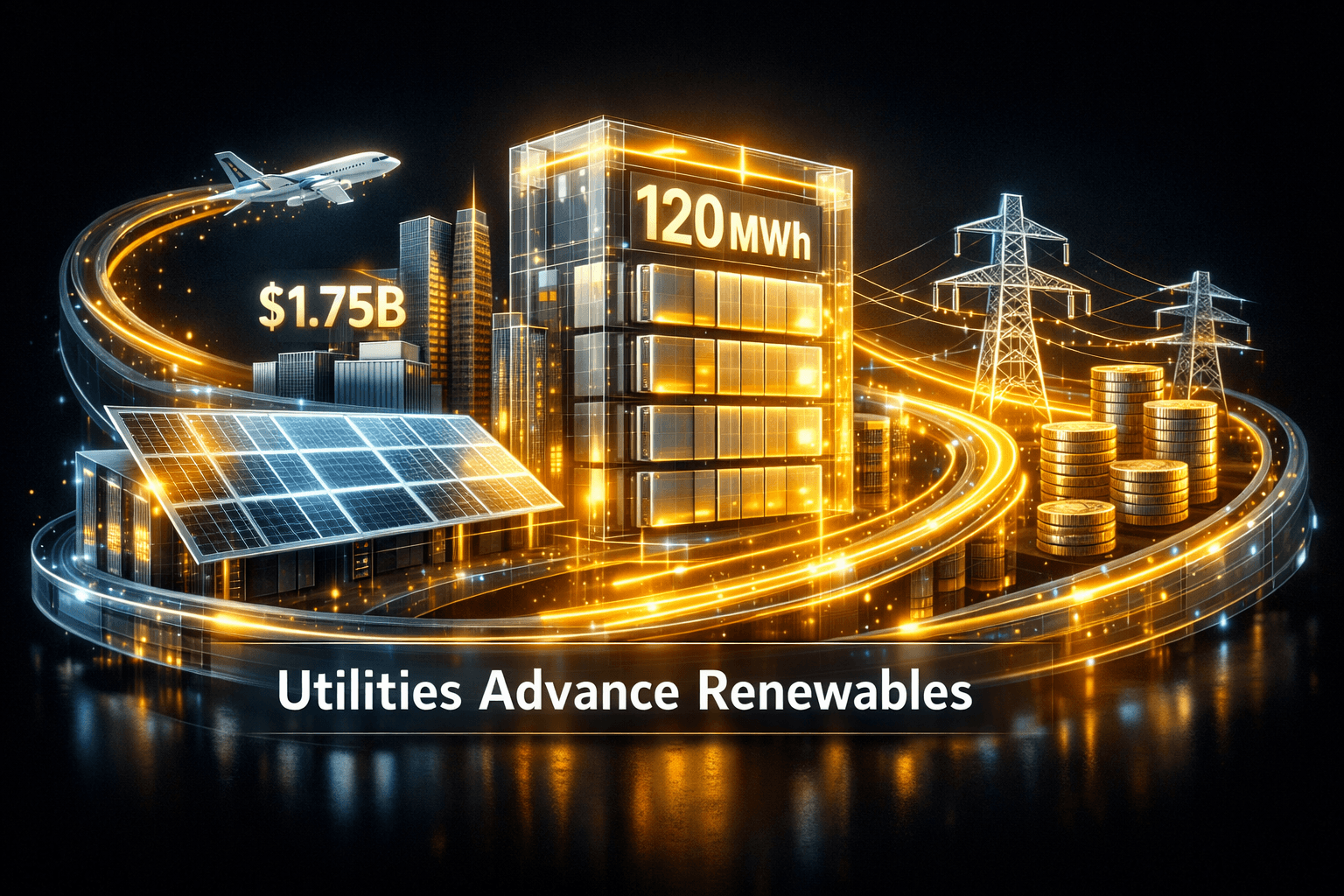
Utilities saw several headline deals overnight that push the sector toward cleaner generation and more grid flexibility. National Grid Ventures committed $1.75 billion for a 35% stake in Joulent to develop large-load power solutions, while CleanPeak Energy will invest more than $50 million to supply Western Sydney International Airport with 100 percent renewable electricity including 9 MWp of rooftop solar and a 120 MWh battery.
These moves matter because they combine big capital with practical projects that improve reliability and resiliency. For you as a market watcher, the message is clear, momentum is building behind storage, grid integration and commercial-scale renewables.
Market Highlights
Quick facts and figures to scan before the open.
- National Grid Ventures commits $1.75 billion for a 35 percent stake in Joulent, targeting large-load demand solutions in the U.S., signaling major institutional capital flow into grid infrastructure.
- CleanPeak Energy will invest over $50 million to install 9 MWp of rooftop solar and a 120 MWh battery system at Western Sydney International Airport to achieve 100 percent renewable electricity at the site.
- Massachusetts utilities awarded contracts covering roughly 4.5 GWh of energy storage, including a project sited on a former fossil plant, reflecting procurement focus on long-duration capacity.
- Arizona Public Service plans to convert retired Cholla coal units to natural gas, adding about 380 MW online by 2029, aligning reliability upgrades with decarbonization timelines, as overseen by $PNW operations.
- WeaveGrid and $GM expand grid-integrated EV charging and home energy program support, tying auto OEM efforts to utility programs and vehicle-to-grid pilots.
Key Developments
Major capital: National Grid Ventures buys into large-load solutions
The $1.75 billion investment for a 35 percent stake in Joulent is the most consequential single financial move overnight. It signals that major utilities and institutional players are funding infrastructure focused on heavy industrial and large commercial power needs, where demand response, storage and tailored solutions are crucial.
Analysts note this kind of capital helps scale projects that can serve bulky loads and support grid stability as intermittent renewables grow. What does that mean for you, the investor? Expect more deals like this to surface as utilities chase reliability and decarbonization in tandem.
Renewables plus storage: CleanPeak, Massachusetts contracts, and campus projects
CleanPeak Energy's $50 million-plus build at Western Sydney International pairs rooftop solar with a substantial 120 MWh BESS to meet airport demand with 100 percent renewable electricity. That project shows how site-specific hybrid systems are moving from pilots to commercial scale.
In New England, utilities inked contracts for about 4.5 GWh of storage, including a facility on a former fossil plant site. Those awards underline a trend, storage is being procurement-prioritized to replace retiring thermal assets and provide longer duration capacity.
Grid integration and emerging tech: EVs, floating solar, and permitting shifts
WeaveGrid's collaboration with $GM to expand grid-integrated EV charging and home energy programs ties automotive electrification directly to utility demand-side resources. Vehicle-to-grid programs could become a distributed resource for utilities if adoption follows.
Meanwhile, technological advances in floating solar, designed to survive multi‑meter waves, open new geographic options for large-scale PV. Regulatory moves at the EPA could also give developers more flexibility in securing air permits ahead of finalizing emissions offsets. Will permitting speed up development cycles? That's likely if guidance reduces procedural bottlenecks.
What to Watch
Look for near-term catalysts and monitor the risks that could sway project timelines or valuations.
- Permitting and EPA guidance, which may let projects secure air permits sooner, could accelerate project starts and influence utility capital deployment. Keep an eye on implementation details from regulators.
- Progress on the Joulent developments and any supplier or offtake announcements tied to the $1.75 billion deal will be milestones to watch for proof of scale and revenue visibility.
- The timeline for the Cholla conversions, set to start construction in 2028 and produce roughly 380 MW in 2029, matters for regional capacity and fuel mix. Monitor fuel price trends, as natural gas economics will affect operating costs.
- Contract awards for the 4.5 GWh in Massachusetts include projects on retired fossil sites. Watch for interconnection and community benefits updates, which can affect project economics and permitting risk.
- Adoption rates for grid-integrated EV programs and any pilot results from $GM and WeaveGrid will show whether EV fleets can be a meaningful distributed resource. How quickly will you see utility pilots move to scale?
Bottom Line
- Big institutional capital and multiple storage awards show the sector is shifting from pilot projects to commercial-scale renewables plus storage.
- Site-specific hybrid projects like CleanPeak's airport build demonstrate a growing template for meeting large, consistent loads with renewables and BESS.
- Regulatory tweaks at the EPA could ease permitting timing, which should help projects reach construction faster, though operating permissions still require offsets.
- Transitional moves to natural gas, such as the Cholla conversion under $PNW, highlight a practical balance between reliability and decarbonization.
- Grid integration efforts, including EV program expansion with $GM, add a distributed resource angle that you should track as part of demand-side capacity growth.
FAQ Section
Q: How significant is the National Grid Ventures investment in Joulent? A: The $1.75 billion commitment for a 35 percent stake is a major capital vote of confidence in large-load and grid infrastructure solutions, likely accelerating project deployment.
Q: Will EPA guidance change how quickly projects get built? A: The guidance could let developers secure key air permits earlier, shortening lead times for permitting, though projects still must have offsets before operating.
Q: Are conversions from coal to gas a setback for clean energy goals? A: Conversions like the Cholla project add capacity and reliability in the near term while utilities pursue longer-term decarbonization, so they are a transitional step rather than a final outcome.