The Big Picture
Today the utilities sector showed momentum driven by practical deployments and policy moves that broaden the roadmap for renewables and resilience. Multiple commercial and community solar projects reached key milestones, and Virginia clarified agrivoltaics rules, expanding viable land use for generation.
For you as a market watcher, that combination matters because it links near-term project economics to longer-term growth potential in decentralized generation and grid upgrades. The positive items outweigh isolated setbacks, and analysts note the pattern points to accelerating buildout activity.
Market Highlights
Here are the quick facts and numbers that stood out from today's coverage.
- Renewable America completed a 1.9 MWDC commercial solar portfolio for Pearl Crop across four sites in California, addressing rising energy costs for the food processor.
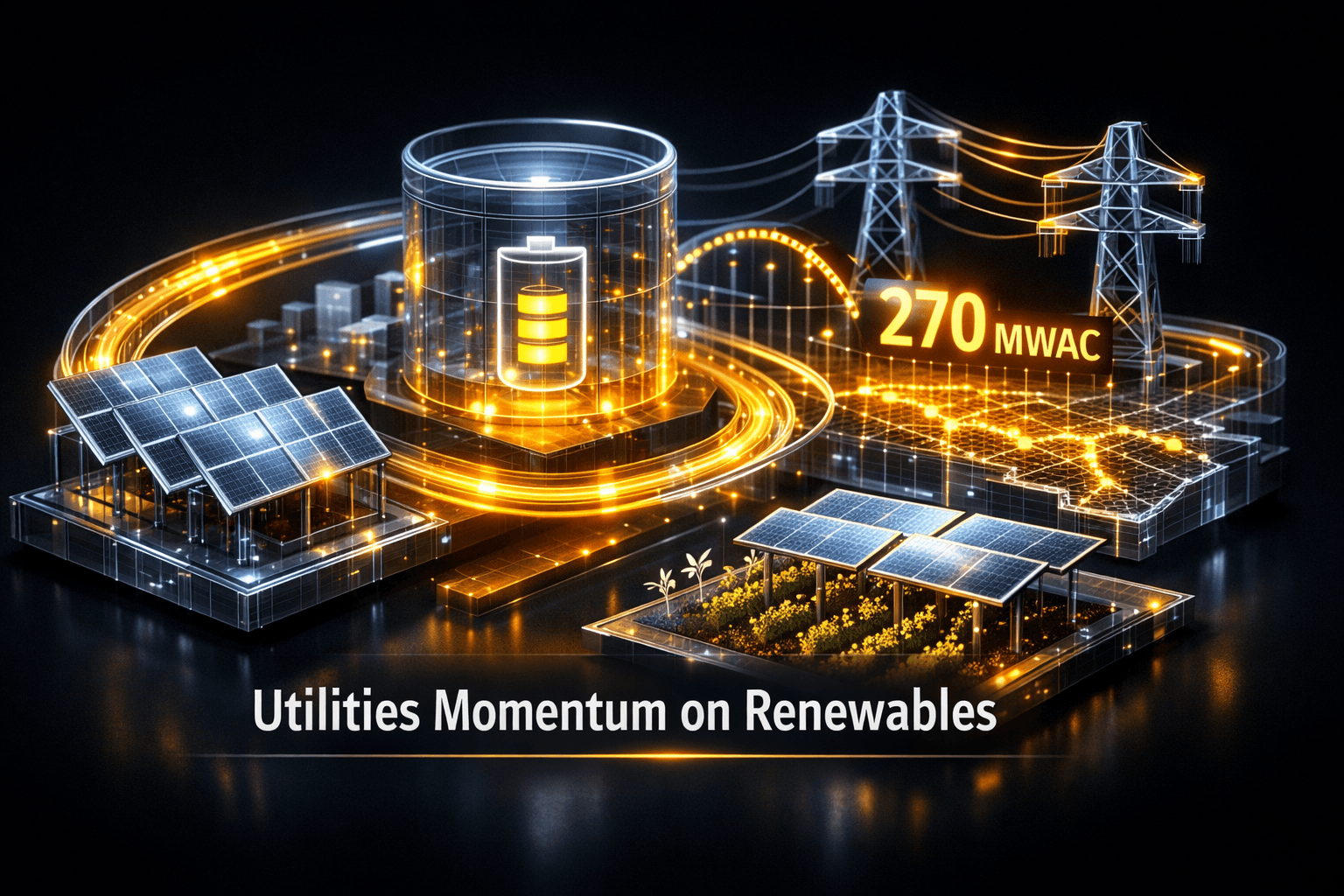
- Earthrise Energy’s Archtop Solar Project reached commercial operation on June 9, adding 270 MWAC by tying into surplus interconnection capacity at a natural gas peaking plant, a novel interconnection shortcut.
- Two Marin County community centers installed solar plus storage to provide outage resilience and reduce bill pressure during peak events, strengthening local reliability.
- Virginia passed a definition for agrivoltaics that explicitly protects farmer flexibility, potentially unlocking more dual-use projects for solar on working agricultural land.
- PJM pushed back on a waiver request tied to a roughly $2 billion gas-fired project, showing regulators remain attentive to fairness in fast-track interconnection processes.
- Market watchers often look to large names like $NEE and $DUK for renewables exposure, while project developers and solar contractors may see direct demand from the builds announced today.
Key Developments
California community resilience: solar plus storage in action
Two community centers in Marin County deployed solar and battery systems to keep critical services running during outages. The projects are smaller in scale, but they provide real-world proof that distributed resources can shore up local resilience and lower operational costs for nonprofits and community facilities.
For you that means these kinds of projects could become templates for other municipal and nonprofit sites, expanding market demand for behind-the-meter storage and local installers.
Commercial solar and creative interconnection
Renewable America’s 1.9 MWDC portfolio for Pearl Crop demonstrates how businesses are turning to on-site generation to wrestle with higher energy bills. The series of four projects across Ripon, Linden, and Stockton shows commercial-scale adoption is practical for energy-intensive processors.
In Illinois, Earthrise Energy’s approach to use surplus capacity at a natural gas peaker to accelerate interconnection for 270 MWAC offers a potential template to cut long lead times. Can approaches like this materially shorten project timelines at scale? If regulators and operators accept similar arrangements, you could see faster realization of pipeline capacity.
Policy, grid ops and pushback
Virginia’s agrivoltaics law clarifies that dual-use solar must accommodate farmer needs and market flexibility, which should ease developer concerns about land conflicts. That policy change is practical, and it can help convert agricultural acreage into additional capacity without forcing a tradeoff between food and power production.
At the same time, PJM’s rejection of a waiver for a developer seeking relief on a fast-track interconnection review highlights a continued regulatory focus on fairness and orderly queue management. The decision underscores that not all creative workarounds will clear the bar, and you should watch how grid operators balance speed with process integrity.
What to Watch
Look for near-term catalysts that could move the sector: state-level permitting updates, more solar+storage announcements from municipalities, and FERC or RTO rulings on interconnection reforms. Those decisions will affect pipeline realization and cost recovery models.
Risk factors include grid interconnection backlogs, equipment and labor constraints, and municipal budget pressures that could slow community and commercial projects. How quickly can developers translate policy wins into shovel-ready projects, and will interconnection ingenuity face regulatory limits?
As you scan the calendar, keep an eye on upcoming state regulatory dockets and RTO/ISO filings on queue reform. Digital inspection programs, like ESB Networks’ five-year plan to inspect 10,000 structures, are also worth monitoring because they signal growing investment in preventative grid maintenance that may reduce outages over time.
Bottom Line
- Practical deployments and policy moves are creating visible momentum in solar and storage, from community resilience projects to commercial portfolios.
- Interconnection innovation, such as using surplus capacity at gas peakers, could shorten timelines, but regulators will scrutinize fairness and precedent.
- Virginia’s agrivoltaics definition opens new land-use possibilities for dual-purpose projects, a silver lining for developers and farmers.
- PJM’s pushback on a waiver request and broader affordability pressures for public power show headwinds remain, so selectivity matters.
- Digital inspection and asset management programs point to a longer-term shift toward proactive grid maintenance that supports reliability.
FAQ Section
Q: How soon will these solar and storage projects affect utility revenues? A: Most community and commercial projects affect local bills and operator costs quickly, while utility-scale revenue impacts depend on tariff changes and wholesale market treatment, which can take quarters to materialize.
Q: Will agrivoltaics lead to significant new solar capacity? A: The Virginia law reduces regulatory uncertainty and could accelerate dual-use projects, but landowner uptake and economic incentives will determine how much capacity actually appears.
Q: What does PJM’s stance on interconnection waivers mean for developers? A: PJM’s decision signals stricter scrutiny of nonstandard queue requests, meaning developers may need clearer technical and fairness justifications to win approvals.