The Big Picture
A wave of real-world deployments and product launches is pushing utilities beyond pilots and into scale, while an aging hydropower asset highlights a sharp operational risk. Today, you should note that the Champlain Hudson HVDC line began delivering hydropower to New York City and ore-scale long-duration energy storage deals moved from concept to contract.
These moves matter because they change how cities and suppliers meet peak and baseload demand. What does that mean for your view of utility sector stability and growth? It suggests accelerating investment in transmission and storage, even as legacy hydro faces acute shortfalls.
Market Highlights
Quick facts and headline metrics from overnight and pre-market news:
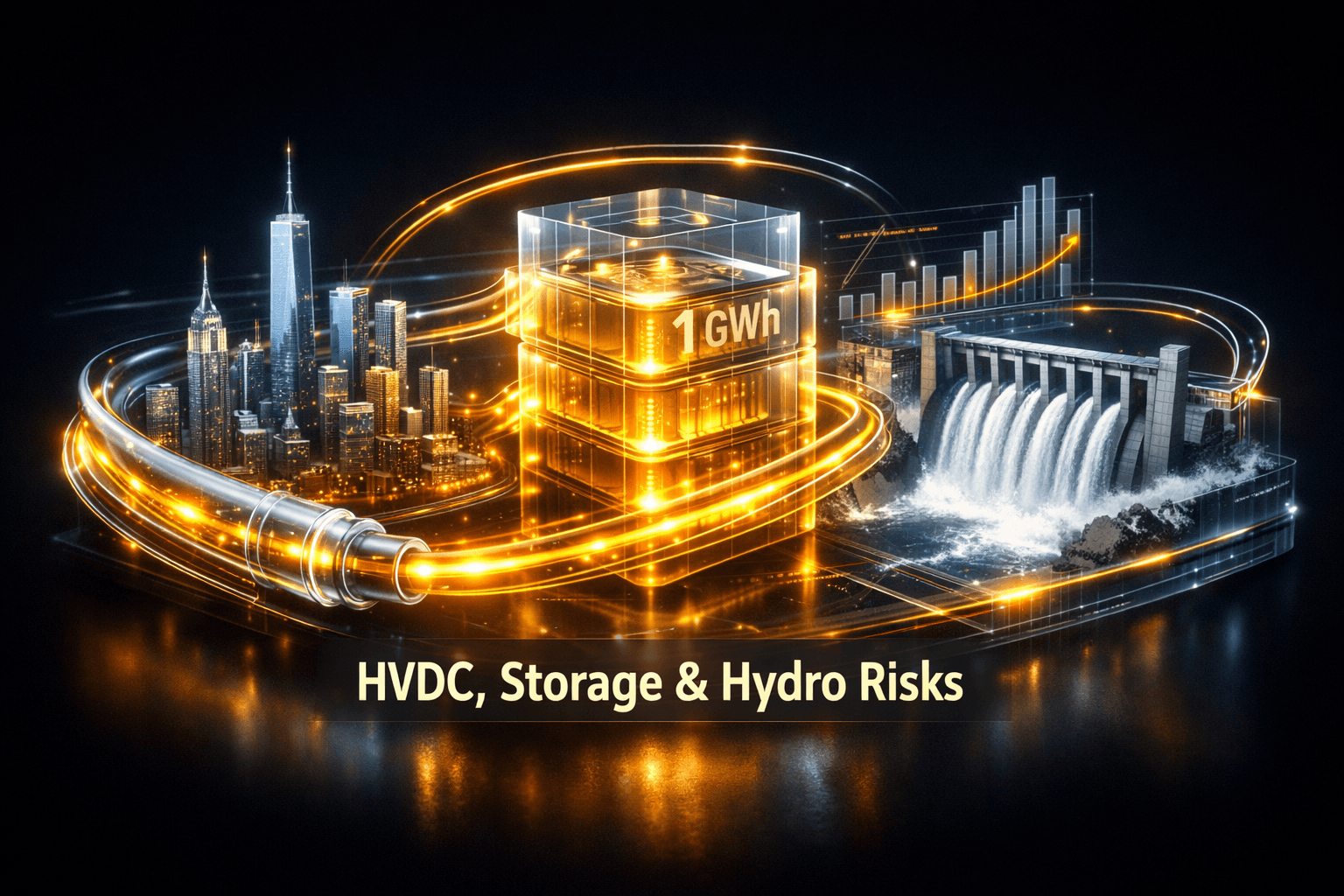
- Champlain Hudson Power Express now delivers hydropower from Canada to New York City, meeting roughly 20% of the city’s electricity needs.
- Ore Energy signed to deploy 1 GWh of iron-air long-duration energy storage in the Netherlands with Budget Thuis, marking one of Europe’s larger LDES commercial rollouts.
- Hoover Dam hydropower output could shrink by about 70% if Lake Mead drops below 1,035 feet, a major regional supply risk.
- Jackery launched the HomePower 1000 v2, HomePower 2000 Plus v2 and HomePower 3600 Pro Max with limited-time promotional pricing June 23 to June 26.
- NIO Factory Two was added to the World Economic Forum’s Global Lighthouse Network, a manufacturing recognition for $NIO that signals efficiency and scale in EV production.
Key Developments
HVDC Line Energizes New York
Governor Kathy Hochul announced the Champlain Hudson Power Express is now feeding Canadian hydropower into New York City. The project is expected to meet about 20% of city demand, which could ease reliance on fossil fuel peaker plants and lower system emissions.
For you, the takeaway is transmission matters as much as generation. Large, low-carbon imports can change regional capacity planning and wholesale price dynamics, so utilities and large buyers may rethink local procurement.
Long-Duration Storage Moves from Lab to Field
Ore Energy’s 1 GWh iron-air deployment with Dutch supplier Budget Thuis is a sign that multi-day storage technologies are stepping into commercial contracts. Iron-air systems target lower-cost, multi-day discharge, which complements daily battery cycles.
Data suggests long-duration storage can be a game changer for seasonal balancing and for buyers like utilities that need sustained discharge. Could this be the rising tide that lifts utility-scale storage adoption across Europe and beyond?
Hydropower Headwinds at Hoover Dam
Authorities warn Lake Mead could decline below the threshold that sustains Hoover Dam output, potentially cutting hydropower generation by about 70%. That would affect regional customers and increase pressure on alternative generators in the Southwest.
This is a stark reminder that climate and drought are operational risks. Which risks should you prioritize, reliability or emissions? Both matter, and utilities will likely accelerate investments in storage, transmission and dispatchable clean resources.
What to Watch
Upcoming catalysts and risks for your radar include policy moves, contract rollouts and operational stress points.
- Transmission and offtake agreements, including commercial flows on Champlain Hudson, will show how much dispatchable clean energy displaces fossil peakers in real time.
- Scale-up metrics from Ore Energy and other LDES pilots, such as round-trip efficiency, cost per MWh over lifecycle, and commercial performance guarantees.
- Hydrological updates for Lake Mead and other critical reservoirs, plus any emergency allocation decisions that could force utilities to secure replacement capacity.
- Regulatory scrutiny on onsite diesel backup at data centers, where air permitting requirements are adding complexity and potential cost for large corporate buyers.
- Product adoption signals from Jackery and consumer storage makers, which could influence behind-the-meter adoption and peak shaving behavior.
You'll want to monitor contract terms, operational performance data, and permitting outcomes. If you're tracking utility names, prioritize clarity on revenue models for storage and transmission, and look for operator disclosures about water-driven risk.
Bottom Line
- Deployment momentum is real: HVDC and commercial LDES deals show utilities and suppliers are acting at scale.
- Hydropower remains a double-edged sword, providing low-carbon energy while exposing the grid to drought risk; Hoover Dam is a wake-up call.
- Storage diversification, from lithium batteries to iron-air, is gaining commercial traction and will increasingly shape capacity planning.
- Permitting and environmental rules are material for onsite backup and large consumers like data centers, so regulatory risk is not just theoretical.
- Watch transmission flows and LDES performance metrics for signs that a longer-duration clean energy stack is feasible and bankable.
FAQ Section
Q: What is the Champlain Hudson Power Express and why does it matter? A: The Champlain Hudson Power Express is an HVDC transmission line bringing Canadian hydropower into New York City, expected to meet about 20% of city demand and reduce reliance on fossil peakers.
Q: How significant is Ore Energy’s 1 GWh deal for storage markets? A: The 1 GWh iron-air contract with Budget Thuis is significant because it demonstrates commercial-scale long-duration storage deployment, offering multi-day discharge that complements short-duration batteries.
Q: Should I be worried about the Hoover Dam projection? A: The potential 70% reduction in hydropower output if Lake Mead falls below critical levels is a major operational risk that could force regional utilities to secure replacement capacity, so it merits close monitoring.