The Big Picture
Today brought more evidence that the utilities sector is shifting from debate to deployment, as policy, supply-chain moves, and grid upgrades accelerated project viability. You saw wins for domestic solar content and faster interconnection alongside advances in vehicle-grid integration, all of which could help projects clear permitting and financing hurdles faster.
That momentum comes with a reminder that governance and legal risk still matter. A $150 million settlement tied to political misconduct at NextEra grabbed headlines, and you'll want to balance opportunity with regulatory and reputational watchpoints.
Market Highlights
Quick takeaways and numbers investors should note.
- Soltec announced its U.S. SFOne and SF7 single-axis trackers meet FEOC PFE domestic-content requirements, enabling tracker solutions with 100% U.S. domestic content for eligible projects.
- The Arizona Court of Appeals vacated the ACC-approved grid access charge for rooftop solar customers of Arizona Public Service, a win for distributed solar advocates and customers.
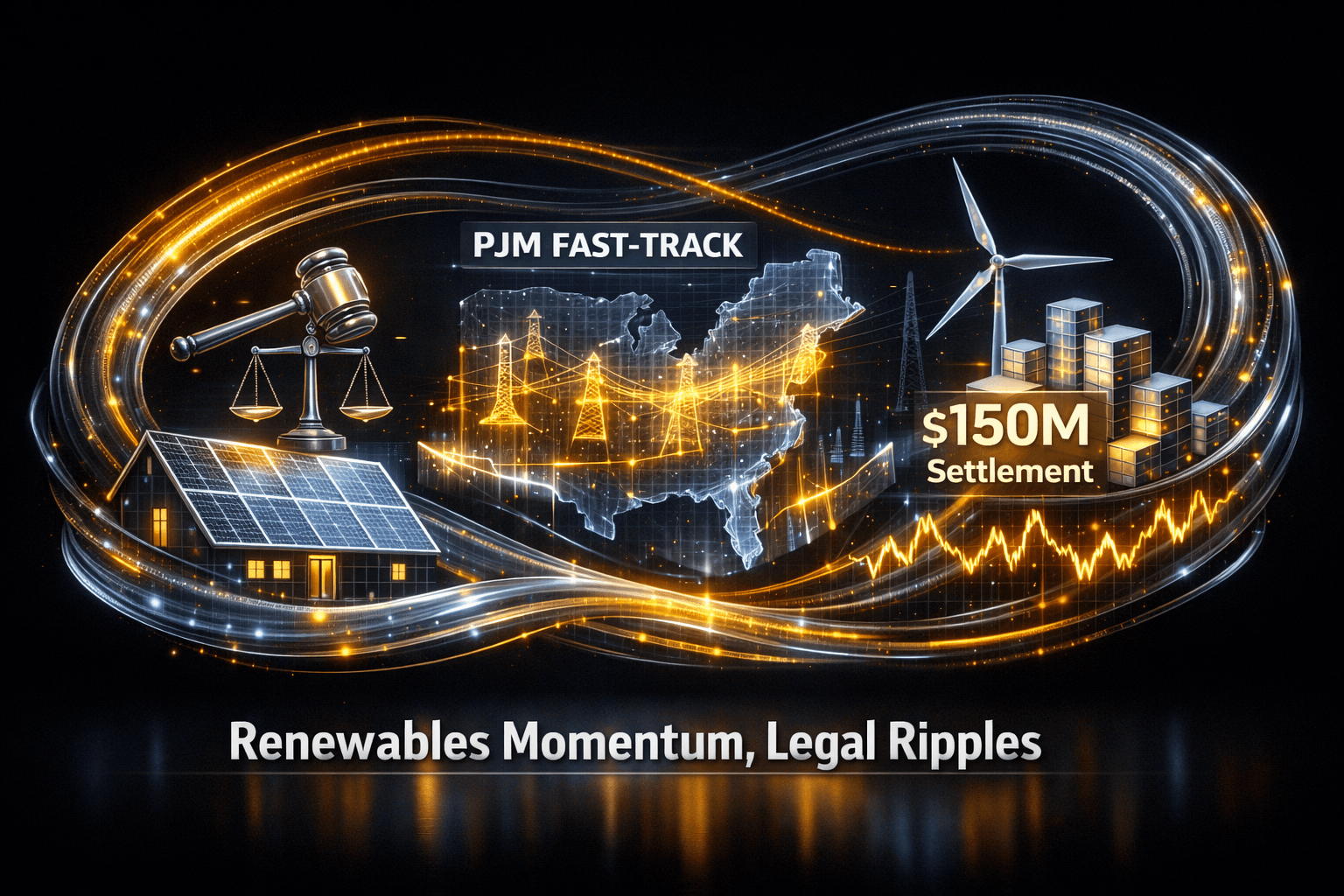
- Federal regulators approved PJM's Expedited Interconnection Track, a temporary fast-track for a handful of shovel-ready projects, as FERC signs off on a plan to speed interconnection.
- Automakers and utilities are backing managed, bidirectional EV charging, with recent moves from $GM and $RIVN highlighting load management potential and customer-side flexibility.
- $NEE agreed to pay $150 million to resolve charges tied to political misconduct, a development coming a month after its $67 billion proposed merger with $D was announced.
- Heat pump shipments rose through April, according to AHRI data, signaling continued electrification of building heating and cooling markets.
Key Developments
Domestic content and the U.S. solar supply chain
Soltec's certification that the SFOne and SF7 trackers meet FEOC domestic-content rules is a concrete win for project sponsors chasing tax and incentive certainty. Domestic-content compliance can unlock investment tax credit enhancements and reduce procurement risk, and op-eds today emphasized that value goes beyond just ITC qualfication.
If you're watching project economics, domestic supply options reduce lead-time exposure and may improve financing terms. That could translate into more shovel-ready projects and a smoother path from signing to construction.
Distributed solar and customer protections
The Arizona Court of Appeals ruling to vacate the ACC's grid access charge for rooftop-solar customers removes a major cost headwind for residential solar in APS territory. The decision reinforces legal protections for net metering and customer choice, and it could influence other state-level disputes.
At the same time, product-level innovation like Jackery's FridgeGuard and rising heat pump shipments show growing customer demand for backup power and electric heating and cooling. That demand ties into utility planning and distributed resource strategies, and it raises questions about who pays for grid upgrades and how you'll see value captured.
Grid bottlenecks, interconnection reform and corporate governance
FERC's approval of PJM's Expedited Interconnection Track aims to fast-track a select group of large, shovel-ready projects. The pilot could shave months or more off interconnection timelines for those projects, but it's a limited tool and not a cure-all for backlogs.
Meanwhile, $NEE's $150 million settlement on political misconduct claims is a reminder that large utility transactions and corporate actions are subject to governance and reputational scrutiny. That settlement arrives as NextEra pursues a proposed $67 billion merger with $D, and it could affect regulatory reviews and stakeholder sentiment.
What to Watch
Here are the catalysts and risks that should be on your radar for tomorrow and the near term.
- PJM implementation details, timelines and the criteria for the Expedited Interconnection Track. Will this pilot actually speed the queue for more projects, or will bottlenecks shift elsewhere?
- Regulatory follow-ups and potential appeals after the Arizona decision. Could similar rate design challenges be revived in other states?
- Company-level reactions to the NextEra settlement, and any regulatory commentary tied to the proposed $NEE and $D merger. Does this change the merger timeline or approvals?
- Domestic procurement announcements from developers and equipment suppliers. Watch for more suppliers claiming FEOC or PFE certification, and for project bids that highlight 100% domestic content.
- Rollouts of managed, bidirectional EV charging programs from utilities and automakers, and early pilot results on grid support and customer economics.
What does this mean for your exposure to utilities names? You should watch policy and interconnection signals closely, because they influence project volume and timing as much as technology trends do.
Bottom Line
- Renewables momentum is tangible today, driven by domestic-content wins, interconnection pilots, and stronger demand for heat pumps and backup power.
- Policy and legal decisions remain decisive. The Arizona appeals ruling and FERC's PJM order show how regulatory outcomes can quickly shift economics.
- Corporate governance matters. The $150 million NextEra settlement raises merger and regulatory review risks for the proposed $67 billion deal with $D.
- Electrification trends from EVs to heat pumps are expanding addressable markets, but interconnection and permitting remain gating factors.
- Analysts note that selectivity matters. You should focus on companies with clear supply-chain advantages, strong regulatory engagement, and transparent governance.
FAQ Section
Q: How does Soltec's FEOC compliance affect project economics? A: FEOC or PFE certification lets developers claim enhanced domestic-content benefits and can reduce procurement risk, which may improve financing terms and project timelines.
Q: Will the Arizona appeals court decision stop utilities from changing rooftop-solar charges elsewhere? A: The ruling sets a state precedent and could influence similar cases, but outcomes will depend on local regulators and court rulings in other jurisdictions.
Q: Can PJM's Expedited Interconnection Track speed up most projects? A: It targets a limited set of shovel-ready projects to accelerate delivery, but it's not a systemic fix for the entire interconnection backlog. You'll want to track implementation details to see real impact.