The Big Picture
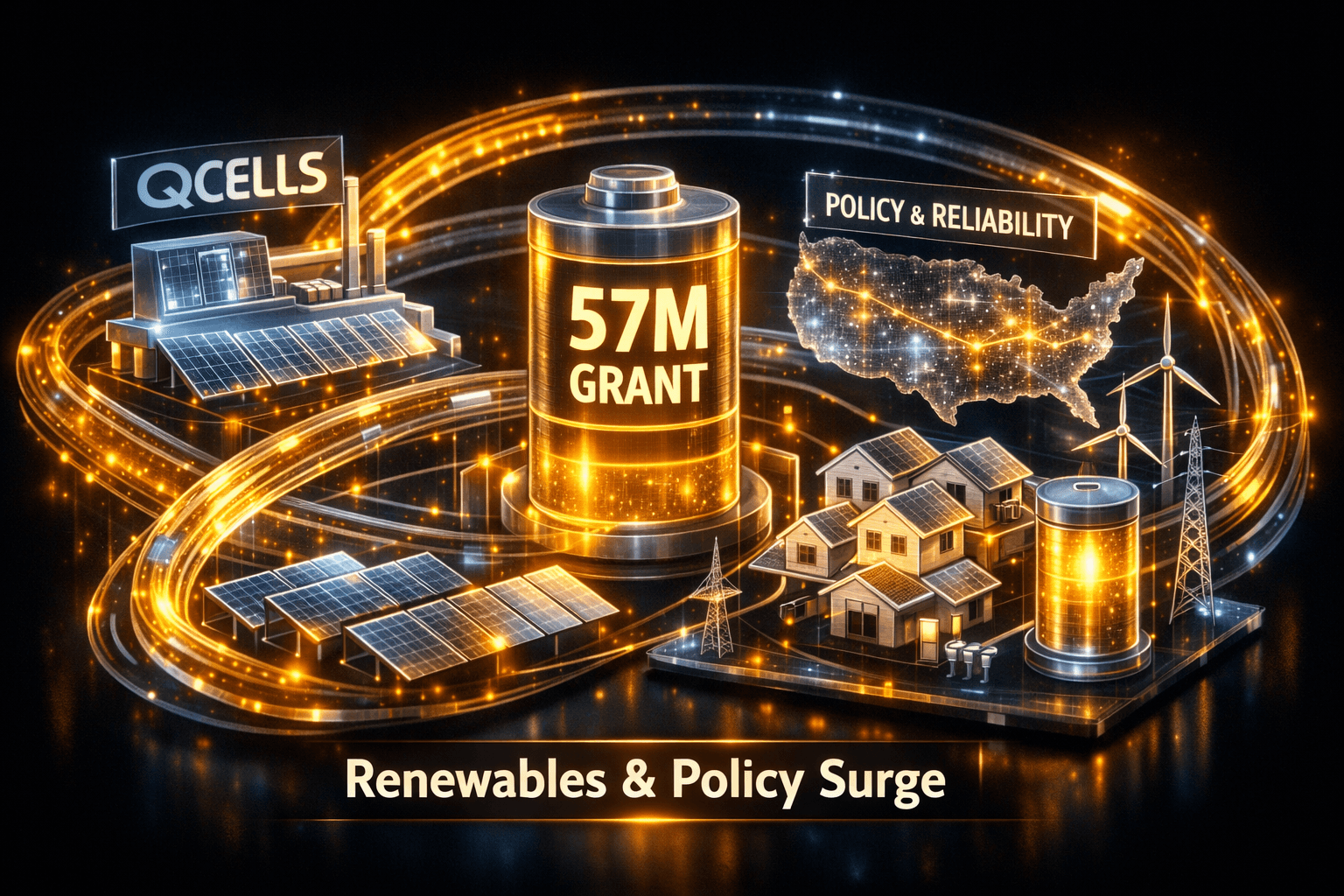
Overnight headlines favored the energy transition as manufacturing and finance moves popped to the front of the utilities story. You saw a major solar manufacturer bring silicon cell production to the U.S., a federal grant reinstated for a lithium refinery and recycling project, and community solar and storage deals gaining traction.
Those developments matter because they target supply chain resilience and grid reliability at once. For your portfolio, the trend signals growing industrial-scale buildout of renewables and batteries, even as policy and reliability questions create near-term volatility.
Market Highlights
Key facts and figures from today’s utilities beat and policy updates.
- Qcells started silicon solar-cell production in Cartersville, Georgia after a $2.5 billion investment in its integrated campus, making it the only fully integrated silicon solar panel site in the U.S.
- U.S. Department of Energy reinstated a $57 million grant for American Battery Technology, supporting plans for a $115 million commercial-scale lithium refinery and recycling facility.
- A Texas utility broke ground on a new 570-MW natural gas-fired plant intended to add dispatchable capacity to the grid.
- Common Energy will build five community solar projects totaling 16 MW to benefit Trinity Services in the Chicago area.
- Utilities are finalizing hurricane-season preparedness plans as the Atlantic season begins in June, and not-for-profit utilities are accelerating battery storage to improve reliability and price hedging.
Key Developments
Qcells opens U.S. silicon cell plant, domestication accelerates
Hanwha Qcells has begun producing silicon solar cells at its Cartersville, Georgia campus, after investing $2.5 billion to integrate ingot, wafer, cell and panel manufacturing on site. That move reduces supply chain exposure and should improve margin stability for U.S. project developers and installers over time.
For you, that means projects sited in the U.S. may face fewer procurement delays and potential tariff complexities down the road. Domestic cell capacity is set to take center stage as developers compete for timely module deliveries.
DOE reinstates $57M grant for American Battery, battery supply chain picks up
The Department of Energy reinstated the $57 million grant it had canceled last year, enabling American Battery Technology Co. to proceed with plans for a $115 million commercial lithium refinery and to expand its battery recycling operations. The funding win clears a major permitting and financing hurdle for a domestic source of lithium processing.
This is a tangible positive for utilities and storage project sponsors who want localized, lower-risk supply for battery inputs. It also underscores growing federal support for upstream battery manufacturing, which helps lower long-term costs for energy storage deployments.
Grid reliability, new gas capacity and regulatory headwinds
In Texas, a new 570-MW natural gas plant broke ground to bolster dispatchable capacity as grid operators weigh the balance between intermittent renewables and firm power. At the same time utilities are ramping up hurricane-season preparations and not-for-profit providers are deploying batteries to improve resilience around data center demand.
But policy risk remains. The Supreme Court sent a rulemaking on non-condensing gas furnaces and water heaters back to appeals court, creating uncertainty for electrification timelines. You also saw geopolitical and regulatory noise in EV supply chains with companies like $NIO pushing back on U.S. Department of Defense listings that could complicate market access. These legal and policy questions could slow some electrification curves even as buildout continues.
What to Watch
Focus on catalysts that will move the sector in the coming weeks and quarters.
- Manufacturing output and supply chain signals: Track Qcells’ ramp rate in Georgia and milestones for American Battery’s refinery. Higher domestic output should ease module and battery cost pressure over time.
- Storage adoption headlines: Watch deployments at not-for-profit utilities and independent power providers, plus announced merchant or utility-scale storage contracts. Those deals will set price expectations for batteries and ancillary services.
- Policy and litigation: Monitor developments from the Supreme Court furnace remand and any further DoD actions affecting Chinese-linked manufacturers. How will regulators balance electrification goals with legal constraints?
- Weather and hurricane season impacts: Early storms can stress grids and accelerate spending on hardening and storage. Are utilities bringing online mobile generation, grid sensors, and rapid-restoration crews?
- Community and distributed solar growth: Follow the progress of projects like the 16 MW Chicago community-solar program, which shows demand for localized, nonresidential subscriptions and social benefit programs.
What should you prioritize in this shifting landscape? Consider resilience and supply-chain clarity when assessing exposure to the sector. How much policy risk can you accept, and how important is near-term cashflow versus long-term transition gains?
Bottom Line
- Domestic manufacturing is scaling up, with Qcells’ Cartersville plant and American Battery’s reinstated grant strengthening U.S. supply chains.
- Energy storage and community solar projects are expanding, improving grid resilience and broadening access to clean power for nonprofits and municipalities.
- New gas-fired capacity in Texas highlights the continuing need for dispatchable power to back up renewables during the transition.
- Policy and legal developments, including the Supreme Court furnace remand and DoD listings, add near-term uncertainty for some electrification pathways.
- Analysts note the mix of supply-side investment and regulatory questions will create active trading and selective opportunities, depending on your risk tolerance.
FAQ Section
Q: How will Qcells’ U.S. cell plant affect solar project timelines? A: Increased local cell production should reduce lead times and import sensitivity for U.S. projects, which can speed project completion and reduce procurement risk.
Q: Does the DOE grant reinstatement guarantee American Battery’s refinery will be built? A: The grant reinstatement clears a major funding hurdle, but the project still depends on final permits and additional financing to reach commercial operation.
Q: Should hurricane season change how utilities allocate capital this year? A: Many utilities will prioritize hardening, mobile generation, and storage to shorten outage response times, which could shift near-term capital toward resilience projects.