The Big Picture
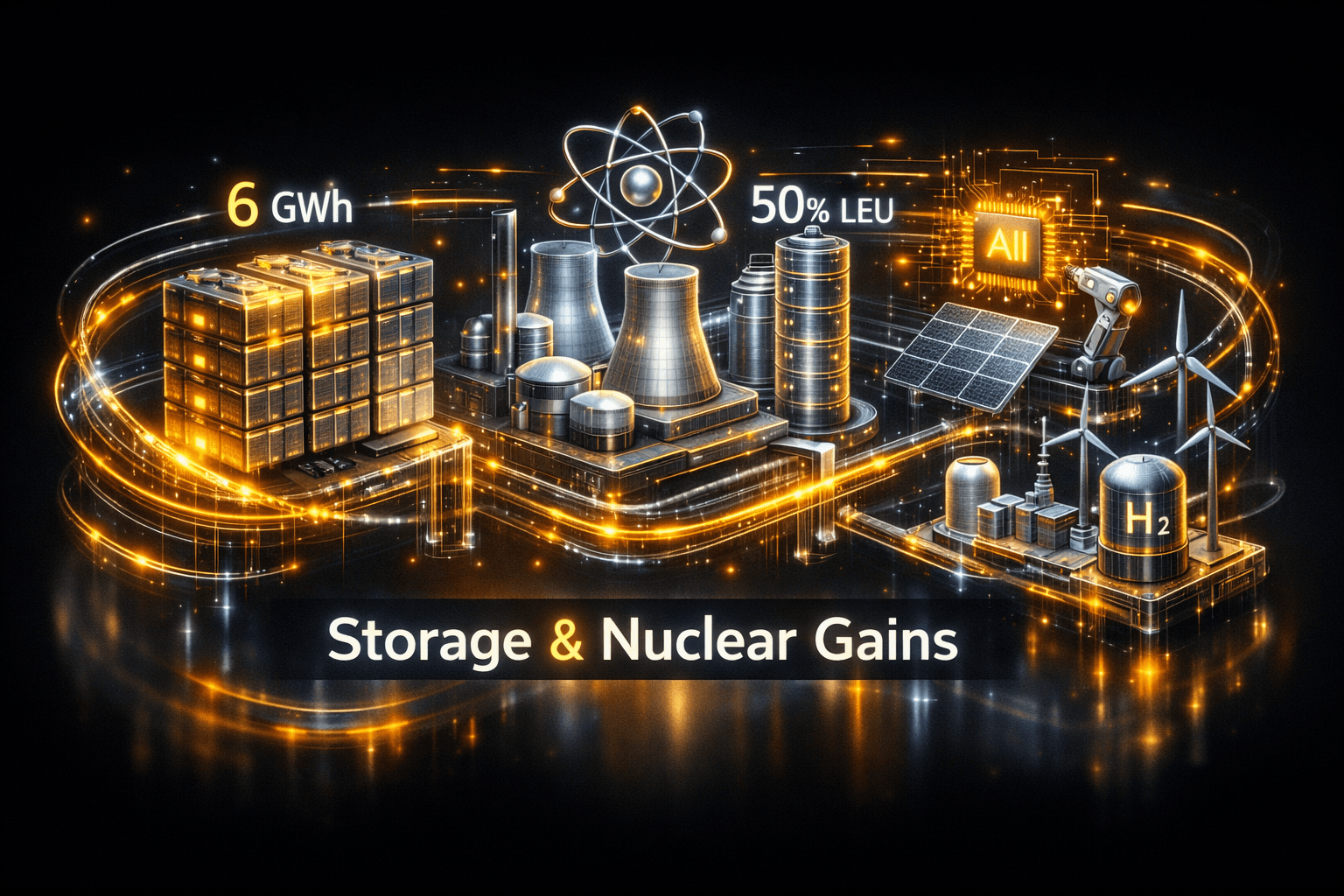
DTE Energy's partnership with LG on a 6 GWh battery deployment and Urenco USA's private multibillion dollar expansion of uranium enrichment capacity were the most consequential stories for utilities today. Together, they point to growing investment in grid flexibility and fuel security that could ease supply constraints and support higher renewable penetration.
Those wins don't erase policy and scaling concerns. A multi-state lawsuit over a federal offshore wind lease buyout and questions about hydrogen refueling throughput temper enthusiasm. Still, technology and capacity builds are accelerating, and you'll want to pay attention to how these projects change resource mixes over the next several years.
Market Highlights
Today moved the dial on both short and long-term supply-side and demand-side capacity in the utilities space.
- DTE Energy, $DTE, announced a partnership with LG to deploy 6 GWh of battery storage, as part of a plan that expects more than 2.9 GW of storage on its system by 2042, more than doubling current capacity.
- Urenco USA, operator of the National Enrichment Facility, will expand low-enriched uranium capacity by nearly 50%, adding about 2.1 million SWU through a privately funded investment.
- TotalEnergies, $TTE, is at the center of a legal fight after seven states sued the federal government over an offshore wind lease buyout tied to the company, creating regulatory uncertainty for offshore developers.
- Solar-focused firms continued to innovate: EPCs are adopting industrial AI for construction monitoring and Thornova Solar will integrate Nextpower steel frames to reduce module deflection and glass breakage.
Key Developments
DTE Energy and Battery Storage Deployment
$DTE's deal with LG for 6 GWh of battery storage is a concrete step toward utility-scale flexibility. DTE projects more than 2.9 GW of storage by 2042, which signals system planners are betting on batteries to manage variable renewables and peak demand.
For you, that means utilities are starting to lock in mid-term capacity that can shift load and provide ancillary services. Expect more announcements like this as developers push to integrate renewables reliably.
Urenco Expansion Bolsters Nuclear Fuel Security
Urenco USA's decision to privately fund a nearly 50% increase in LEU capacity at the Eunice, New Mexico facility will add roughly 2.1 million SWU. The investment aims to relieve a widening nuclear fuel supply gap and support baseload generation.
Analysts note this reduces one source of supply risk for utilities relying on nuclear generation. It's a strategic, supply-side move that could stabilize fuel availability for reactors over the medium term.
Offshore Wind Legal Headwinds and Hydrogen Scaling Questions
Seven states sued the federal government over an alleged sham settlement tied to a TotalEnergies offshore wind lease buyout. The suit raises procedural and policy questions that could slow project timelines and increase developer risk.
Meanwhile, Belgium's announced hydrogen stations tout a combined capacity of more than 7 tonnes per day, but reporting flagged kilograms-per-day limitations that could make the rollout insufficient for heavy-duty fleets. Can hydrogen scale fast enough to meet trucking and bus demand? That's still unclear and worth watching.
What to Watch
There are several near-term catalysts and risk factors that will shape utility sector momentum into tomorrow and beyond.
- Battery project announcements and procurement tenders. Watch other regulated utilities for follow-on deals like the DTE-LG pact, especially ahead of summer peaks.
- Regulatory and legal updates on the TotalEnergies lease buyout. Court filings and federal responses could affect offshore project schedules and developer risk premiums.
- Progress and timelines for Urenco's new enrichment plant. Construction milestones and commissioning dates will matter for nuclear fuel markets.
- Grid integration metrics as more storage comes online. You'll want to track capacity factor impacts, ancillary service revenues, and interconnection queue movement.
- Hydrogen throughput and pricing data for refueling stations. Scaling issues in Belgium highlight that announced capacity doesn't always equate to usable output for heavy-duty operators.
Bottom Line
- Capacity and tech wins dominated today, with battery storage and uranium enrichment announcements signaling stronger supply-side fundamentals.
- Solar construction is getting more efficient through AI and improved module hardware, which should speed deployments and reduce losses in the field.
- Regulatory uncertainty around offshore wind and practical throughput limits for hydrogen show policy and scaling are still key hurdles.
- Monitor procurement pipelines and legal developments closely, because policy changes can alter project economics quickly.
- Analysts note the sector's momentum indicates growing flexibility, but you should watch near-term execution and permitting risks before drawing conclusions.
FAQ Section
Q: How material is DTE's 6 GWh battery deal for the utilities sector? A: It is a notable mid-size deployment that signals greater commitment to storage at the utility scale, and similar deals could follow at other regulated utilities.
Q: Does Urenco's expansion solve the nuclear fuel shortage? A: The expansion adds significant LEU capacity and helps reduce supply pressure, but global demand dynamics and timelines mean it is a major piece, not a complete solution.
Q: Should I worry about the offshore wind lawsuit and hydrogen station limits? A: The lawsuit injects policy uncertainty that could delay projects, and reported hydrogen throughput issues show scaling risks. Both are legitimate headwinds to monitor for project timelines and costs.