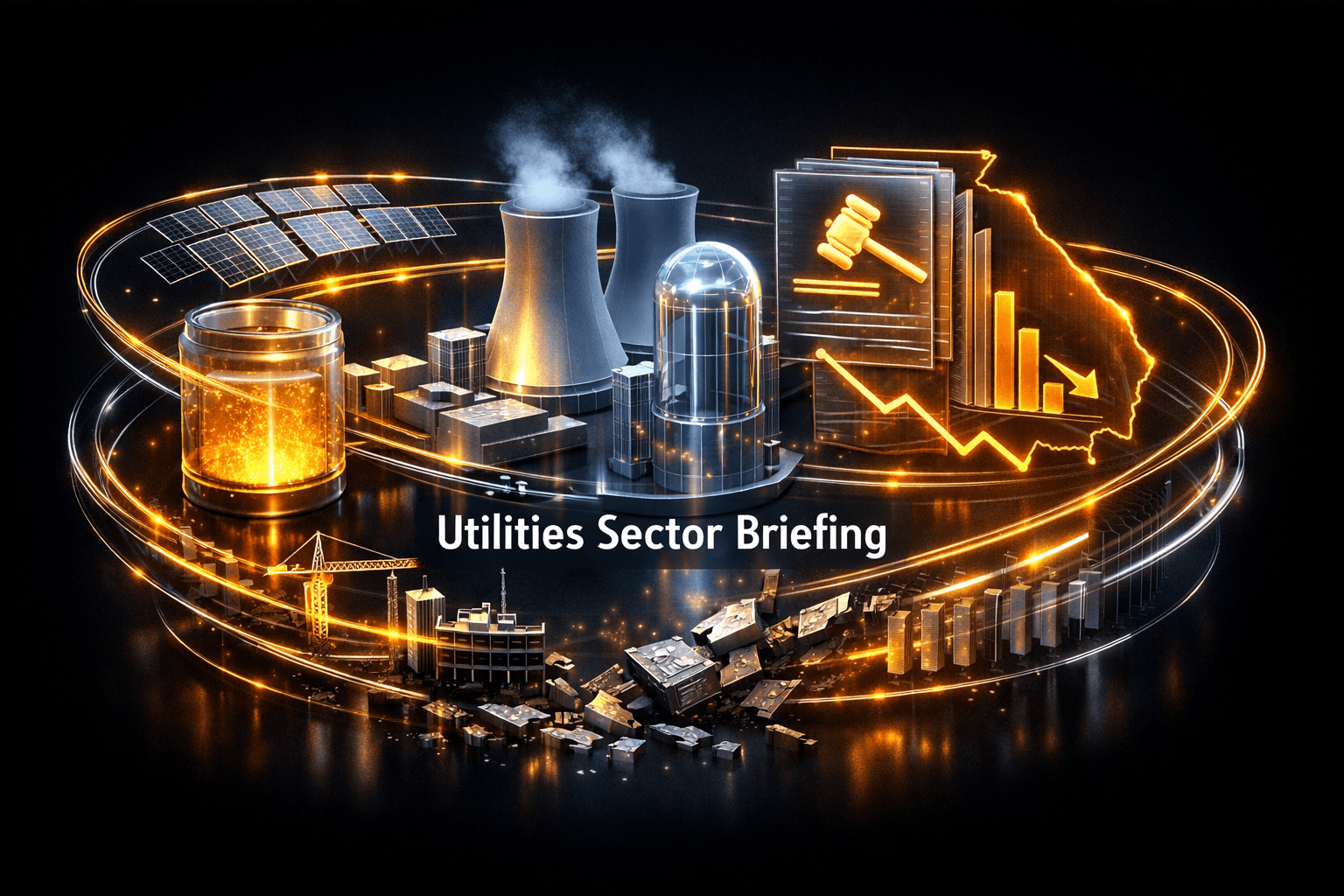
The Big Picture
Today’s utilities landscape is sending mixed signals, with major capacity investments and policy wins running up against project cancellations and contentious regulatory decisions. You’ll see momentum in long-duration storage, grid modernization and a renewed push for nuclear capacity, but there are clear near-term headwinds for developers and ratepayers.
Why this matters to you, the investor: these threads will shape earnings, capital allocation and regulatory risk across utilities, independent power producers and project developers for the rest of 2026. Time will tell which trends dominate, so you’ll want to watch catalysts closely.
Market Highlights
- Thermal storage commission: POET and Antora Energy brought a 5 GWh multi-day thermal energy storage system online at POET’s Big Stone City bioprocessing site, signaling commercial-scale deployment for long-duration storage.
- Nuclear push in Sweden: Blykalla and Studsvik filed for up to 1.7 GW of new capacity, and the Swedish government proposed a $3.7 billion capital commitment to the Ringhals SMR project, marking a policy shift toward new nuclear investment.
- State policy and DER: New Mexico earned top marks for its DER interconnection rules, highlighting faster, more transparent queues and adoption of IEEE technical standards for storage and rooftop solar.
- Ratepayer impact: The Georgia Public Service Commission approved continued automatic pass-through of fuel costs for Georgia Power, a decision that shifts near-term cost pressure onto customers rather than the utility, and raises regulatory scrutiny for peers like Southern Company, parent of Georgia Power, referenced as $SO.
- Utility tech and resilience: PG&E opened a Continuous Monitoring Center to move from reactive wildfire response to proactive detection and prevention, an operational upgrade relevant to $PCG and other high-risk utilities.
- Clean energy momentum and risks: Q1 2026 saw 12 GW and $19 billion of announced clean energy investments, but E2 data shows 45 project cancellations totaling about $14 billion, underlining financing and timing stress for developers.
Key Developments
Long-duration storage reaches commercial scale
The commissioning of a 5 GWh thermal storage system at POET’s South Dakota facility with Antora Energy is one of the more tangible examples yet of multi-day storage moving from pilot to plant. For utilities and large industrial offtakers, that means you may see new options for shifting thermal loads and firming intermittent renewables, which could change procurement dynamics.
Policy and capital reshape the nuclear outlook in Sweden
Two separate filings for up to 1.7 GW and a proposed $3.7 billion government backing for Ringhals SMR show Sweden is seeking to accelerate nuclear deployment. Analysts note this could help normalize financing for advanced reactors if the government support becomes law, and it may influence other nations considering SMRs for capacity and emissions targets.
Regulatory and project risk, side by side
The Georgia PSC decision to allow Georgia Power to pass through fuel costs raises a regulatory risk conversation, because it reduces the utility’s short-term incentive to control fuel spending. At the same time, the surge in project cancellations tied to expiring tax credits shows developers are racing the clock, and you should expect more volatility in project pipelines as credits sunset.
What to Watch
Keep your eye on several near-term catalysts that could move stocks and project economics. First, watch state and federal policy signals, especially any clarifications on tax credits and interconnection reforms that affect project viability. Will developers accelerate construction to lock in credits, or will cancellations continue?
Second, monitor utility regulators and rate cases. The Georgia PSC action is a live example of how cost-recovery mechanisms can shift margins and cash flow timing for utilities. You should also watch capital spending plans tied to wildfire mitigation and grid hardening, which could affect earnings and credit metrics.
Third, follow commercial deployments of long-duration storage and SMR procurement. Announcements of additional offtake agreements, or follow-on capital commitments to projects like Ringhals, could help set a clearer growth path for companies working in these areas.
Bottom Line
- Sector sentiment is neutral, with durable advances in storage, nuclear and DER policy offset by project cancellations and cost-shift regulatory decisions.
- Long-duration storage moving to commercial scale and Swedish nuclear funding are structural positives that could alter capacity planning over multiple years.
- Project pipelines remain fragile, as E2’s data on cancellations shows, so you should expect uneven execution and timing risk for developers.
- Regulatory actions, such as the Georgia PSC ruling, materially affect ratepayer outcomes and utility incentive structures, and they merit close monitoring.
- Analysis is informational only, analysts note this briefing does not constitute individualized investment advice and does not recommend any specific transactions.
FAQ Section
Q: How will multi-day thermal storage affect utility procurement? A: Thermal storage offers a firming option that can reduce reliance on peaker plants for some loads, improving flexibility for utilities and large industrial customers.
Q: Should you expect more project cancellations as tax credits sunset? A: Data suggests cancellations have accelerated, so developers face a timing squeeze and you may see more pipeline churn until policy clarity or financing improves.
Q: What does the Georgia PSC decision mean for ratepayers and utilities? A: The ruling shifts short-term fuel cost risk to ratepayers, reducing the utility’s immediate incentive to cut fuel spending and raising regulatory scrutiny for similar mechanisms elsewhere.