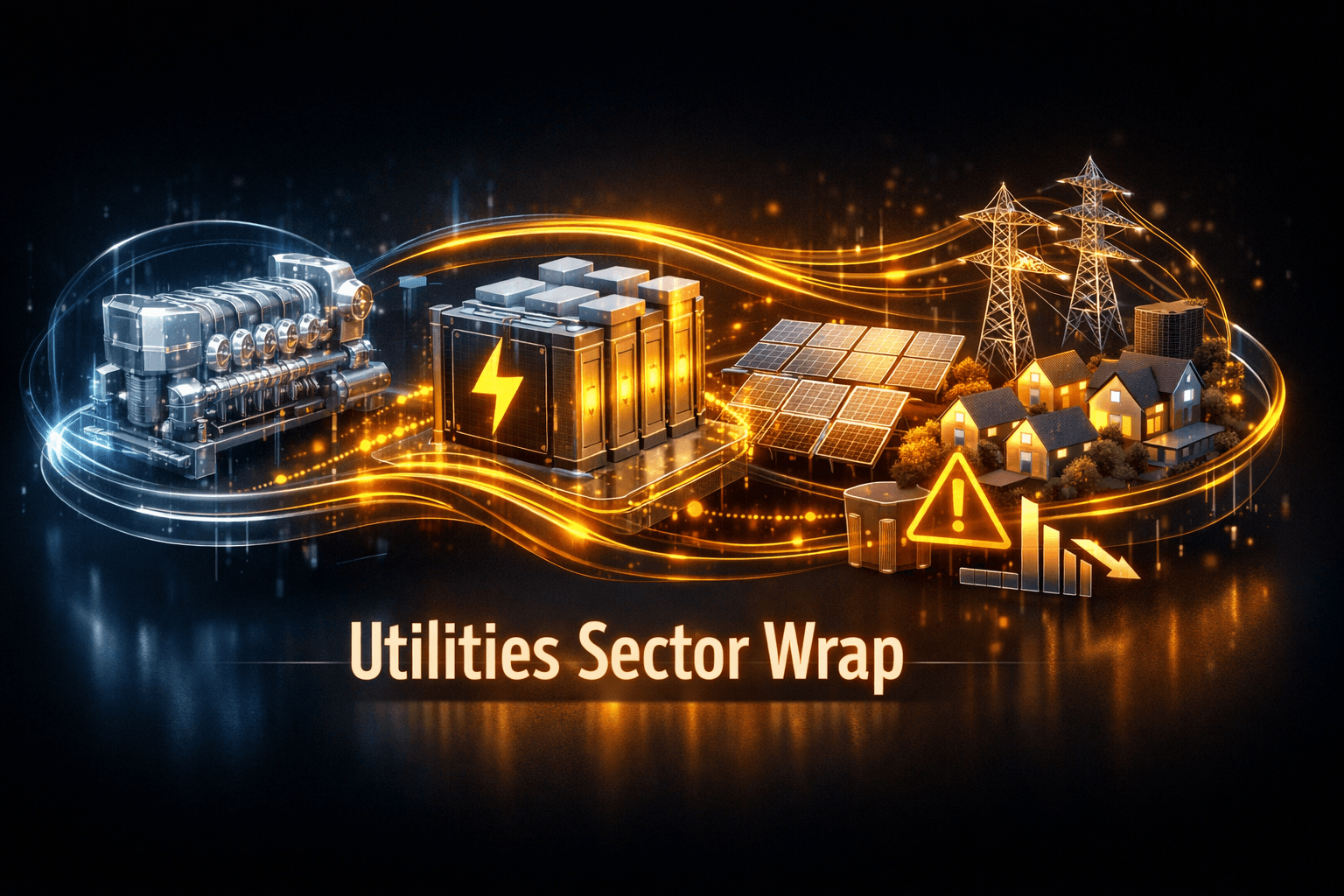
The Big Picture
Utilities headlines today showed clear momentum on project delivery and technology adoption, while structural and policy issues kept risk firmly on the table. You saw new generation and storage contracts, local solar rollouts, and advances in asset monitoring, but you also got reminders that interconnection bottlenecks and policy shifts can slow deployment and raise costs.
That mix matters because it tells you the sector is building capacity and capability even as operational frictions and shifting incentives could delay returns. What should you expect tomorrow, and how might these trends change your view of utility names and clean energy suppliers?
Market Highlights
Trading reflected a sector working through both growth news and nagging constraints, with select project announcements drawing attention from renewable and grid technology investors.
- Wärtsilä and Origem Energia announced two equipment supply contracts for Brazilian balancing capacity, covering two batches of 18 Wärtsilä 34SG engines, a total of 36 units aimed at fast-response power needs.
- Alsym Energy partnered with Juniper to deploy 500 MWh of sodium-ion grid-scale storage across California and other states, highlighting growing interest in alternatives to lithium chemistry.
- Smaller scale solar and community projects moved forward: Cherry Street Energy brought a 112.89 kW system online in Richmond, and a climate fund-backed project added about 270 kW across 40 Montgomery County affordable housing units.
- Exus Renewables rolled out Anomaly+ for predictive maintenance in solar and wind, showing growing investment in software to boost asset uptime and lower operating costs.
- No single large-cap utility move was reported from these stories, and broader intraday price swings tied to these announcements were modest based on sector commentary today.
Key Developments
Balancing Capacity Installations: Wärtsilä and Origem Energia
Wärtsilä signed two equipment-supply contracts with Origem Energia to deliver two batches of 18 Wärtsilä 34SG engines for Brazilian balancing projects. These reciprocating engine installs are aimed at meeting fast-response needs as grids integrate more variable renewables.
For you that means developers and OEMs that offer flexible thermal and hybrid solutions remain relevant, especially in emerging markets where grid stability is a near-term priority.
Large-Scale Storage and Alternative Chemistries
Alsym Energy and Juniper agreed to bring 500 MWh of sodium-ion grid-scale storage to California and other states. This scale signals a shift toward diversified storage chemistries for long-duration and cost-sensitive projects.
Data suggests sodium-ion is gaining traction where lifecycle cost and raw material risk matter, and you should watch which developers adopt the chemistry at scale.
Distributed Solar, Community Projects, and Monitoring Software
Cherry Street Energy finished a 112.89 kW rooftop system for Insight Global in Richmond, while a nonprofit backed by Billie Eilish supported roughly 270 kW across 40 affordable housing townhomes. These are modest but meaningful wins for distributed generation and energy equity.
Exus Renewables’ Anomaly+ launch underscores how predictive maintenance and analytics are becoming standard tools to protect yield and reduce operating expense, a trend that will affect project valuations and O&M budgets.
What to Watch
Keep an eye on policy moves and queue reforms, because they directly affect project timing and cash flow. Will regulators push for standardized interconnection processes to ease long backlogs? That could be a game changer for rooftop and storage developers.
Also monitor early deployment metrics for sodium-ion systems, including round-trip efficiency and degradation rates, because they will affect PPA pricing and bankability. Are developers reporting comparable lifetime costs to lithium solutions?
Finally, watch for guidance or proposals on energy efficiency incentives. Analysts note weaker federal or state support can raise demand for generation and storage and shift the economics for customer-side upgrades.
Bottom Line
- Project activity is robust, from balancing engines in Brazil to 500 MWh of sodium-ion storage, showing developers are still scaling capacity and experimenting with new chemistries.
- Distributed and community solar projects continue to move ahead, but long interconnection queues remain a significant drag on deployment schedules and expected revenues.
- Software for monitoring and predictive maintenance is advancing, and it will matter for operating margins and asset longevity.
- Policy shifts on energy efficiency and growing energy demand from AI and other computing create offsetting pressures that can change the sector’s near-term economics.
- For your portfolio perspective, expect selective opportunities where execution and regulatory clarity align, and caution where operational bottlenecks persist.
FAQ Section
Q: How will sodium-ion storage affect grid-scale battery competition? A: Sodium-ion offers lower raw material risk and potential cost advantages, but you should watch field performance and degradation data to judge competitiveness versus lithium.
Q: What does the DER interconnection backlog mean for distributed solar returns? A: Longer queue times delay revenue start dates and increase development risk, so project economics can change materially if interconnection reform is slow.
Q: Should I expect policy support for energy efficiency to return soon? A: Policy timing is uncertain, and today’s coverage suggests momentum for reinstating strong incentives is mixed, so you need to factor potential policy headwinds into long-range modelling.