The Big Picture
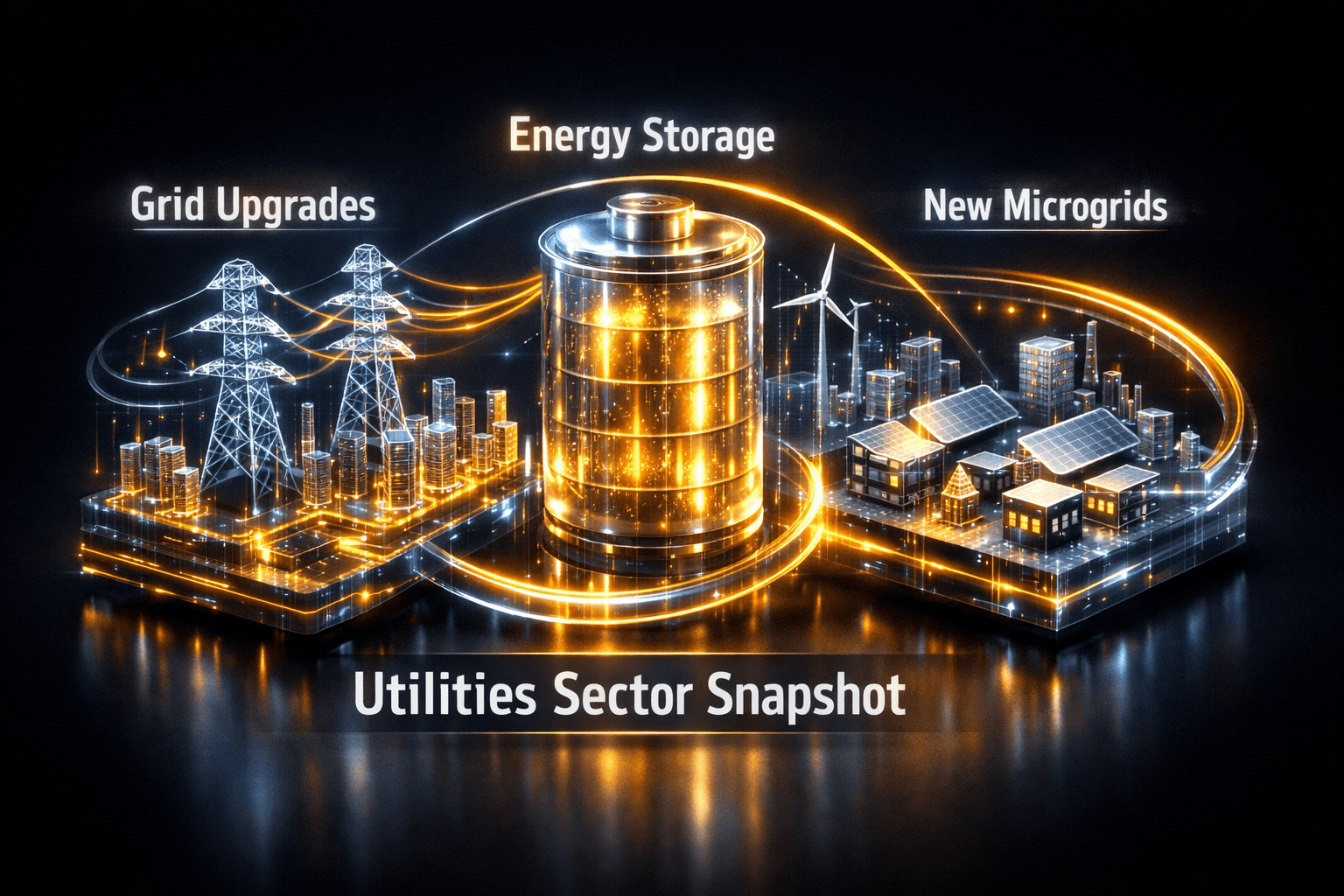
Utilities and grid-related companies are seeing concrete demand and policy moves that translate into near-term project pipelines and longer-term revenue opportunities. Recent headlines include a multibillion dollar grid plan for New York, master supply agreements for battery firm Fluence, and new microgrids proving on-site carbon neutrality.
That combination, along with industry coalitions pushing climate rules in Europe and new nuclear construction milestones, suggests momentum building across generation, transmission, and storage. You’ll want to focus on which policies and contracts will drive earnings and which regulatory fights could slow deployment.
Market Highlights
Quick facts and numbers from overnight and recent sector developments.
- Con Edison announced plans to spend $29 billion to reinforce the New York City area grid as electrification increases, a major transmission and distribution investment for the region.
- Fluence Energy signed master supply agreements with two large hyperscalers, a deal Jefferies called significant progress for the company’s data center thesis, accelerating battery demand for large-scale customers, $FLNC.
- Tesla reported very limited sales of rear-wheel-drive Cybertrucks, with just 173 RWD units identified over two years, a datapoint that highlights volatility in EV product mix, $TSLA.
- Siemens’ Wendell, NC plant is now carbon neutral after installing a 1.25 MW solar carport paired with a 3.9 MWh battery energy storage system, which cut campus grid consumption by 2.5 MWh annually, $SIEGY.
- Industry coordination grew in Europe as 55 companies formed the ETS2 Action Alliance to back the EU’s ETS2 framework, signaling corporate support for stricter emissions rules that can drive clean energy demand.
Key Developments
Con Edison to fund a $29B grid overhaul
Con Edison’s $29 billion plan to shore up the NYC-area grid reflects the large-scale cost of electrifying buildings and transport in dense urban markets. For utilities, big T&D budgets mean steady regulated returns and lots of work for contractors and equipment suppliers.
For you, that means incumbent utilities and vendors tied to grid modernization may see multi-year revenue visibility as electrification drives load growth and reliability upgrades.
Fluence lands master agreements with hyperscalers
Fluence signed master supply agreements with two major hyperscalers, a move analysts say came earlier than expected and materially advances Fluence’s data center strategy. Jefferies called the development “significant progress.”
Energy storage companies benefit when large cloud and AI operators lock in supply chains, because those contracts can underpin long-term project pipelines. Watch how contract timing impacts Fluence’s backlog and revenue cadence.
Distributed projects and industrial microgrids prove out economics
Siemens’ Wendell facility reached carbon neutrality after adding a 1.25 MW solar carport and a 3.9 MWh battery system, cutting the site’s grid energy use. GameChange Solar paired with Raptor Maps to introduce autonomous tracker monitoring, improving O&M feedback loops for utility-scale solar owners.
These deployments show the accelerating shift toward distributed assets that reduce operating costs and exposure to wholesale prices. Are you positioned to benefit from O&M, monitoring, or microgrid service providers?
Policy and supply chain dynamics are shaping deployment
European industry groups and civil society backed ETS2 rules, signaling demand for cleaner fuels and electrification in the medium term. Meanwhile, U.S. solar manufacturers asked for an investigation into Ethiopian exports, alleging tariff circumvention for panels and cells.
Policy support and trade scrutiny can both lift and complicate deployment pathways. Analysts will be watching whether tariffs push module prices up and slow installation growth, or whether stronger emissions pricing accelerates clean-electron demand.
What to Watch
Upcoming catalysts that could move names across the utilities, renewables, and storage space.
- Regulatory actions and rate cases tied to Con Edison’s $29 billion plan, since approvals and cost-recovery timelines will determine near-term cash flows.
- Fluence’s contract disclosures and project backlog updates, which will show how quickly master agreements convert to shipments and revenue.
- Trade agency decisions on the Ethiopia solar probe, a ruling that could change module supply flows and pricing in the U.S. market.
- Nuclear project milestones, including construction timelines for Natrium and Hermes 2, where scaling challenges could affect supply chains and capital needs.
- State-level rulings like Oregon’s move to charge data centers for grid upgrades, which may set a precedent for cost allocation in other regions and affect large customer siting economics.
Which names are likely to react first? Watch utilities with heavy T&D exposure, storage suppliers with hyperscaler contracts, and module manufacturers that compete in U.S. markets. Keep your eye on the ball when earnings and regulatory filings come out this quarter.
Bottom Line
- Grid investment is accelerating, with Con Edison’s $29 billion plan a high-profile example of how electrification requires major distribution upgrades.
- Storage demand is firming as Fluence signs master agreements with hyperscalers, suggesting multi-year procurement for utility-scale batteries.
- Distributed energy and O&M innovation are proving value, highlighted by Siemens’ microgrid and GameChange’s autonomous tracker integration.
- Policy and trade developments remain pivotal, with ETS2 backing in Europe and a U.S. probe into Ethiopian solar exports creating both tailwinds and headwinds.
- Monitor regulatory approvals and contract-to-delivery timelines to gauge near-term revenue visibility across utilities and clean energy suppliers.
FAQ Section
Q: How will Con Edison’s $29 billion plan affect utility rates? A: Rate impacts depend on public utility commission approvals and cost recovery schedules, analysts note that multi-year investments are typically phased into rates with regulatory oversight.
Q: Do Fluence’s master agreements guarantee revenue this year? A: Master agreements signal demand but revenue depends on contract timing, project milestones, and component supply, so conversion into booked sales still needs monitoring.
Q: Could the Ethiopian solar probe raise U.S. module prices? A: If trade authorities find circumvention and impose duties, module supply could tighten and prices may rise, which would affect installation economics in the near term.