The Big Picture
Electrification momentum meets grid reality today, as more electric trucks and aggressive EV charging programs point to rising power demand while market reforms and M&A activity aim to manage the transition. You should note both the growth signals and the operational constraints because they will shape utility earnings, capital spending, and policy debates this year.
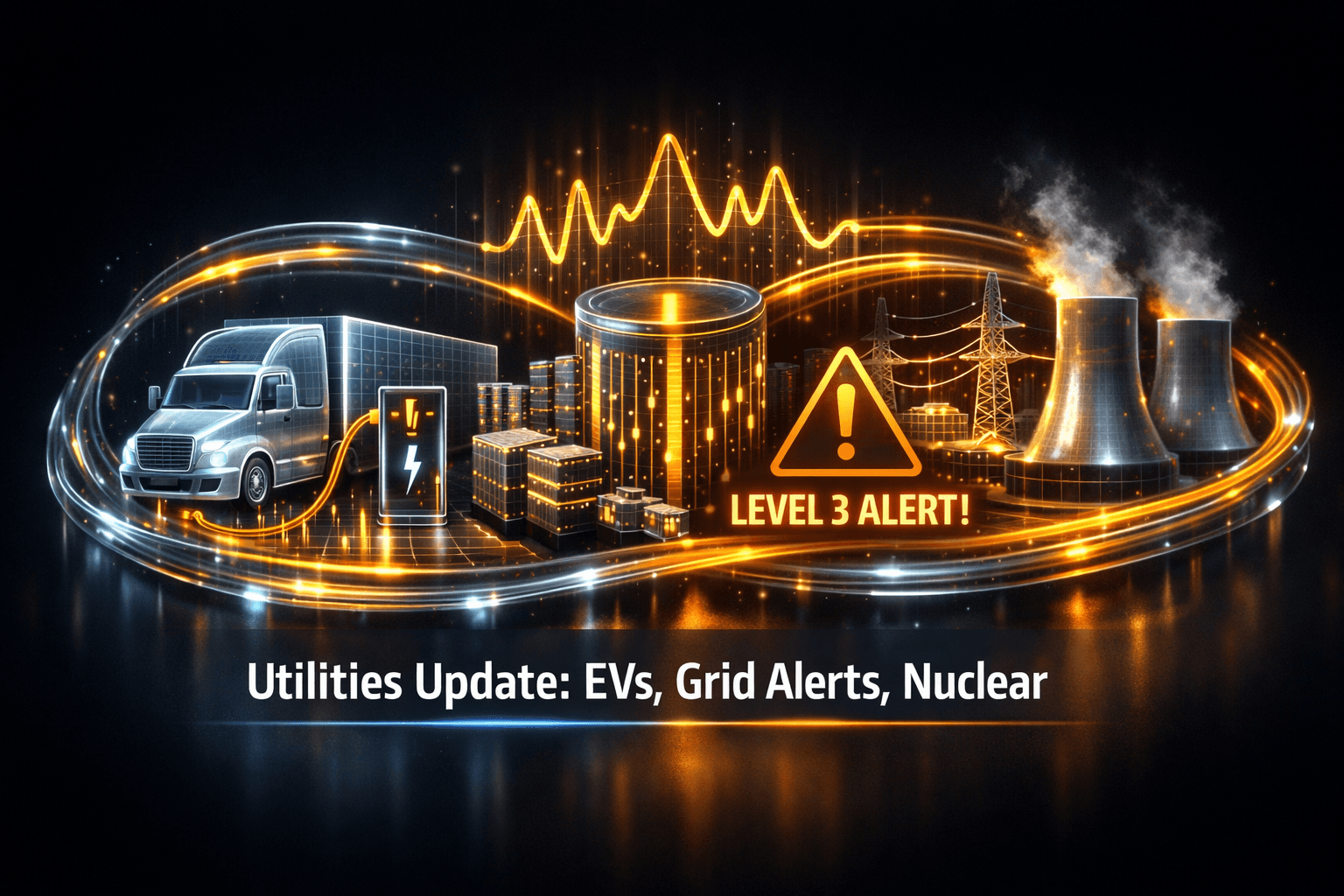
Major developments include the live Extended Day Ahead Market in the West, a Level 3 NERC alert on data center loads, a pending acquisition of Cleco, and rising nuclear shares at TVA. These items together suggest momentum building in clean power and grid modernization even as capacity and reliability questions create short-term headwinds.
Market Highlights
Here are the quick facts you need before the bell.
- EDAM launch, May 1: CAISO and PacifiCorp began the Extended Day Ahead Market, aiming to lower costs by coordinating supply across the West.
- NERC Level 3 Alert: The North American Electric Reliability Corporation issued a Level 3 Essential Action Alert on May 4, urging urgent action on large data center loads.
- Cleco deal: Stonepeak and Bernhard Capital Partners announced a planned acquisition of Cleco, a Louisiana utility serving about 298,000 customers, pending regulatory approvals.
- EV adoption signals: CleanTechnica notes a visible rise in electric trucks in China from LANDKING, while $F drivers under a TXU Energy plan shifted 515 MWh to off-peak hours in 2025.
- Nuclear trends: TVA reports nuclear now supplies 41 percent of its power, and $PSEG says New Jersey's nuclear outlook improved after a moratorium lift, though federal support remains necessary.
- Coal declines: Coal deliveries for non-power uses in the South fell 75 percent between 2010 and 2025, a 14.7 million short ton drop, underscoring structural fuel shifts.
Key Developments
Grid reliability and the NERC Level 3 Alert
NERC's Level 3 Essential Action Alert on May 4 makes clear that rapid, concentrated data center growth has created immediate risks for certain regions. Operators are being urged to coordinate curtailments and reliability measures to avoid outages, and this is drawing attention to transmission and interconnection bottlenecks.
What does this mean for you as an investor? Expect utilities and grid operators to prioritize near-term investments in load management and to push for faster interconnection reforms. The alert may also accelerate demand-side programs and contracts with hyperscalers to smooth peaks.
Electrification momentum, EV charging and trucks
Electrification headlines are showing real-world impact. CleanTechnica's coverage of LANDKING at Auto China highlights EV truck adoption at scale in freight corridors. Closer to home, TXU Energy's program for $F drivers produced a 515 MWh shift to off-peak charging in 2025, a notable proof of concept.
If you follow utility revenue models, charging load growth creates both upside and pressure. Utilities can book new load and rate-base investments, but they will also face capital needs for distribution upgrades. The writing's on the wall for long-term demand growth, but the timing and location of that growth will matter to returns.
Market design, M&A and the nuclear angle
The EDAM market, live since May 1, is intended to reduce costs by sharing resources across balancing areas. Analysts note EDAM could cut dispatch costs and improve utilization of renewables and existing thermal plants, which should help customer bills and system reliability.
Meanwhile, private equity interest in regulated assets is visible in the proposed Stonepeak and Bernhard purchase of Cleco, which serves about 298,000 customers. On the generation side, TVA's increase of nuclear to 41 percent of supply and $PSEG's comments on New Jersey's improved nuclear outlook indicate policy and financial frameworks will be pivotal for future builds.
What to Watch
Several near-term catalysts and risks could move utilities shares and sector sentiment today and in coming weeks.
- Regulatory decisions on the Cleco deal, including state public utility commission reviews, will set precedent for private capital in regulated utilities.
- Implementation details and early results from EDAM will be monitored for cost savings and dispatch impacts. Will you see meaningful customer bill relief or only modest dispatch efficiency gains?
- Follow NERC and regional entity notices for load curtailment guidance and transmission dispatch orders tied to data center growth. These will indicate how immediate the grid risk is.
- Watch utility filings for grid investments and rate cases prompted by EV charging load growth, plus any hyperscaler offtake deals needed to underwrite new nuclear projects.
- Political developments such as the Sierra Club endorsement of Tom Steyer in California could influence state policy and clean energy procurement, which may affect your exposure to state-focused utilities.
Bottom Line
- Electrification and market reform are creating structural growth opportunities across the utilities sector, from EV charging to expanded market coordination.
- Grid reliability issues driven by concentrated data center demand are a near-term risk that will spur investments and operational responses.
- M&A interest in regulated utilities and shifts in generation mix, including rising nuclear shares, will shape capital deployment and regulatory debates.
- Policy and federal support remain critical levers, especially for new nuclear projects and large transmission upgrades needed for electrification.
- Data suggests selective exposure to utilities tied to clean energy integration and grid modernization may capture sector momentum, while you should monitor execution and regulatory outcomes closely.
FAQ Section
Q: What is EDAM and why does it matter? A: EDAM is the Extended Day Ahead Market launched by CAISO and PacifiCorp to coordinate dispatch across the West, which analysts note could lower dispatch costs and improve renewable utilization.
Q: Should I be worried about the NERC Level 3 alert? A: The alert signals immediate operational risk from large data center loads, so it's a cautionary flag. Utilities and operators will likely take measures to manage risk while longer term transmission and interconnection work continues.
Q: How will EV charging programs affect utility revenue? A: Charging programs can increase energy sales and create new rate-base investment needs, while load-shifting programs like TXU's show you can flatten peaks and reduce grid stress if programs are well designed.