The Big Picture
Clean energy deployments and policy support set the tone for the utilities sector today, with new storage projects, a major U.S. solar manufacturing expansion, and legislative moves in California and Maryland. These developments point to accelerating adoption of batteries and on-site generation that can lower energy costs and ease grid constraints.
For you as a retail investor, that means momentum in the technologies that utilities and corporate offtakers are buying, plus potential revenue and regulatory shifts you need to watch. Who benefits and who takes on more regulatory pressure will be clearer over the coming quarters.
Market Highlights
Key facts and company ties from today’s coverage, drawn from project announcements and policy approvals.
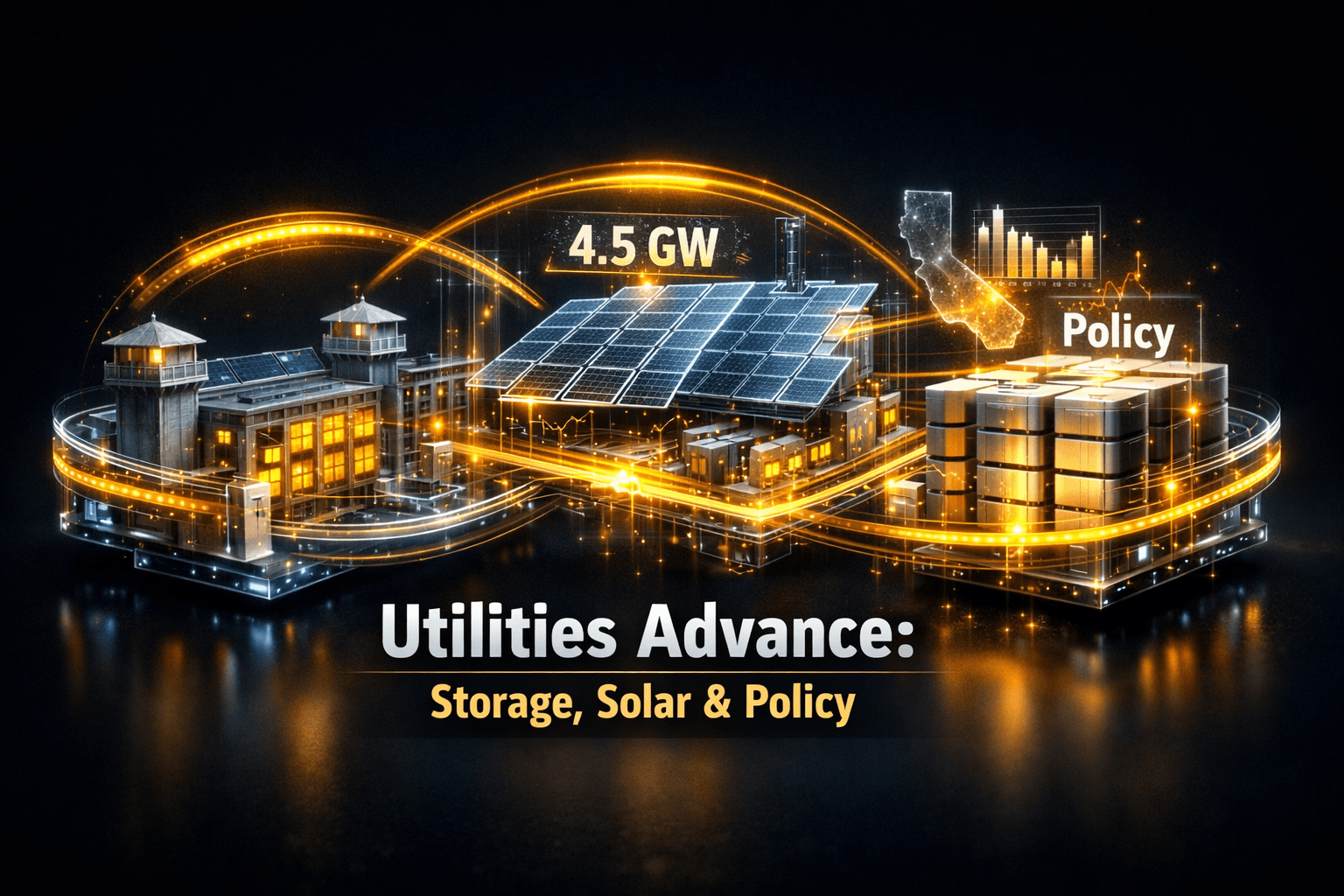
- Monterey County jail, Salinas, CA: 1.243-MW solar carport plus a Tesla battery, financed under a PPA by Sunrock Distributed Generation, expected to save more than $12 million over the system lifetime.
- Suniva expansion: plans a 4.5-GW monocrystalline solar cell plant in Laurens, South Carolina, targeted to open Q2 2027, adding to its existing 1-GW site near Atlanta.
- Second-life batteries: Rivian $RIVN partners with Redwood Materials to repurpose EV battery packs for on-site storage at its Normal, Illinois factory, aiming to ease peak-power constraints on industrial growth.
- Policy lift for distributed storage: California proposals like SB 913 seek to designate residential batteries as resource adequacy capacity, while utility pilots such as Ava Community Energy’s SmartHome Battery program offer incentives for shared systems.
- Rate relief and grid spending: Maryland lawmakers passed a measure estimated to lower utility bills by about $150 per year, reflecting affordability concerns that can influence utility revenue models and regulatory outcomes for companies like $EXC and $FE.
Key Developments
Storage and Second-Life Batteries Gain Traction
Multiple stories today made clear that battery deployments are moving from pilot to scale. The Salinas jail project pairs a 1.243-MW solar carport with a Tesla battery under a PPA, delivering an estimated $12 million in lifecycle savings to the county. That’s a concrete example of how storage can cut operating costs for public and institutional buyers.
Meanwhile, $RIVN’s deal with Redwood Materials to deploy second-life packs at its Illinois factory shows manufacturers are turning batteries into a resource for onsite flexibility, not just vehicle propulsion. What does that mean for grid demand and for companies that build storage? It suggests more predictable, localized capacity where new transmission would otherwise be required.
U.S. Solar Manufacturing Scales Up
Suniva’s announced 4.5-GW solar cell facility in South Carolina is a material capacity expansion for U.S. cell manufacturing. Combined with its 1-GW site outside Atlanta, the move signals strengthening domestic supply chains for module- and cell-level production.
That production growth supports downstream project development and could blunt some supply-driven price swings, especially as developers and utilities place longer-term contracts. You should note this is a supply-side catalyst that may ease equipment bottlenecks over the next 12 to 24 months.
Policy Moves: State-Level Support and Affordability Pressure
Regulatory action cut both ways today. California is moving to recognize distributed residential batteries as resource adequacy, which would give them a clearer revenue stream and make deployments more bankable. That’s a positive for installers and battery providers.
At the same time, Maryland’s rate relief bill aims to reduce household bills by roughly $150 per year. That’s good news for consumers, but it raises questions about cost recovery and capital spending for regulated utilities. Will utilities absorb tighter short-term margins in exchange for long-term grid investment? That will be a key fiscal balancing act for commissions and companies like $SO, $EXC, and $FE.
What to Watch
Look for near-term and medium-term catalysts that will move the needle on adoption, costs, and regulated returns. You’ll want to track these items closely.
- Earnings and guidance: Watch utilities and equipment suppliers in upcoming quarterly reports for commentary on storage contracts, PPA wins, and capital plans that reflect these projects.
- Policy timelines: Follow California’s SB 913 progress and state commission proceedings on how residential batteries will be counted for resource adequacy. Those rulings will affect market access for distributed storage.
- Manufacturing milestones: Monitor Suniva’s permitting and commissioning schedule toward Q2 2027. Delays or acceleration will influence supply-chain expectations and module pricing.
- Affordability vs. investment trade-offs: Keep an eye on rate cases and legislative measures like Maryland’s relief act. They can alter utility cash flow and capex pacing, which affects credit metrics and project financing.
- Technology maturation: EPRI’s work on electron beam welding for heavy nuclear components could lower fabrication costs for large reactors over time, making nuclear a longer-term play in capacity planning.
Bottom Line
- Storage and solar are getting real deployment and manufacturing commitments, which is bullish for the clean-energy supply chain and project developers.
- State-level policy is increasingly supportive of distributed batteries, improving revenue prospects for residential storage programs and aggregators.
- Manufacturing additions like Suniva’s 4.5-GW plant could ease equipment constraints and stabilize pricing over the next 12 to 18 months.
- Affordability measures such as Maryland’s bill present regulatory headwinds for utility rates in the near term, so watch how commissions rebalance cost recovery and grid investment.
- For you, the takeaway is to stay selective and follow company disclosures, regulatory filings, and production milestones to separate near-term noise from durable trends.
FAQ Section
Q: How will distributed batteries being counted for resource adequacy affect my utility investments? A: Analysts note that if residential batteries can be counted as resource adequacy, developers and aggregators gain clearer revenue streams, which improves bankability for deployments and can change utility procurement strategies.
Q: What does Suniva’s new 4.5-GW plant mean for solar project costs? A: Increased domestic cell capacity should relieve some supply pressure and may help stabilize module pricing over the next 12 to 24 months, according to industry data and manufacturing plans.
Q: Should I worry about rate relief laws like Maryland’s hurting utilities? A: Data suggests affordability measures will compress near-term revenue, but regulators often adjust long-term cost recovery and capital plans, so the net impact varies by company and upcoming rate cases.