The Big Picture
Renewables and electrification dominated utilities news on Apr 10, as new project announcements and fast-moving development pipelines reinforced momentum across the sector. At the same time, a proposed Department of Energy budget cut and a market-manipulation settlement injected policy and compliance risk into the story.
This mix matters because it shows the sector is still building capacity and demand, even as investors and project sponsors must navigate federal budget uncertainty and heightened regulatory scrutiny. You'll want to weigh growth signals against those headwinds when you follow utilities and clean-energy names.
Market Highlights
Key facts and figures from today's coverage give a quick snapshot of where activity concentrated.
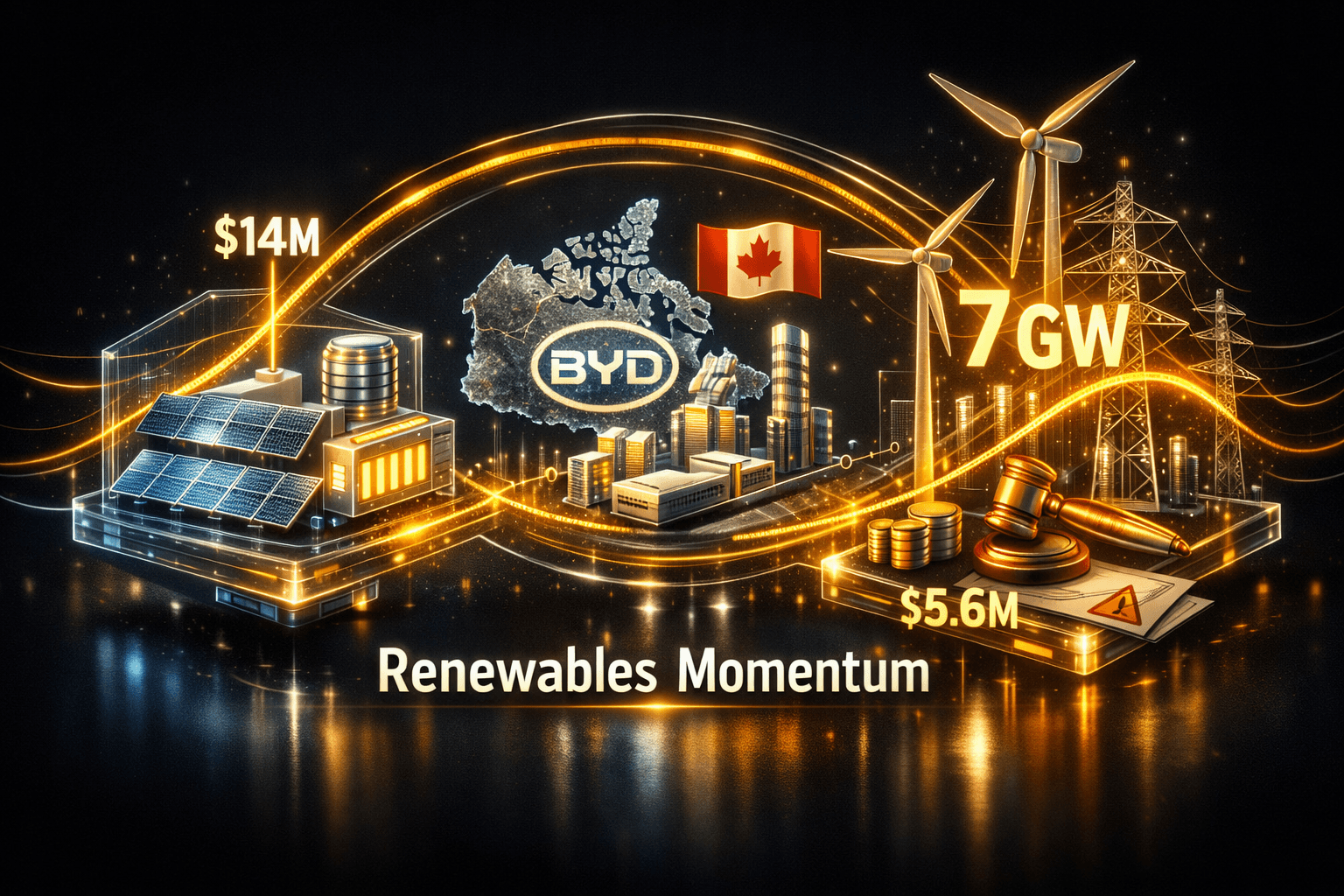
- University of Hawai’i–West O’ahu: planning a $14 million solar carport and battery system expected to produce about 2.38 million kWh annually, with construction targeted for August 2026.
- BYD expansion: automaker to open 20 dealerships across Canada this year, accelerating EV availability in major markets including Toronto, Montreal, Vancouver and Calgary; US ADR trades as $BYDDY.
- Linea Energy: founder Cassidy DeLine reports a 7-GW renewable pipeline built in under two years, underscoring rapid project origination capacity in the independent power producer space.
- Permitting speed: a UMass study finds most state-level wind and solar permits clear in under one year, and about 90% of projects are ultimately approved.
- Regulatory and enforcement: the DOE proposed cuts to non-defense energy spending signaled federal funding pressure, while Terra-Gen agreed to pay $5.6 million to settle CAISO market manipulation charges with FERC oversight.
Key Developments
Campus Solar and Distributed Storage Projects Gain Ground
The University of Hawai’i–West O’ahu's $14 million solar carport and battery plan is a concrete example of institutional demand for on-site generation and storage. You can see why campuses and large commercial sites are attractive hosts: they offer predictable load profiles and visible community benefits.
Projects like this also validate the permitting trend detailed in the UMass study, which suggests state-level approvals are increasingly timely. Faster permitting helps developers convert pipeline opportunities into construction starts more quickly.
Electrification Momentum: EV Dealers and Electric Trucks
BYD's plan to launch 20 Canadian dealerships this year and reports that electric truck makers are selling briskly point to strengthening demand for electrified transport. That matters to utilities because more EVs and electrified fleets mean incremental electricity demand and grid-interconnection opportunities.
Fleet electrification, from medium-duty trucks to passenger EVs, creates revenue potential for utilities and developers around charging infrastructure and managed charging programs. Where will the additional load show up first, and how will utilities capture it?
Policy and Compliance: Budget Cuts, Settlements, and Rule Changes
The DOE's proposed reduction in non-defense energy spending introduces a material policy risk for programs tied to federal funding. The proposal, which the White House framed as cutting certain initiatives, could slow some grant-driven projects and demonstrations.
Separately, FERC-related enforcement produced a $5.6 million settlement by Terra-Gen for failing to store energy as ordered, highlighting that market rules are being enforced and that operational compliance carries financial risk. The EPA proposal to relax coal ash protections drew criticism from advocates and creates regulatory uncertainty around legacy power plant liabilities.
What to Watch
As you track the sector, several near-term and medium-term catalysts will shape sentiment and outcomes.
- DOE budget process: follow Congressional responses and appropriation language. Analysts note changes to DOE program funding could affect project pipelines that rely on grants or lab partnerships.
- Permitting timelines and state-level policy: the UMass study suggests approvals are faster than often assumed, but site-specific hurdles still apply. Watch state public utility commission dockets and interconnection queue reforms.
- Project start dates: construction for the UH-West O’ahu carports is slated for August 2026, a date to watch for procurement and local contracting activity.
- Regulatory enforcement signals: the Terra-Gen settlement and any FERC follow-ups could influence how developers and asset owners set operational rules for storage and market participation.
- Technology and supply-chain flow: factory-built microreactors like those from AMPERA and rapid commercial rollouts from developers such as Linea could reshape long-term capacity planning, but you'll want to see commercial milestones and financing clarified.
Bottom Line
- Renewables and electrification show clear momentum, from university solar-plus-storage projects to expanding EV dealer networks; data suggests project permitting is speeding up.
- Policy risk is rising, with DOE budget proposals and EPA rule changes adding uncertainty to federal support and regulatory requirements.
- Enforcement matters: the Terra-Gen $5.6 million settlement signals that market and operational compliance can carry meaningful costs.
- Growth opportunities remain, but you should monitor funding pathways, permitting timelines, and regulatory dockets to gauge near-term project delivery risk.
- Analysts note that the balance of faster permitting and strong commercial demand could keep construction activity elevated, even if federal support tightens.
FAQ
Q: How could DOE budget cuts affect renewable projects? A: Reduced DOE non-defense spending may slow grant-funded demonstrations and some transmission or storage programs, making private financing and state incentives relatively more important.
Q: Does the Terra-Gen settlement mean wider risk for renewables operators? A: The $5.6 million settlement highlights enforcement risk for market participation and storage operations, but it doesn't imply systemic failure across the sector; operators may tighten compliance practices.
Q: How fast can solar and wind projects get permitted? A: The UMass study finds most state-level permits are issued within a year and about nine in 10 projects are approved, suggesting permitting delays are less frequent than many assume.