The Big Picture
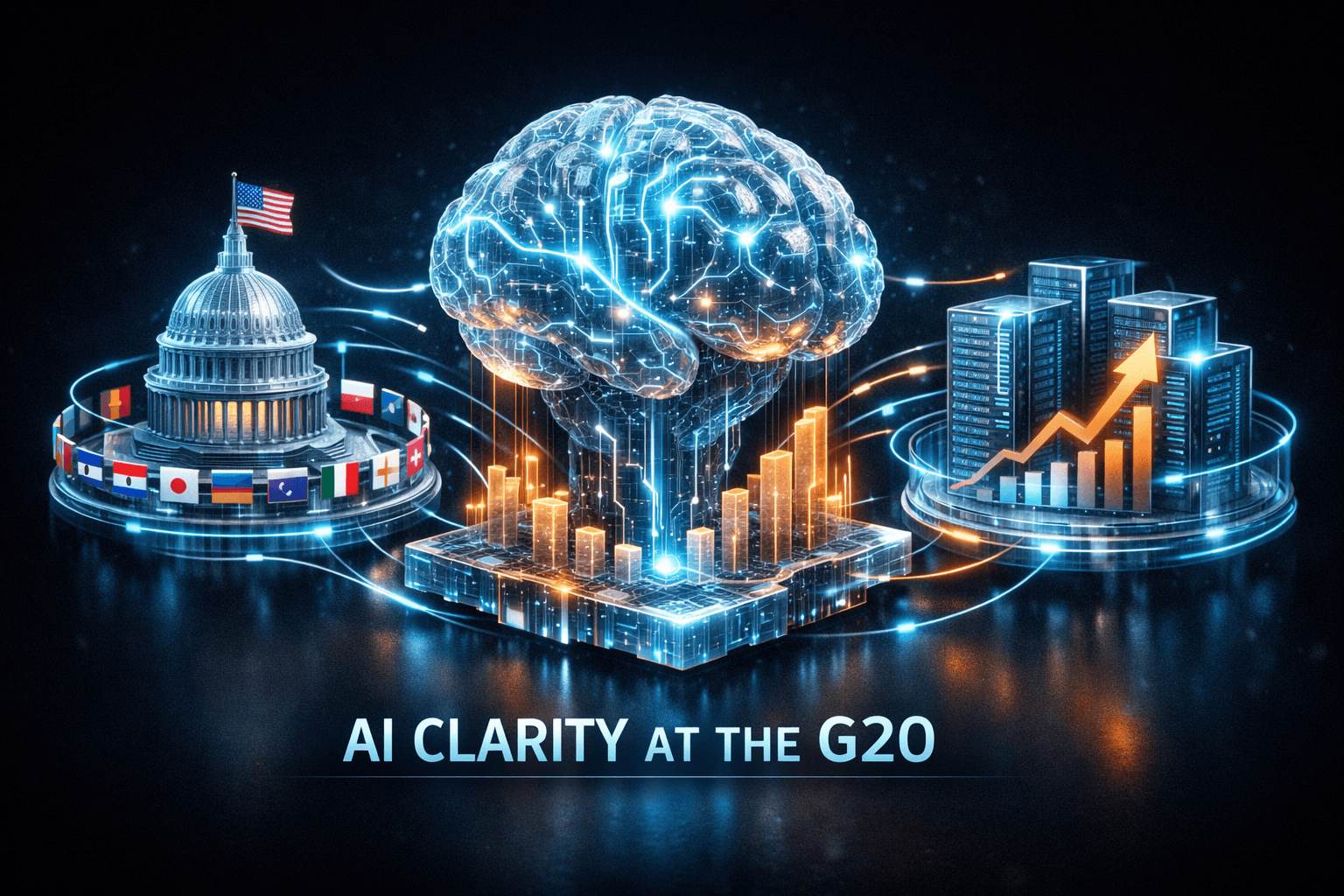
The G20 delivered a clear win for the tech sector today when all member nations endorsed the non-binding Carolina Principles, a U.S. backed framework favoring lighter, sector specific AI rules. You should see this as a reduction in near term regulatory uncertainty for AI heavyweights and startups alike.
At the same meeting, major executives including Jensen Huang, Mark Zuckerberg, Sam Altman, and Elon Musk lobbied policymakers against heavy-handed regulation, reinforcing the industry push for innovation friendly rules. For investors watching AI adoption and cloud growth, the twin signals of political and corporate alignment matter for capital allocation and earnings visibility.
Market Highlights
Quick facts and numbers to scan before the open.
- G20 endorsement: All member nations unanimously backed the Carolina Principles, promoting sector specific, lighter touch AI governance.
- Microsoft changes: $MSFT will split reporting into two segments and disclose quarterly Azure revenue for the first time, a move aimed at clarifying AI driven growth.
- Palo Alto deal: $PANW paid roughly $500 million to acquire Thrive backed Console, underscoring continued M&A in cybersecurity and AI operations.
- Data center pushback: Community opposition halted a proposed $100 billion data center project in Virginia, a reminder of local headwinds to infrastructure expansion.
- New products: Awol Vision’s LuxVision projector promises 4K 120Hz at 6000 ISO Lumens and a 120 inch image from 7.5 inches, while Belkin launched trackers compatible with Apple and Google networks.
Key Developments
G20 backs Carolina Principles, tech leaders press case
The unanimous G20 endorsement gives the industry a policy tailwind. Tech executives met with officials to argue that rapid private sector safety advances reduce the need for prescriptive rules, and the Carolina Principles promote sector specific guidance over blanket restrictions.
What should you take from this? Reduced regulatory uncertainty can support valuation multiples for AI focused firms and may speed deployment of new models and cloud services across industries.
Microsoft to report Azure revenue, reshapes financial transparency
$MSFT announced it will split its business reporting and disclose quarterly Azure revenue for the first time. That change is meant to better reflect how AI is reshaping Microsoft’s operations and revenue mix.
For you, that means clearer line of sight into cloud and AI monetization. Analysts will get new data points to model growth and margins, and you’ll want to watch the first Azure line item for surprises on growth rates and profitability.
Cybersecurity M&A and data center politics
Palo Alto Networks’ approximately $500 million Console acquisition signals continued consolidation in AI powered IT operations and security. The deal also highlights buyer appetite for tools that automate cloud and enterprise services.
At the same time, organized opposition in Virginia stopped a $100 billion data center project, showing that real estate, environmental, and community risks can derail even large infrastructure plans. Should you re-evaluate exposure to hyperscale buildouts? Local permitting and social license are now material risk factors for data center owners and their suppliers.
What to Watch
Expect a busy news flow that will shape sentiment and short term price action. You should track these catalysts closely.
- Microsoft's first Azure revenue disclosure, watch growth rates, margins, and how management segments AI related revenue.
- Regulatory follow ups to the Carolina Principles, especially national implementation notes and any binding domestic rules in the U.S., EU, or major Asian economies.
- Further M&A in cybersecurity after $PANW’s purchase, and whether private equity or strategics double down on AI ops tools.
- Local permitting and community pushback on data center projects, especially in key U.S. hubs. Data center rollouts may slow in contested jurisdictions.
- TechCrunch Disrupt sessions and Real World AI panels featuring $NVDA and robotics demos, where partnerships and product roadmaps could surface for public companies and startups alike.
How might these items move markets today? Expect stocks tied to AI and cloud to respond to Microsoft’s new reporting, and watch cybersecurity names for M&A driven rerating. Will local pushback on infrastructure become a drag on valuations? It could, for companies with heavy capex in affected regions.
Bottom Line
- G20’s Carolina Principles ease regulatory uncertainty, favoring AI leaders and cloud service providers.
- Microsoft’s decision to disclose Azure revenue increases transparency, creating new benchmarks for AI monetization.
- Targeted M&A in cybersecurity shows strategic investment in AI driven operations, while data center opposition highlights infrastructure risks.
- Product launches from smaller hardware and accessory makers reflect steady demand for consumer facing innovation.
- Stay selective and monitor Microsoft’s Azure metrics and local permitting developments closely, as they will inform near term positioning.
FAQ
Q: What are the Carolina Principles? A: They are a U.S. proposed, non binding framework endorsed by the G20 that advocates sector specific, lighter touch AI regulation.
Q: How will Microsoft’s reporting change affect investors? A: Disclosure of Azure revenue will give analysts and you clearer data on cloud and AI growth, making it easier to compare peers and model profitability.
Q: Should I worry about data center backlash? A: Local opposition can delay or stop projects and add permitting risk, so you should watch regional developments if you have exposure to hyperscale infrastructure companies.