The Big Picture
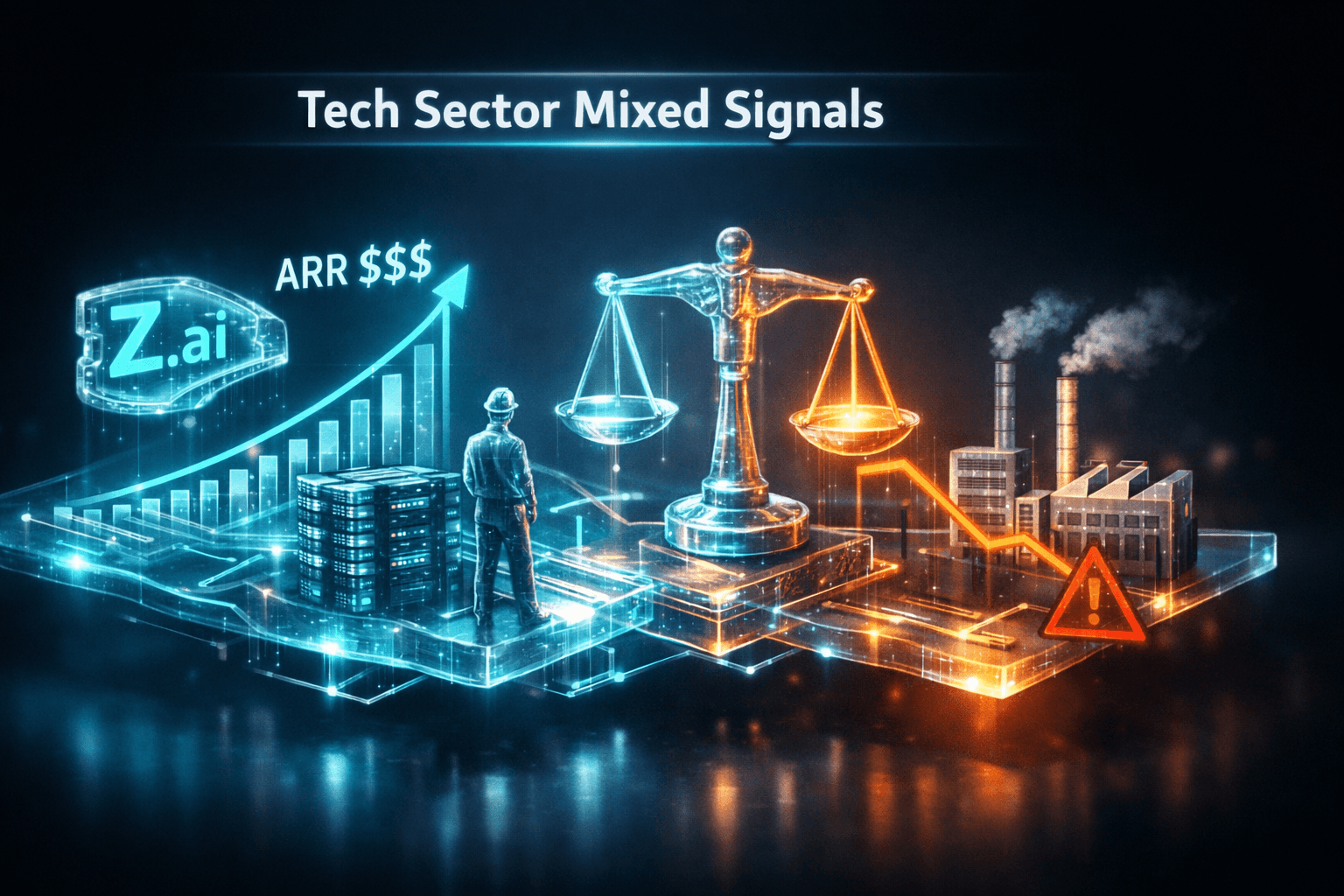
Z.ai's reported push toward $1 billion in annual recurring revenue grabbed headlines overnight, marking a rare scale milestone for a Chinese AI startup and signaling continued enterprise demand for AI software. At the same time, infrastructure moves and regulatory shocks are creating mixed signals across the sector, so you'll want to weigh growth drivers against emerging policy and execution risks.
The net effect is a market narrative that points to selective strength, not broad-based certainty. If you're watching AI, cloud infrastructure, or semiconductors, today will be about parsing momentum versus potential headwinds.
Market Highlights
Quick facts to start your trading day.
- Z.ai, a China-based enterprise AI startup, is reported to be on track for about $1 billion in annual recurring revenue after meeting its full-year sales target in July.
- $AMZN related personnel moves: Dave Brown, outgoing SVP of AWS Compute, AI, and Platform, will join $META to work on data center build-out, according to the Wall Street Journal.
- SpaceX aborted its second Starship V3 launch after ignition late Wednesday, and the company's stock moved more than 4 percent in after-hours trading before paring losses.
- HP was fined 1.4 billion rupees for alleged cartelization in printing supplies, a regulatory hit that was reported late Thursday.
- Tata Electronics plans India's first large-scale chip fab in Dholera using largely 90nm nodes, a significant step back from prior talk of 28nm capacity.
- On consumer tech, Google reopened enrollment for Pixel Care Plus at $5 per month, and MSI's new Cyborg 15 gaming laptop drew positive reviews for work and play versatility.
Key Developments
Z.ai's $1B ARR Trajectory
Bloomberg sources say Z.ai has met its full-year sales target in July and is on track for roughly $1 billion in annual recurring revenue. That would be a first for a Chinese AI company at this scale and it underscores robust enterprise demand for AI tools outside the U.S.
For you as an investor, this suggests enterprise AI spend remains a strong growth corridor, and analysts note the milestone could accelerate vendor partnerships and investor interest in comparable firms.
Meta Boosts Infrastructure Muscle with AWS Exec Hire
The Wall Street Journal reports Dave Brown will leave Amazon Web Services and join $META to help expand its data center footprint and internal compute capabilities. Brown led AWS compute and AI platform efforts, which makes him a strategic hire for Meta's server and efficiency push.
This move tightens the competition for large-scale cloud and AI compute. You'll want to track capex guidance and public statements from $META and hyperscalers for signs of faster infrastructure spending or tighter execution timelines.
Regulatory and Execution Headwinds
Several stories point to growing friction that could sap near-term momentum. San Francisco's mayor is pushing for tougher rules for robotaxis after a Waymo-induced traffic fiasco, raising regulatory risk for autonomous vehicle operators. SpaceX's abrupt Starship V3 abort spooked markets late Wednesday with a more than 4 percent swing in after-hours trading.
Meanwhile, Tata's plan to start with 90nm wafers rather than 28nm highlights the gap between semiconductor ambition and on-the-ground reality in emerging fab ecosystems. Add HP's 1.4 billion rupee fine for alleged cartelization and you get a reminder that regulatory and legal headaches are active across hardware and services.
What to Watch
Here are the catalysts and risk markers that could move technology names today and in the near term.
- AI revenue signals: Look for follow-up commentary or filings from Z.ai or partners that could confirm sustainability of large deals. Will comparable private AI vendors disclose similar growth metrics?
- Infrastructure spend: Monitor $META and $AMZN statements on data center build-outs and capex, and watch semiconductor equipment suppliers for signs of order momentum.
- Regulation and safety: Keep an eye on municipal and state-level guidance for robotaxi operations in California, and on any official probes following the Waymo incident.
- Launch program updates: SpaceX statements and FAA or company technical notes will be key after the Starship V3 abort. These affect perception of space-related suppliers and insurers.
- Manufacturing strategy: Expect further reporting on Tata's fab plans and potential government incentives tied to domestic chipmaking. Node choices like 90nm versus 28nm matter for downstream customers and supply chain investment.
- Consumer product add-ons: Google’s Pixel Care Plus reopening at $5 a month could modestly boost recurring revenue for hardware ecosystem players, and MSI's Cyborg 15 review may influence seasonal PC demand.
Are you positioned for select strength in AI and infrastructure, or are you getting protective about regulatory and execution risk? That question will shape trading decisions this week.
Bottom Line
- Z.ai hitting the $1 billion ARR trajectory suggests enterprise AI demand remains durable, yet it's a private-company milestone that needs confirmation and follow-through.
- $META's hire of a senior AWS compute executive highlights the importance of in-house compute and data center scale in the AI era, analysts note.
- Regulatory incidents with Waymo and a large fine for HP underscore rising policy and legal friction across several tech subsectors.
- Tata's 90nm-first fab plan is a pragmatic start for India, but it tempers expectations for rapid local production of advanced nodes.
- Watch infrastructure spending, regulatory updates, and follow-on disclosures from private AI firms to separate momentum from headline noise.
FAQ Section
Q: What does Z.ai reaching $1B ARR mean for public AI stocks? A: It signals strong enterprise demand which can lift investor sentiment for AI-related public companies, but analysts caution you should look for similar revenue proofs among public peers before drawing conclusions.
Q: How material is Dave Brown's move from AWS to Meta? A: It's notable, because it strengthens Meta's in-house compute expertise and could accelerate its build-out timeline, which matters to suppliers and competitors in cloud infrastructure.
Q: Should regulatory headlines about Waymo or fines like HP's change your exposure to tech? A: Regulatory and legal developments add risk and can affect specific business models, so data suggests a selective approach and monitoring of official regulatory actions rather than broad market moves.