The Big Picture
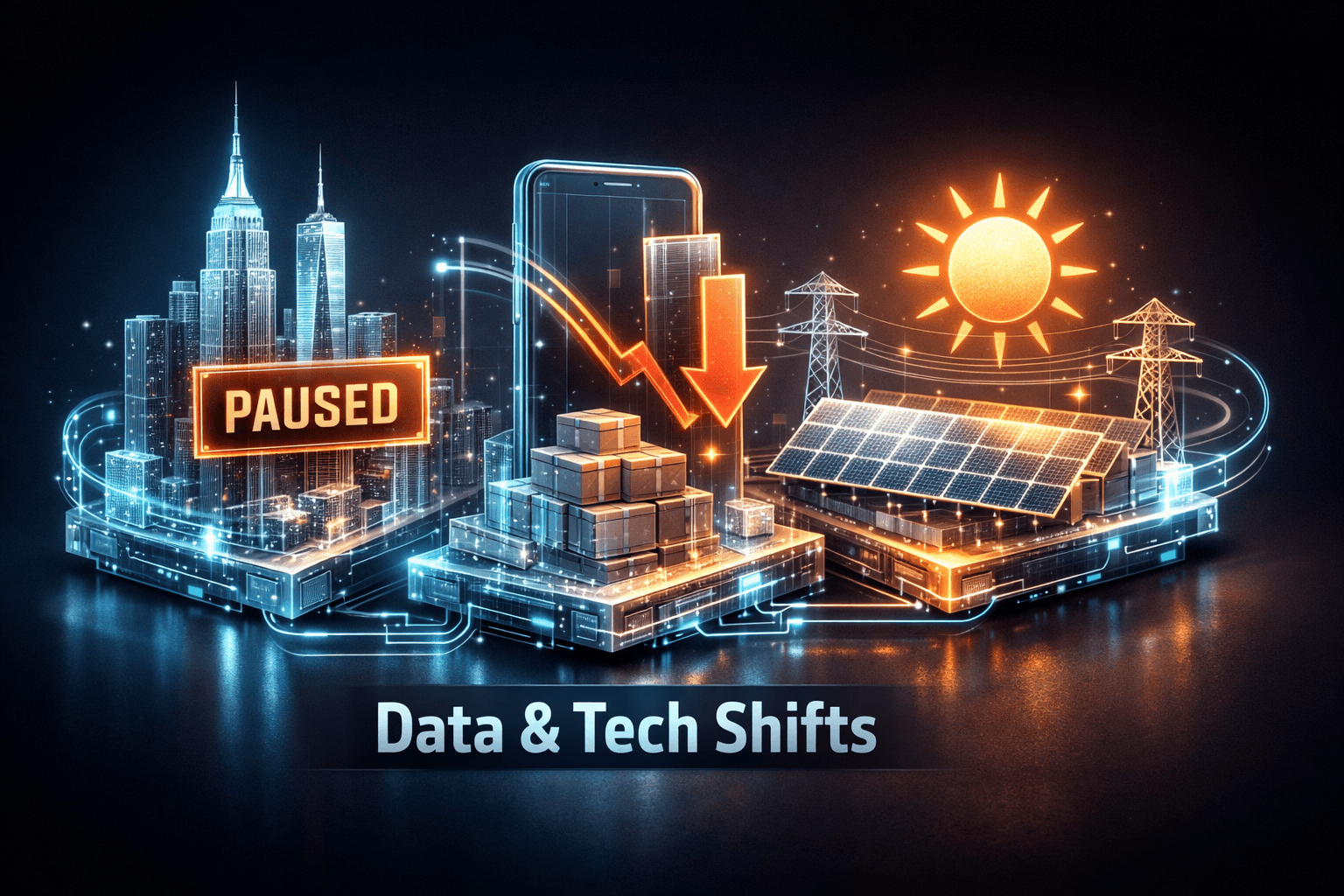
The biggest development this morning is regulatory friction colliding with continued corporate demand for tech-scale energy and product upgrades. New York's one-year moratorium on new hyperscale data center permits creates an immediate policy headwind, while $GOOGL's 100% power purchase deal for a 1.6GW solar project signals that big cloud buyers are still locking in clean energy for long-term growth.
That mix of policy constraints and operational commitments matters because it forces you to weigh near-term capacity and permitting risks against persistent demand for cloud services, AI infrastructure, and product improvements. The sector is sending mixed signals, so you'll want to be selective about which themes you lean into this year.
Market Highlights
Quick facts from overnight and pre-market reports to keep on your radar.
- China smartphone shipments fell 4.3% year over year to about 66 million units in Q2, marking a fifth consecutive quarterly decline, though Huawei and $AAPL recorded shipment growth.
- New York enacted the nation's first statewide moratorium on new hyperscale data center environmental permits, effective for up to one year, tightening local development risk for $AMZN, $MSFT and $GOOGL.
- $GOOGL agreed to buy 100% of initial output from the 1.6GW Steel River Energy Center solar project in Arkansas when it comes online in 2029, signaling continued corporate demand for renewables.
- eMarketer estimates chatbots will generate less than $1 billion in U.S. ad revenue in 2026, while OpenAI projects $2.5 billion in ChatGPT ad revenue this year, underlining a wide gulf in market expectations.
- $UBER's product strategy and $GOOGL's Maps update show continued focus on incremental product improvements that can shift user experience and monetization over time.
Key Developments
China smartphone market slips, but premium players gain ground
IDC reports Chinese smartphone shipments declined 4.3% YoY to roughly 66 million units in Q2, the fifth straight quarterly drop. The weakness reflects soft consumer demand and component constraints, including memory shortages, but Huawei and $AAPL expanded shipments during the period.
For you that means the smartphone cycle is uneven, with premium brands and those with tight supply-chain control doing better. Pay attention to margin signals and ASP trends rather than unit volumes alone.
New York data center moratorium raises permitting and capacity risk
Governor Kathy Hochul signed a measure that effectively pauses new environmental permits for hyperscale data centers in New York for up to a year. The state could also pass additional restrictions that are still pending.
That pause is a clear near-term constraint on where large cloud and AI operators can expand physical capacity. Companies with concentrated build plans in the Northeast may need to alter timelines or seek alternative sites, and you should monitor any reported impacts on suppliers and regional power markets.
AI monetization debate and tactical product wins
eMarketer's forecast that chatbot ad revenue will fall short of $1 billion in 2026 contrasts with OpenAI's own $2.5 billion projection for ChatGPT ad revenue this year. Analysts note the divergence points to uncertain early monetization pathways for conversational AI.
At the same time, $GOOGL rolled out a major Google Maps 3D Immersive View update for Android Auto and other product improvements are being showcased by players like $UBER. These updates matter because they drive user engagement and create more tangible, near-term paths for revenue than headline ad estimates alone.
What to Watch
Expect the next several weeks to be defined by permit decisions, corporate energy commitments, and clarity on AI monetization. Here are the catalysts and risks that could move stocks and themes.
- Permitting and policy: Watch follow-on legislation in New York and any local ordinances that might extend the moratorium or add new requirements. How will hyperscalers respond with alternate build sites?
- Energy deals and supply: Track developer timelines for the Steel River Energy Center and similar deals. Corporate offtake agreements are shaping data center and cloud cost curves into 2029, so follow project milestones.
- AI revenue signals: Look for concrete ad or subscription metrics from OpenAI, $GOOGL and other AI platforms. Will reported monetization narrow the gap with eMarketer's conservative view?
- Product rollouts: Monitor user uptake and partner integrations for $GOOGL's 3D Maps and $UBER's product experiments, since user engagement often precedes monetization improvements.
- China handset trends: Keep an eye on ASPs, component supply notes, and carrier promotions that could signal recovery or continued softness in the smartphone cycle.
You're likely to see volatility around these data points, so plan to watch company updates and official timing closely. What should you prioritize in the near term, growth or defensive exposure? That depends on your timelines and risk tolerance.
Bottom Line
- Neutral backdrop: Policy headwinds in New York and China market softness are offset by corporate renewables deals and product improvements, creating a mixed outlook.
- Data center risk is real: Permitting delays can shift build timelines and supply-chain plans for hyperscalers and suppliers.
- AI monetization remains uncertain: Estimates for chatbot ad revenue vary widely, so concrete metrics will be a key inflection point.
- Product wins still matter: Incremental UX and service improvements at $GOOGL and $UBER can shape engagement before advertising or commerce models scale.
- Stay selective and follow catalysts: Track permit updates, energy project milestones, monetization metrics, and China handset trends to refine your view.
FAQ Section
Q: How will New York's data center moratorium affect major cloud providers? A: The moratorium pauses new environmental permits for up to a year, which can delay planned builds and push operators to seek alternate regions or adjust timelines.
Q: Is the China smartphone decline a sign to avoid hardware stocks? A: A 4.3% YoY drop in Q2 signals softness, but premium vendors like $AAPL and Huawei showed growth, so the impact is uneven across manufacturers and segments.
Q: Should you expect chatbot ad revenue to fund AI investments this year? A: Estimates vary sharply, with eMarketer below $1 billion for 2026 and OpenAI projecting higher figures; data suggests monetization is still nascent and you should watch company-reported metrics.