The Big Picture
Today the Technology sector served up a mixed bag, with big financial endorsements for AI and strong consumer demand counterbalanced by security and safety questions that could draw regulatory attention.
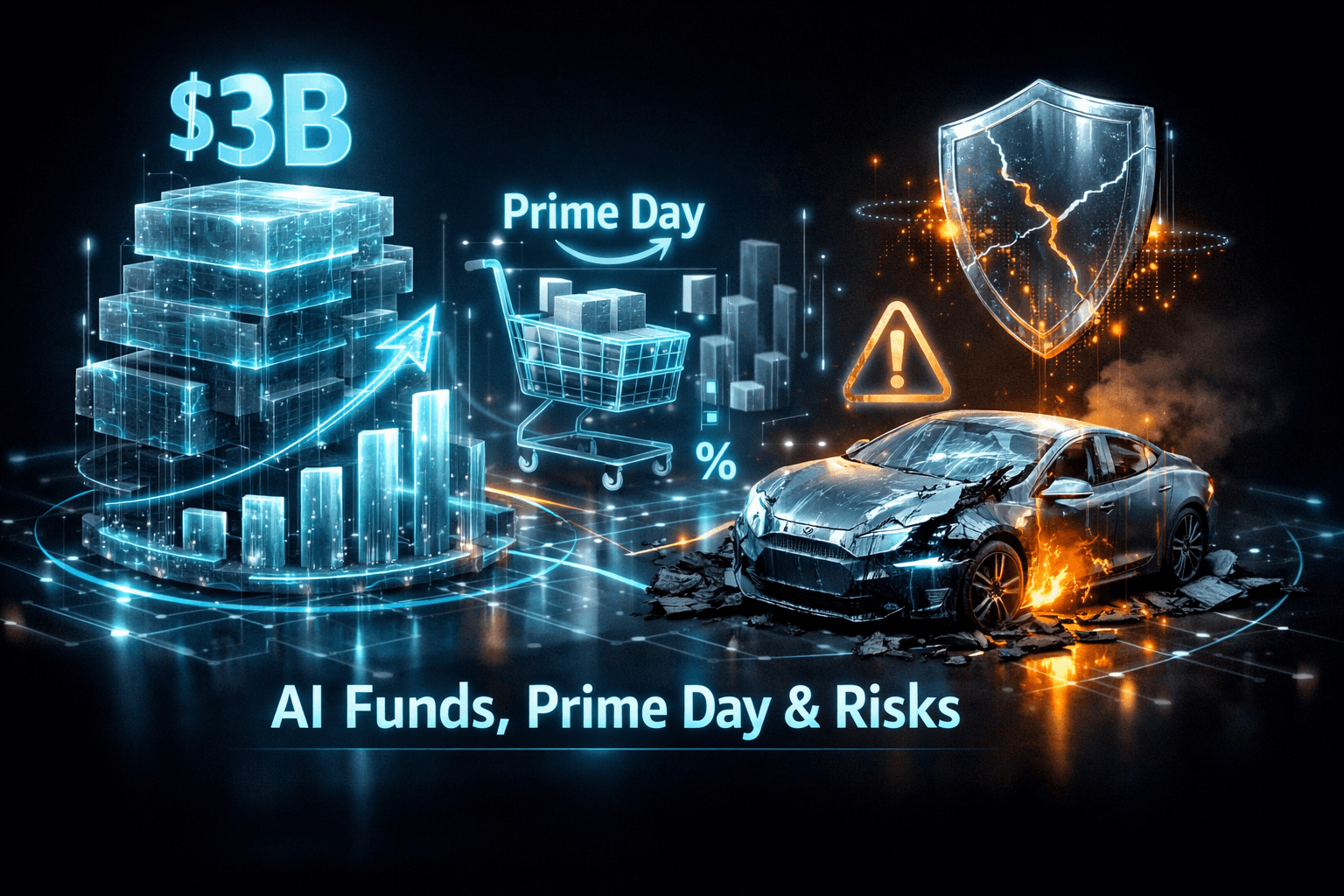
Menlo Ventures' $3 billion fund and widespread Prime Day gadget traffic highlight demand and capital flow into tech. At the same time, a disclosed credential theft at Klue and a fatal Texas crash involving a Tesla with alleged self-driving engagement underscore operational and reputational risks you should watch closely.
Market Highlights
Quick facts and price signals that mattered today.
- Menlo Ventures raised a $3.0 billion fund after its successful Anthropic bet, signaling continued private capital momentum into AI startups.
- The FCC auction of mid-band spectrum cleared for more than $3.5 billion, with proceeds earmarked largely to replace Chinese telecom equipment in the U.S., a win for vendors tied to infrastructure upgrades like $ERIC and $NOK.
- Prime Day drove heavy consumer activity, with the Garmin Fenix 8 Pro emerging as a top-selling deal for $GRMN, and a Samsung flagship OLED being discounted by about $1,100 in competing retailer offers.
- High-profile safety and security stories landed today, including a Klue credential theft that led to customer data exposure and a deadly Texas crash where $TSLA said the driver overrode self-driving controls.
- New product and platform initiatives stayed on the radar, with Mark Zuckerberg pushing for a standalone prediction market that could expand engagement across $META properties.
Key Developments
Menlo’s $3B Fund, AI Momentum
Menlo Ventures closed a $3 billion fund after a bold $750 million Anthropic bet in 2024 helped build its reputation as an AI investor. This fundraise reinforces the flow of private capital into large foundational models and associated infrastructure, which could move the needle for early-stage AI suppliers and enterprise tooling providers.
For you that means continued venture-backed innovation in AI, and potential public market beneficiaries may include companies providing training compute, inference services, and developer platforms, though exact winners will vary by execution and contracts.
Prime Day Sales, Retail Tech Demand
Prime Day and competing retailer promotions drove a torrent of consumer purchasing, with several outlets flagging big-ticket discounts on TVs and wearables. The Garmin Fenix 8 Pro was a top-seller in early Prime Day data, and major OLED models saw deep markdowns from rivals during the event.
Retailers like $AMZN and $COST are executing promotions that keep hardware demand visible, which matters for supply-chain exposed names and seasonal revenue. Are these sales pulling future purchases forward, or are they sustainable demand signals? It's an open question you'll want to track through upcoming retail sales reports.
Security and Safety Headwinds
Klue disclosed that a credential stolen in 2022 was later used by hackers to access systems holding customer access keys, prompting breaches of customer data. The episode raises questions about credential hygiene, long-term access revocation policies, and vendor risk management across enterprise software stacks.
Meanwhile $TSLA faced scrutiny after a deadly Texas crash, with the company saying the driver manually overrode self-driving controls. These incidents could lead to renewed regulatory focus on autonomous driving systems and to more conservative guidance from insurers and fleet customers.
What to Watch
Here are the catalysts and risks that could shape tech stocks tomorrow and in the weeks ahead.
- Contract and spending announcements tied to AI: Watch for vendor partnerships and customer wins that show how Menlo-backed AI startups convert research into revenue.
- Retail and consumer sales data: Keep an eye on same-store sales and holiday-season guidance from major retailers after Prime Day, and check supply chain indicators for inventory digestion.
- Regulatory and legal follow-ups: Expect probes or hearings related to autonomous vehicle safety and to data breach disclosures. These can affect sentiment for $TSLA and enterprise SaaS providers if liability or disclosure practices come under fire.
- Spectrum deployment plans and vendor contracts: The FCC auction proceeds aim to replace Chinese equipment. Look for follow-on contracts and capex cycles that could benefit $ERIC and $NOK, plus smaller domestic suppliers.
- Security posture and vendor governance: You should ask vendors about credential retirement policies and key management practices when assessing enterprise tech suppliers after the Klue news.
Bottom Line
- Private capital is still flowing into AI, exemplified by Menlo's $3B fund, which signals continued innovation and competitive intensity in the AI stack.
- Consumer demand remains visible, with Prime Day generating meaningful activity on wearables and TVs, but watch whether sales are timing shifts or durable growth.
- Security lapses like Klue's breached credential, and safety incidents involving $TSLA, inject regulatory and operational risk into the sector, so caution is warranted.
- The FCC spectrum auction and related replacement funding is likely to generate near-term capex and contract opportunities for telecom equipment makers.
- Stay selective, monitor catalysts, and insist on documented vendor controls and disclosure practices if you're evaluating exposure to enterprise tech or autonomous systems.
FAQ Section
Q: What does Menlo’s $3B fund mean for public tech companies? A: It signals continued private investment into AI startups, which can drive demand for public multicloud, chip, and software infrastructure providers as these startups scale.
Q: Should Prime Day discounts change how you view consumer tech stocks? A: One strong sales event shows demand, but you should compare revenue trends across quarters to see if discounts are substituting future purchases or expanding total demand.
Q: How serious are the implications of the Klue breach and the Tesla crash? A: Both raise tangible risks, from customer trust and liability to tighter regulation. Analysts note these incidents could pressure valuations until companies demonstrate stronger controls or clearer safety outcomes.