The Big Picture
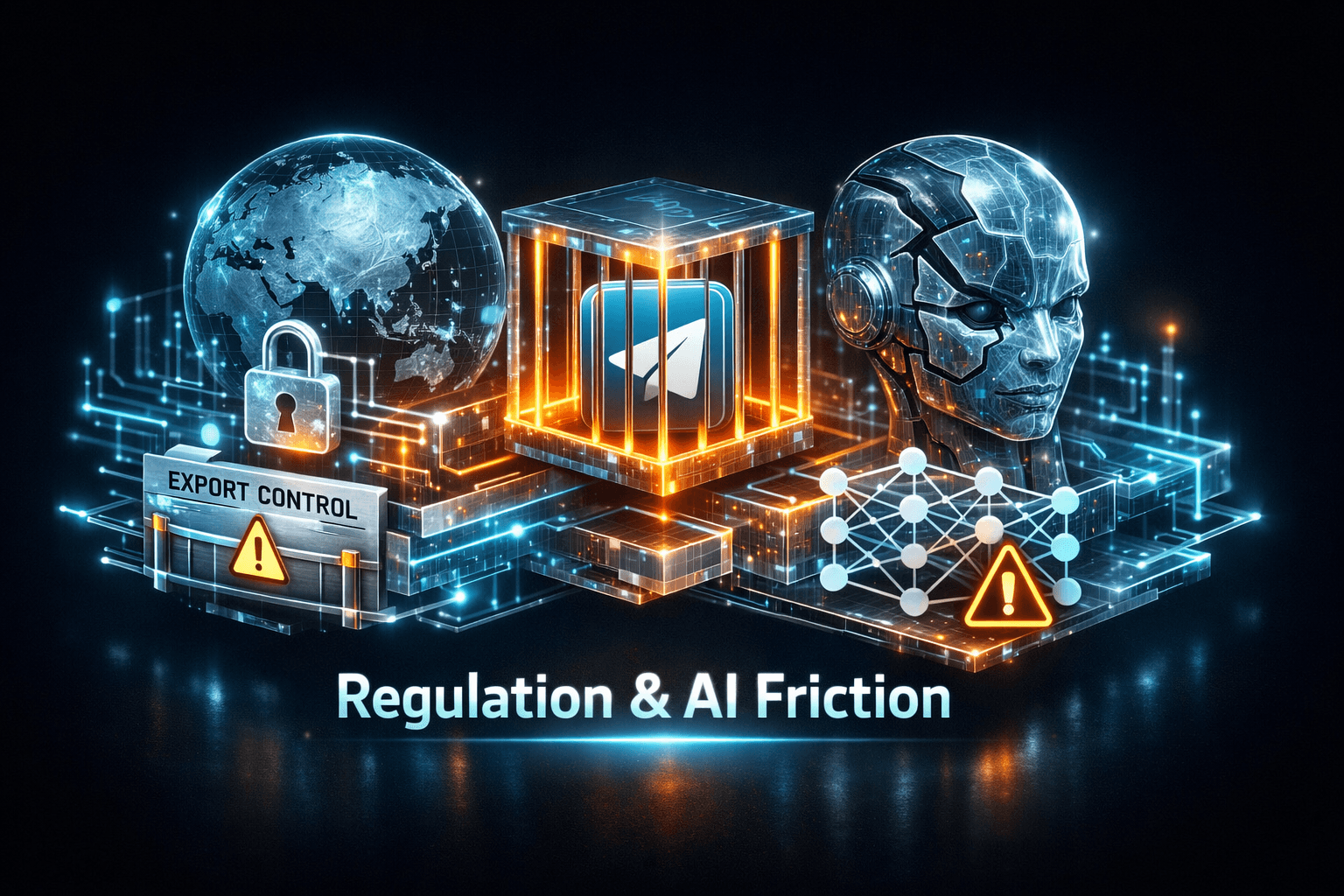
Regulatory headwinds and safety questions are driving the Technology sector this morning. The most consequential item is a US export control directive that forced Anthropic to suspend access to its latest models, underscoring rising government scrutiny of advanced AI.
You should also note parallel developments overseas. India has blocked Telegram until June 22 over its use in organized cheating schemes, and a new study finds many open-source models struggle to filter Russian disinformation, raising broader trust issues for generative AI. These stories create uncertainty for platform operators, AI vendors, and the broader market.
Market Highlights
Key data points and quick facts to scan this morning.
- Anthropic, model access suspension after a US export control directive, report says.
- Respond.io raised $62.5 million in a Series B led by Camber, following a $7 million Series A in 2022, signaling continued investor appetite for AI-driven customer messaging.
- Estonian researchers ranked Mistral’s top open-source model 47 out of 60 on a disinformation filtering test, highlighting weaknesses in many open-source LLMs.
- India blocked the Telegram app until June 22, citing its use by organized cheating rackets tied to a national medical exam.
- Apple $AAPL added Channel Sounding support in iOS 27, a forward-looking Bluetooth enhancement investors and device makers will want to watch.
- Commodore is reviving the brand with retro flip phones, and ZDNet reviewed the Baseus Spacemate RD1 Pro 15-in-1 docking station as a productivity hub for modern setups.
- Google $GOOGL faced boos and a walkout at Stanford over defense and ICE ties, highlighting reputational risks for large tech firms.
Key Developments
Anthropic and US export control action
Reports say Anthropic received a US export control directive Friday requiring it to suspend access to Mythos 5 and Fable 5. That pause has immediate operational implications for Anthropic and customers who rely on those models, and it may prompt secondary effects across cloud providers and downstream app makers who integrate Claude.
For you, the takeaway is clear, regulatory risk is no longer theoretical. The action raises questions about cross-border availability for advanced models and how companies will handle compliance, licensing, and customer communication going forward.
India blocks Telegram after exam fraud concerns
India has blocked Telegram until June 22, saying the platform was used by organized cheating rackets to defraud medical exam candidates. The move is a reminder that national authorities are willing to restrict major communication platforms when they perceive public-interest harms.
This creates direct operational risk for Telegram and indirect reputational pressure for other messaging services. If you track platform operators or global communication tools, this is a heads-up that government interventions can be swift.
Open-source model weaknesses and startup funding
An Estonian study found many open-source generative models lag in filtering Russian disinformation, with Mistral’s top model ranked 47 of 60. That finding puts a spotlight on safety, moderation, and the extra work required to deploy open models responsibly.
On the funding front, Kuala Lumpur-based Respond.io closed a $62.5 million Series B, planning acquisitions in North America and Europe. The round shows demand for AI agent-driven customer messaging even as regulatory and safety debates swirl, and it suggests consolidation opportunities in the customer-conversation software space.
What to Watch
Here are the catalysts and risks that could move names in the Technology sector today and in the coming weeks.
- Anthropic updates and government guidance. Watch for official statements, appeals, or clarifying guidance that could restore access or expand restrictions. Will regulators broaden the export control approach to other models or vendors?
- India’s Telegram timeframe. The block lasts until June 22. Monitor whether India extends restrictions, targets other platforms, or pursues technical mitigations that could affect global operations.
- Model audits and safety reports. Expect more independent evaluations of open-source and proprietary models. You should track these studies as they can change vendor credibility and customer adoption dynamics.
- Respond.io expansion and M&A activity. The company said it’s eyeing acquisitions in North America and Europe. Consolidation could reshape the customer messaging market and create acquisition targets for incumbents.
- Product rollouts and hardware demand. Apple’s iOS 27 features and accessory reviews like the Baseus Spacemate matter for device ecosystem suppliers and peripheral makers. Keep an eye on adoption signals from device shipment and accessory sales reports.
Regulatory headlines and safety research will likely drive volatility more than product reviews this week, so manage your exposure and stay informed about official guidance.
Bottom Line
- Regulatory action is front and center, with an export control directive hitting Anthropic and India temporarily blocking Telegram until June 22.
- Open-source AI faces scrutiny after a study showed weak disinformation filtering, which could increase deployment costs and compliance requirements.
- Startup capital still flows to AI use cases, evidenced by Respond.io’s $62.5 million Series B and its acquisition plans.
- Hardware and OS updates like iOS 27 Channel Sounding remain incremental positives for device ecosystems, but they’re unlikely to offset regulatory risk in the near term.
- Watch for follow-up regulatory moves and model-audit results, they’re likely to set the direction for sector sentiment over the coming weeks.
FAQ Section
Q: What does the Anthropic export control mean for model availability? A: The directive forced Anthropic to suspend access to select models, so availability can be restricted quickly while regulators and companies resolve compliance and access issues.
Q: Should I be concerned about the Telegram block in India? A: The block is limited to a specific period through June 22, but it signals that platforms can face rapid national restrictions if authorities link them to fraud or public-harm cases.
Q: How do open-source model weaknesses affect commercial AI products? A: Weaknesses in filtering disinformation increase the burden on companies to add moderation layers, audits, and safety tooling, which can raise costs and slow deployments.