The Big Picture
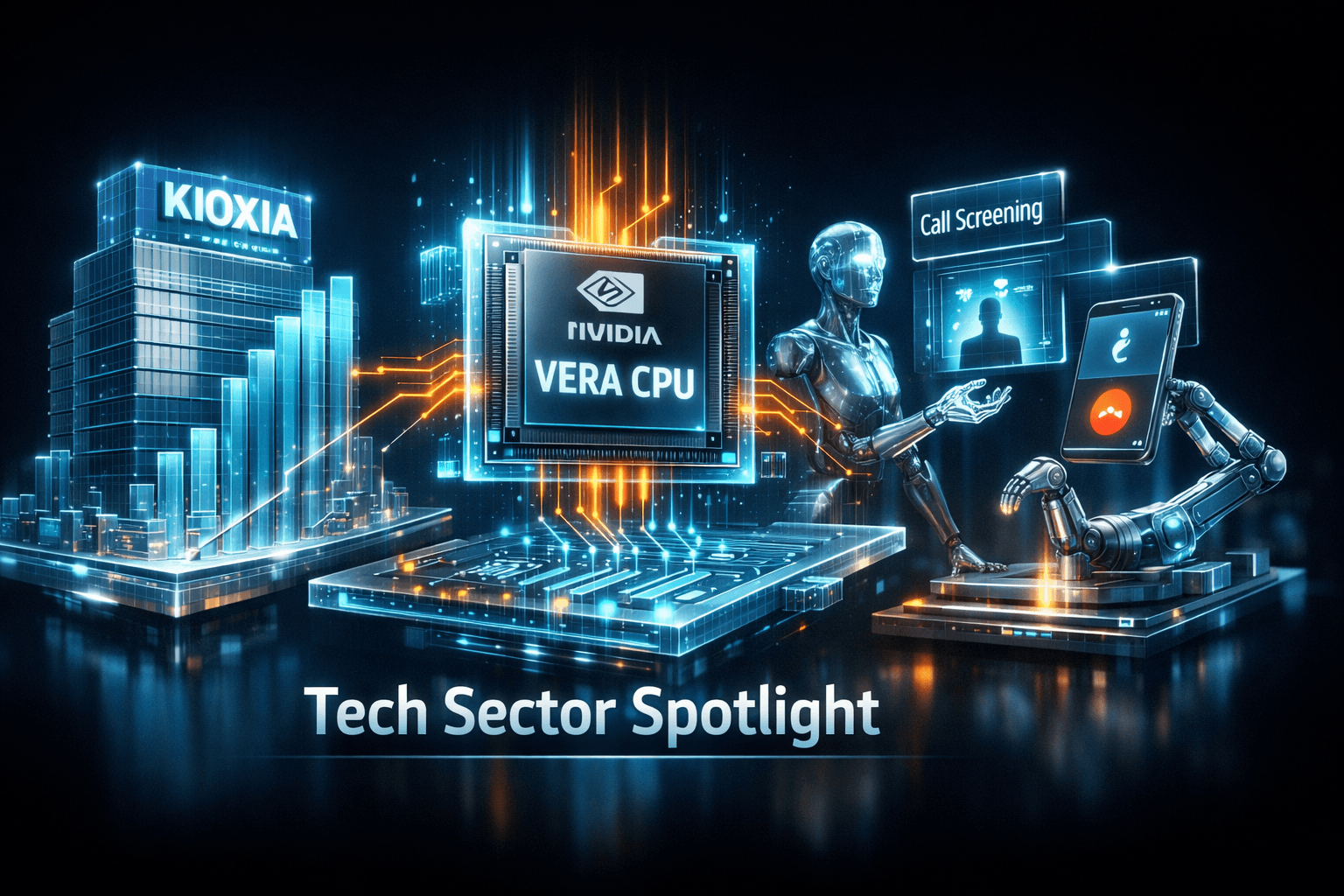
Kioxia's 7.6% jump to a roughly $274 billion market value grabbed headlines overnight, as Asia and U.S. tech names both showed fresh momentum. At the same time, $NVDA's disclosure that Vera CPUs could be orderable for Chinese customers as soon as August underscores accelerating demand for AI datacenter hardware.
What this means for you is a clearer line between AI-driven hardware demand and a wave of venture activity in software and robotics. Today's developments point to rising capital flows into compute, generative AI services, and programmable robots, while consumer AI and smart-home updates keep adoption on track.
Market Highlights
Quick facts and movers to watch before the open and during early trading.
- Kioxia shares surged 7.6% on Friday, lifting the company's market value to about $274 billion, making it Japan's most valuable company by market cap versus Toyota.
- $NVDA, Nvidia, told Chinese clients its new Vera CPUs for AI data centers could be available as soon as August, and that orders can begin, signaling faster unitization of custom AI silicon.
- $AMZN updated Echo Hub software with a customizable homescreen and Ring AI features, showing continued investment in consumer AI and smart-home integration.
- Startups drew fresh capital: Theker raised $85 million to build reconfigurable factory robots, Equal AI raised $30 million for AI call screening which now has over 1 million monthly active users, and Avataar launched a low-cost video AI priced at $0.005 per second.
- Apple's Siri now emphasizes guardrails and restraint in conversational AI, reflecting a broader industry debate over evocative, humanlike assistants.
Key Developments
Kioxia's surge highlights memory demand
Kioxia's 7.6% stock jump put it ahead of longtime leader Toyota in market value, illustrating investor appetite for memory and semiconductor exposure. The move reflects stronger-than-expected demand for NAND and DRAM tied to AI and cloud data expansion, and it suggests memory makers may capture outsized investor attention as compute needs grow.
For you, that means chip-cycle dynamics are again a top driver of sector performance. Analysts note memory prices and production cadence will be critical to watch for sustaining this momentum.
Nvidia pushes Vera CPUs into China sooner
Reportedly, $NVDA has told Chinese customers Vera CPUs could be available by August and orders can start now. That is a faster timetable than many expected for a major vendor's AI CPU roll-out, and it adds another dimension to Nvidia's position beyond GPUs.
Supply and geopolitical considerations will remain front and center. If orders convert to shipments, data center refresh cycles and AI model deployment could pick up speed, indicating upside pressure on chip-centric supply chains and related vendors.
Startups and product updates show breadth of AI adoption
Several private companies raised meaningful rounds or cut pricing to scale. Theker's $85 million raise targets flexible factory robots, while Equal AI's $30 million and reported 1 million monthly active users point to rapid consumer adoption for call-screening AI. Avataar's pricing at $0.005 per second aims to unlock video AI at Indian scale.
On the consumer front, $AMZN rolled out a free Echo Hub interface update and deeper Ring AI features. Apple signaled restraint for Siri's conversational behavior, which may slow some kinds of engagement but could reduce regulatory and reputational risk over time.
What to Watch
Expect the focus to split between hardware supply signals and product-level adoption metrics. You should watch next-week earnings and any supply-chain updates from memory and chip suppliers for confirmation of demand trends.
Key catalysts include upcoming quarterly reports from major cloud and chip customers, any official $NVDA guidance about Vera volume and pricing, and memory price reports that could validate Kioxia's valuation shift. How will geopolitical frictions affect chip shipments and access to Chinese customers? That's a live question for traders and longer-term allocators alike.
Also monitor startup metrics. User growth at companies like Equal AI and pricing moves from Avataar give you leading indicators of developer and consumer willingness to pay for AI services. Robotics funding rounds are another signal, but note commercialization timelines can be long, so watch pilot deployments and revenue traction closely.
Bottom Line
- Kioxia's market-cap surge and $NVDA's Vera update point to accelerating demand for AI-related compute and memory, momentum that analysts say merits close attention.
- Venture funding and low-cost AI products in India and elsewhere show commercialization at scale, but adoption proof points remain user growth and pricing durability.
- Consumer AI updates from $AMZN and Apple's cautious Siri posture highlight competing approaches: aggressive personalization versus conservative guardrails.
- Geopolitical and supply-chain risks still matter, so watch order-to-shipment conversions and memory price trends for confirmation of strength.
- Be selective, and focus on objective data such as shipment notices, earnings, and user metrics to separate hype from sustainable momentum.
FAQ
Q: What does Kioxiabecoming Japan's most valuable company mean for chip investors? A: It signals renewed investor focus on memory makers, as data-center demand and AI workloads boost expectations for NAND and DRAM pricing and revenue growth.
Q: Will $NVDA's Vera CPUs change the AI hardware market? A: Vera expands Nvidia's product set into CPUs for AI workloads and could accelerate data-center refreshes if orderable units ship on the schedule reported, analysts note.
Q: How should you track early-stage AI and robotics bets? A: Watch user metrics, pilot deployments, pricing per unit of output and follow-on funding. Those indicators tell you whether startups are moving from proof-of-concept to scale.
Analysts and market data drive the observations in this briefing. This content is informational and not personalized investment advice.