The Big Picture
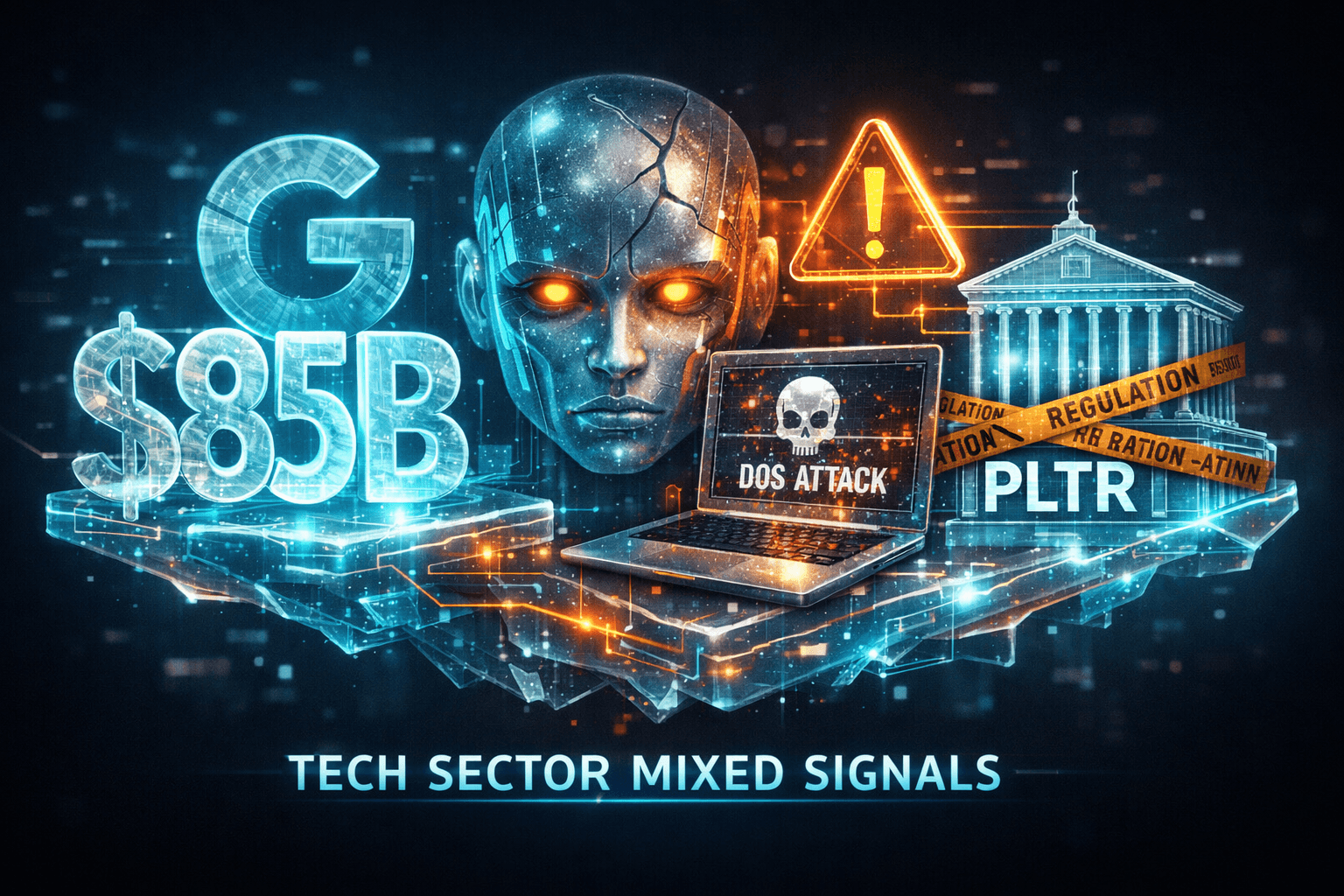
Today's most consequential development was Alphabet's unprecedented $85 billion stock raise for its Google AI business, a clear signal that large investors are willing to back AI infrastructure at scale. At the same time, regulatory scrutiny, cybersecurity discoveries tied to AI tools, and consumer-level shakeouts produced mixed signals about near-term sector risk.
That combination matters because it shows capital and hype are accelerating investment in AI, yet policy and security issues are starting to shape how those investments will be deployed. If you're watching tech themes, you'll want to weigh near-term opportunity against evolving regulatory and security risk.
Market Highlights
A quick look at the headlines that moved stocks and sentiment today.
- Alphabet, $GOOGL: Announced an $85 billion equity raise to fund Google’s AI business, described as record-breaking and interpreted as strong investor appetite for AI assets.
- Palantir, $PLTR: UK lawmakers called for ending a £330 million NHS contract and asked for disclosure about a military contract, creating regulatory pressure on the company.
- Meta, $META: Spun out VR fitness game Supernatural following user pushback after layoffs, a sign the company is reallocating resources rather than simply cutting projects.
- Security and software: Researchers using AI-assisted tools discovered the HTTP/2 Bomb remote DoS exploit affecting NGINX, Apache HTTPD and Microsoft IIS, underscoring rising cyber risk.
- Consumer tech deals: An 8TB SanDisk external SSD is on deep discount at roughly 64% off at Best Buy, while Amazon Prime Day previews and device roundups kept bargain hunting active.
Key Developments
Alphabet’s $85B Raise Signals Big AI Appetite
Alphabet’s move to raise $85 billion in equity is the standout capital market story today. Analysts and commentators framed it as a strong signal that public market investors are willing to finance long-term AI infrastructure, tooling and product bets. For you, that suggests continued investor focus on companies with clear AI roadmaps and balance-sheet flexibility.
Palantir Faces UK Scrutiny, Raising Governance Questions
British MPs urged the government to end a £330 million NHS deal with Palantir and to disclose details of a military contract. The push for transparency creates reputational and contractual risk for $PLTR in the UK, and may lead other governments to review AI and data partnerships more closely. What does that mean for your exposure to defense and government-contract specialists?
AI Tools in Security Research and the Rise of New Exploits
Security firm Calif said it used OpenAI's Codex to discover the HTTP/2 Bomb, a remote denial-of-service exploit that affects major web servers including NGINX, Apache HTTPD and Microsoft IIS. The story illustrates both the power and the peril of AI in cybersecurity: tools can accelerate vulnerability discovery, but they also underscore an expanding attack surface that enterprises and cloud providers must defend.
Consumer and Product Moves: Deals, Spinouts and Creator Tools
Meta spun out VR fitness app Supernatural instead of killing it, a nod to user community and potential smaller-scale operators. Substack rolled out Reply Rules to give creators greater control over audience interactions. Meanwhile, deals on SSDs and Prime Day previews keep consumer spending narratives active, though they don't move market structure like AI and policy news do.
What to Watch
Looking ahead, several catalysts could shift the narrative. Earnings from major cloud and chip providers will show how AI spending is translating into revenue. Watch for any follow-up statements from UK officials on the Palantir contracts, and for similar inquiries in other jurisdictions.
Keep an eye on security bulletins and patch cycles after the HTTP/2 Bomb disclosure, because remediation timelines affect enterprise risk and vendor reputations. Policy moves matter too; OpenAI's proposal for CAISI-led cyber risk evaluations contrasts with the White House EO approach and could influence how you interpret regulatory outcomes.
Are valuations starting to price in persistent AI scaling costs? Will regulatory friction change contract flows to companies serving governments? Those are the questions that will shape sector performance in the next several weeks.
Bottom Line
- Big capital flows into AI, exemplified by Alphabet's $85B raise, are bullish for long-term AI infrastructure adoption, but they don't erase short-term policy and security risks.
- Regulatory scrutiny of $PLTR in the UK could presage more transparency demands for government-AI partnerships globally, increasing project and reputational risk.
- AI-assisted security research accelerated the discovery of a major DoS exploit, highlighting the dual-use nature of generative tools and the need for faster patching cycles.
- Consumer-level product moves, from SSD discounts to app spinouts, show ongoing demand at the edges of the tech economy, but they won't override macro and policy drivers.
- For your watchlist, prioritize clarity on revenue capture from AI investments, governance around government contracts, and vendor ability to manage newly discovered vulnerabilities.
FAQ Section
Q: How does Alphabet's $85B raise affect AI investment in the sector? A: The raise signals strong investor appetite for AI infrastructure funding, which could increase capital availability for AI projects across cloud, chip and software suppliers.
Q: Should you be worried about the Palantir NHS contract news? A: The UK scrutiny raises governance and contract risks for $PLTR in public-sector deals, so monitor disclosure updates and any wider government reviews.
Q: How serious is the HTTP/2 Bomb exploit for enterprise security? A: It's a meaningful vulnerability because it affects major web servers, and it highlights the need for rapid patching and robust DDoS mitigation by providers and enterprises.
Investment disclaimer: This report provides informational analysis only. It does not recommend buying, selling or holding any security, and it is not personalized investment advice. Analysts note that data suggests both opportunity and risk across the technology sector.