The Big Picture
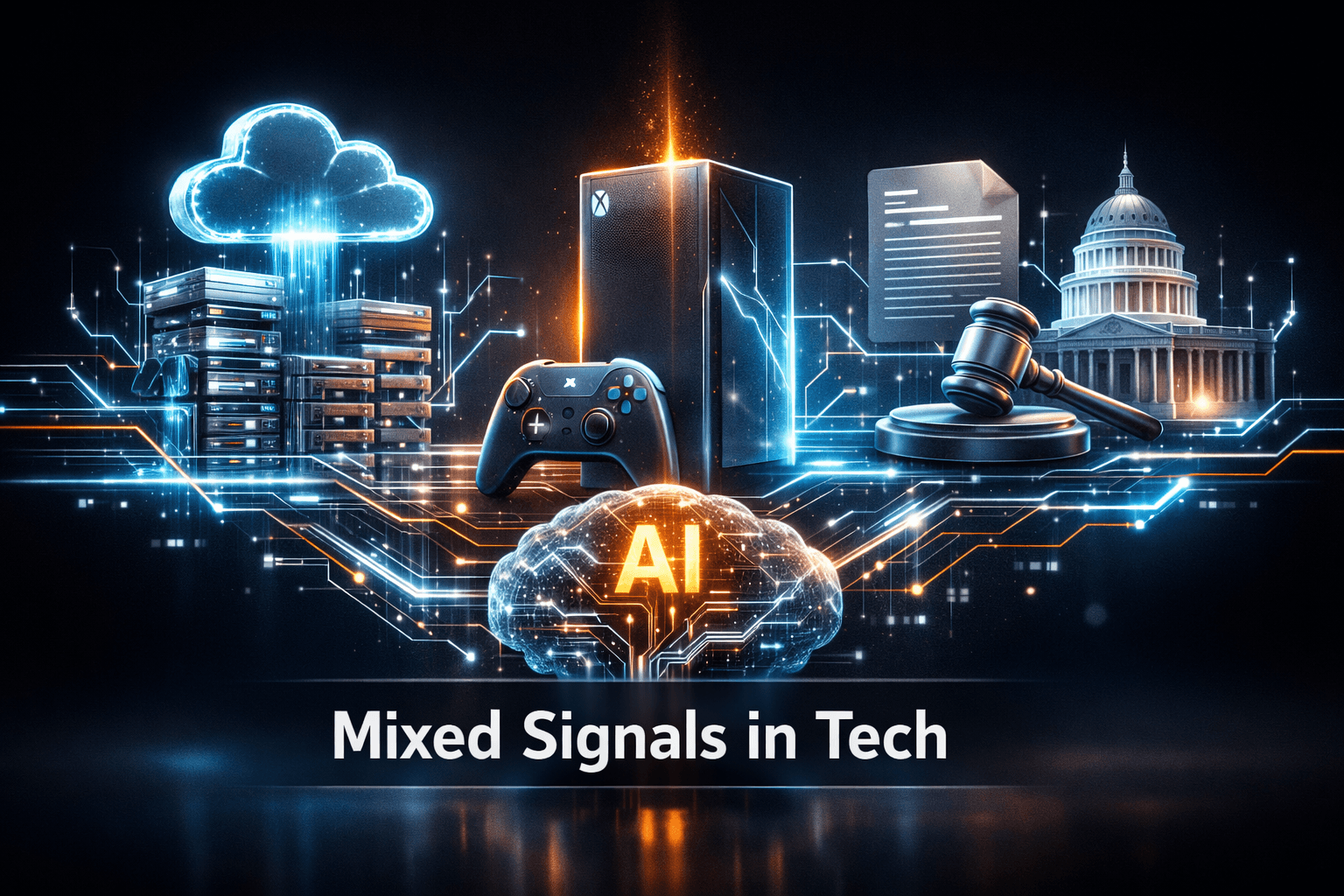
Technology headlines on Sunday, Apr 26, show a sector of contrasts. Large-scale investments and product strategy moves are pushing growth narratives, while governance and trust issues are creating fresh uncertainty for investors to weigh.
What matters to you heading into the long weekend is clarity on which trends are durable and which pose near-term risk. The storylines range from Google’s concentration of AI compute to Xbox’s consumer pivot, and from experimental AI marketplaces to federal-level science governance changes.
Market Highlights
Markets were closed on Sunday. The items below summarize the most quantifiable developments investors should note as of Friday, Apr 24 and over the weekend.
- Google / Alphabet ($GOOGL): Reported control of roughly 25% of global AI compute, citing about 3.8 million TPUs and 1.3 million GPUs, a scale analysts note underpins cloud AI competitiveness.
- Xbox / Microsoft ($MSFT): New Xbox leadership framed a "Return of Xbox" memo, with an explicit aim to make the Series X and S “first-class experiences again,” a signal for renewed consumer-product focus.
- Anthropic: Ran an agent-on-agent marketplace that executed real transactions, showing a new testbed for AI-driven commerce and agent coordination.
- Policy and trust flashpoints: OpenAI’s CEO issued a public apology to a Canadian community after a safety lapse, and the entire National Science Board was dismissed, raising questions about federal research oversight.
- Data centers: Maine’s governor vetoed a proposed statewide moratorium on new data centers, removing a potential early constraint on regional buildout that matters for cloud providers and hyperscalers.
Key Developments
Google’s compute muscle reshapes cloud economics
Financial Times reporting estimates Google controls about 25 percent of global AI compute capacity, with roughly 3.8 million TPUs and 1.3 million GPUs. Google Cloud CEO Thomas Kurian told the paper that current demand and revenue trajectories justify the heavy capital outlay for chips and models.
For you, that concentration means cloud competition is increasingly about scale and proprietary model assets. Analysts note it could pressure smaller cloud providers, but it may also spur partnerships and specialization among AI infrastructure vendors.
Xbox re-focuses on consoles, content and community
In an interview, Xbox CEO Asha Sharma and EVP Matt Booty discussed the "Return of Xbox" memo, emphasizing improvements to make the Xbox Series X and S prime consumer products again. The message suggests Microsoft is balancing console hardware and Game Pass content to recapture momentum in gaming.
That matters to investors watching $MSFT’s consumer-facing segments, and to accessory and game-publishing partners. Will increased console attention translate into higher hardware attach rates or deeper subscription engagement? That question will shape near-term revenue outcomes.
Agent commerce, data center policy and governance risks
Anthropic’s experiment with agents that bought and sold real goods for real money is an early proof of concept for autonomous, commercial AI interactions. This shows new revenue models, but also surfaces regulatory and fraud risk concerns.
Policy developments are mixed. Maine’s veto of a data center moratorium clears the way for continued regional expansion, which is generally favorable for cloud providers and chip demand. At the same time, the Trump administration’s dismissal of the entire National Science Board and public fallout around OpenAI’s safety lapse are reputational and policy headwinds, a reminder that trust and funding channels can shift quickly.
What to Watch
Look for clarity on how scale translates into competitive advantage, and how governance issues might affect regulation and public funding. Are you positioned for the winners of AI infrastructure, or are policy and reputational risks more salient for your exposure?
- AI compute spending: Watch commentary from $GOOGL, $MSFT and $NVDA on capex cadence and chip supply. These updates will signal whether the recent heavy investment pace is sustainable.
- Xbox outcomes: Expect product and service updates from $MSFT’s gaming unit, plus metrics on Game Pass subscriptions, to indicate whether the "first-class" focus moves the needle.
- Regulatory and safety developments: Monitor federal responses to the National Science Board change and any investigations stemming from OpenAI’s incident. Policy shifts could affect R&D funding and oversight rules.
- Data center permitting: Regional permitting and community responses remain relevant. Maine’s veto is a heads-up that not all proposed limits will stick, but local opposition can still slow projects.
- AI commercialization tests: Follow Anthropic and other labs for evidence that agent-driven commerce scales without producing regulatory or fraud losses.
Bottom Line
- Scale is central, and $GOOGL’s reported compute advantage highlights the economics of AI infrastructure, yet concentration creates competitive and regulatory scrutiny.
- $MSFT’s Xbox pivot signals renewed consumer focus, and investors should monitor product metrics and subscription trends for early signals of success.
- Experimental AI use cases like Anthropic’s agent marketplace point to new revenue models, but they bring legal and safety questions that could trigger oversight.
- Policy moves cut both ways: Maine’s data center veto is supportive for capacity buildout, while the NSB dismissal and high-profile safety incidents add uncertainty around funding and governance.
- Analysts note the environment is mixed, so a selective approach may be prudent while you wait for clearer signs on capex sustainability and regulatory responses.
FAQ Section
Q: How does Google controlling 25 percent of AI compute affect competition? A: It strengthens $GOOGL’s bargaining power on pricing and model deployment, but it also concentrates scrutiny on market power and creates openings for niche providers to specialize.
Q: Should Xbox strategy changes change how I view $MSFT? A: The focus on consoles and content is a strategic reset within Microsoft’s gaming arm, and analysts will be watching subscription and hardware signals rather than treating it as a broad change to the company’s cloud or enterprise thesis.
Q: Do AI agent marketplaces pose legal or fraud risks? A: Yes, experiments like Anthropic’s show real commercial potential, but they raise liability, consumer protection and regulatory questions that firms and regulators will need to address.