The Big Picture
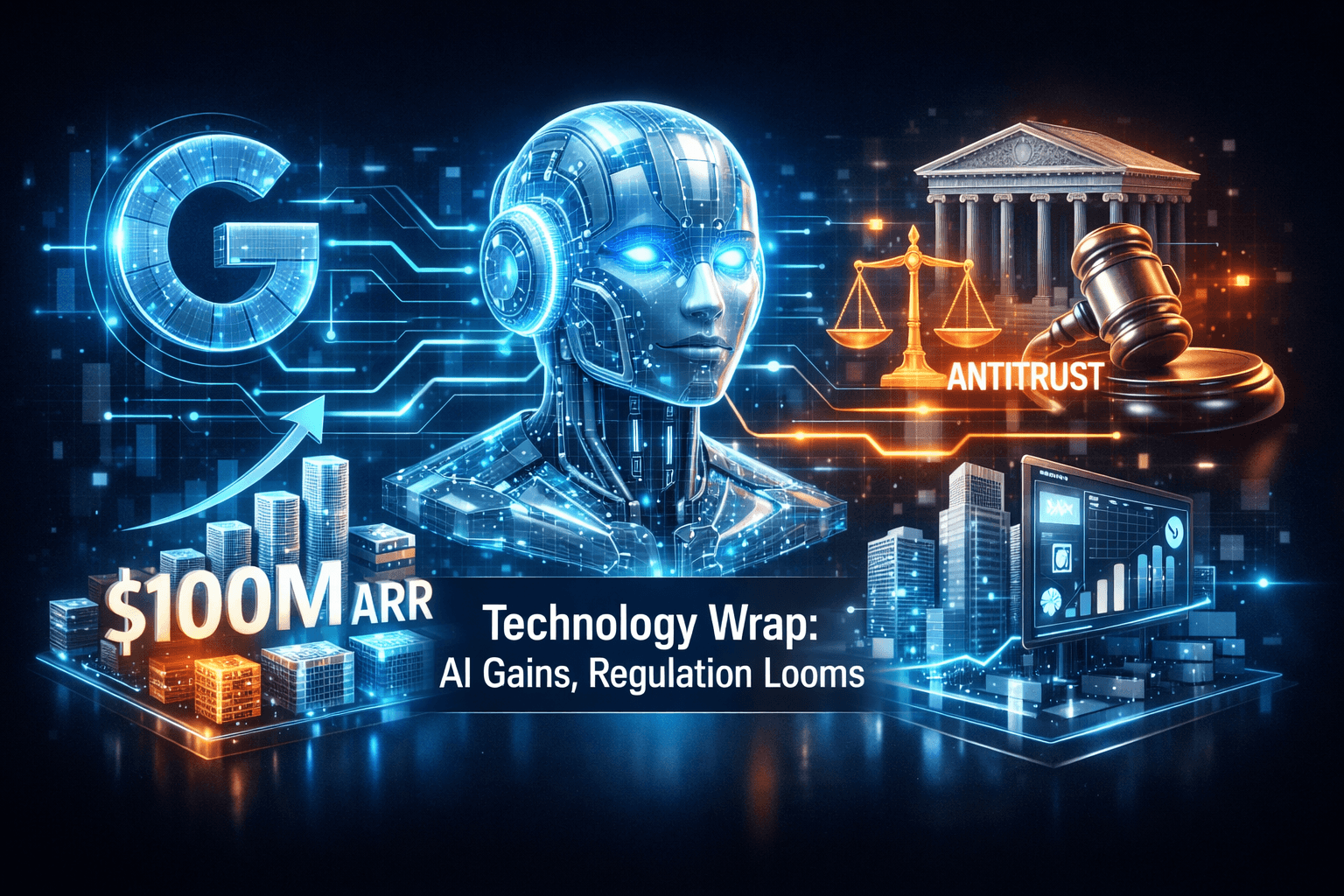
Today the technology sector showed two clear currents: accelerating AI product momentum and rising regulatory scrutiny of platforms and ad markets. You saw product upgrades and startup growth that underline demand for AI tools, but legal and policy moves remind you regulatory risk is front and center.
That mix matters because it shapes where revenue will flow and which companies face near-term pressure. What does this mean for your approach to tech exposure? It calls for selectivity and close attention to upcoming catalysts.
Market Highlights
Major product news and regulatory rulings dominated headlines, with concrete numbers highlighting the day's themes.
- Google expands its AI stack: Gemini 3.1 Flash TTS now supports over 70 languages and adds audio tags for granular speech control, and Google launched a new desktop app that integrates Gemini, Lens, and Search, now available to all, delivering faster access to tools for users and developers. Relevant ticker: $GOOGL.
- OpenAI pushed updates to its Agents SDK to help enterprises build safer, more capable agents, reflecting continued investment in agentic AI for business use cases.
- Startup traction: Hightouch reported $100 million in ARR, growing ARR by $70 million in the past 20 months after launching AI-powered marketing tools.
- Regulatory pressure: A Manhattan jury found Live Nation-Ticketmaster illegally monopolized ticketing and related markets, a verdict reached on three counts, putting $LYV squarely in the legal spotlight.
- Advertising and antitrust: The FTC and eight states proposed a settlement limiting ad agency collaborations on platform boycotts, and WPP, Dentsu, and Publicis settled claims over misinformation policies, adding regulatory uncertainty for digital ad flows.
- Labor snapshot: LinkedIn data shows hiring is down 20% since 2022, with the company attributing the decline primarily to higher interest rates rather than AI.
Key Developments
Google accelerates speech and desktop integration
Google's Gemini 3.1 Flash TTS raises the bar on natural-sounding voice output, with support for more than 70 languages and audio tags giving developers fine-grained control. The new desktop app bundles Search, Lens, and Gemini into a faster, app-like experience that reviewers say changes how they search and access AI tools.
For investors this underscores $GOOGL's push to weave generative AI into core consumer and developer products, which could boost engagement and monetization over time, though monetization timing remains a key variable.
OpenAI and enterprise agent tooling
OpenAI's Agents SDK update adds safety and capability features aimed at enterprise adoption as agentic AI grows in popularity. The move is consistent with broader vendor efforts to make AI agents easier to deploy and govern.
Enterprises experimenting with agents may accelerate software spending, but adoption will hinge on measurable ROI and integration with existing systems. Who benefits most from faster enterprise uptake?
Regulation bites back: Ticketmaster, ad agencies, and platform risk
The Manhattan jury verdict that Live Nation-Ticketmaster illegally monopolized ticketing markets creates legal and operational risk for one of live events' largest platforms. The ruling could spur regulatory scrutiny of other platform tie-ins and distribution agreements.
At the same time the FTC's action and settlements with large ad agencies over misinformation policies change how ad spend flows across platforms. These moves add uncertainty for ad-dependent revenue models and for companies that serve as intermediaries between brands and publishers.
What to Watch
Several near-term catalysts will clarify the direction of the sector and reveal which risks matter most. You should track earnings, policy updates, and product adoption metrics closely.
- Earnings season: Watch quarterly reports from $GOOGL, $MSFT, and chip makers including $NVDA for AI-related revenue commentary and CAPEX plans. Guidance on cloud and AI infrastructure spend will matter.
- Regulatory next steps: Live Nation's legal response and any remedies will be pivotal, and the FTC settlement details will affect ad agency behavior and ad flows. Expect appeals and negotiated remedies that could take months to resolve.
- Ad market trends: Keep an eye on advertising demand, given the FTC moves and the 20% hiring decline LinkedIn reported since 2022. Slower hiring could weigh on enterprise software spend.
- Supply chain and capacity: Comments from $NVDA's CEO about supply chain moats and ASIC competition signal investors should monitor chip supply, capacity expansion, and competition from custom accelerators like Google's TPU.
- Product adoption: Track usage metrics for Gemini 3.1 and OpenAI's agent features, and look for developer uptake signals from Google’s desktop app reviews and integration surveys.
Bottom Line
- Neutral sector tone, with meaningful AI product progress offset by regulatory and ad market headwinds.
- Product upgrades from $GOOGL and OpenAI indicate continued demand for generative AI tooling, analysts note, but monetization timelines will be important.
- Legal and regulatory actions, including the Ticketmaster verdict and FTC ad agency settlements, increase uncertainty for platform and ad-dependent businesses.
- Watch earnings, regulatory filings, and adoption metrics for clearer signals about revenue impact and sector momentum.
- Stay selective and monitor risk, because innovation and regulation are moving markets in different directions; only time will tell which forces dominate.
FAQ Section
Q: How will Google’s Gemini 3.1 affect Google’s revenue? A: Gemini 3.1 may boost engagement and create new product integrations, but concrete revenue impact depends on adoption rates and how quickly Google monetizes speech and agent features.
Q: Does the Ticketmaster verdict mean wider tech antitrust risk? A: The verdict highlights antitrust risk for platform behaviors that tie services together, and it could prompt closer enforcement or private litigation in adjacent markets.
Q: Should you expect hiring declines to be driven by AI? A: LinkedIn’s data attributes a 20% hiring decline since 2022 mainly to higher interest rates rather than AI, though AI may reshape roles over a longer horizon.